Essay | Learning from water: Incorporating Indigenous values into modern science and conservation
Tributary of the West Fork of the Berrie River (West Fork Gallatin River) with the Lone Mountain and riparian plant communities in the background, where I conduct my water quality research.
At the center of all life is water. For humans, animals, and plants, water is essential — without it, there is no life. The water we drink shapes our health, and today, many communities ask: “How can we keep our water clean?” While engineering our way to clean water is one method, I believe another simple and most sustainable method for our communities to maintain clean water is to remember the natural processes that have kept water clean for thousands of years. We must understand our role in the web of relationships that influence our water, acknowledge the interconnectedness of all living things, and learn Mitakuye Oyasin (we are all related -Lakota).
My Lakota elders, Richard Moves Camp and Bruce Long Fox, taught me that Mni Wiconi — water is life — and that water is medicine. These lessons seem simple, but their deeper messages emerge over time and reflection. To truly understand them, I had to explore my own relationship to nature, which is central to my Lakota culture and spirituality. By thinking in Indigenous ways, we can gain deeper understandings and remember how to live in balance with nature.
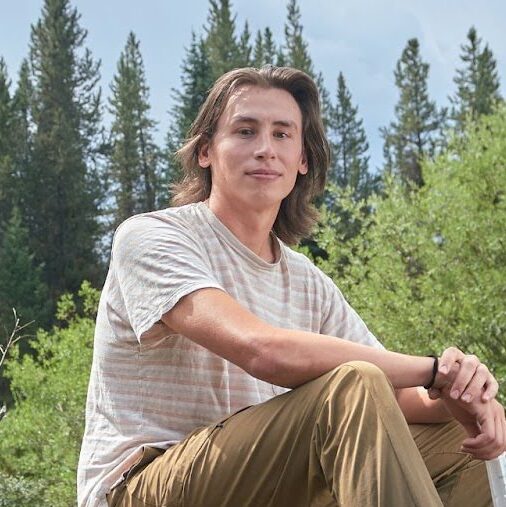
My Lakota name is Wanblee Ozuye (Eagle Warrior). Born in the Rocky Mountain foothills and raised in He Sapa (Black Hills, SD), I was nourished by the waters of Mni Luzahan (Rapid Creek, SD) and now drink from the Berry River (Gallatin River, MT). I am a blend of Lakota Cheyenne, Italian, Irish, Scottish, English, and Polish ancestry – A cross-pollination of Indigenous seeds. Photo by Jordyn Solliday.
Jill Falcon-Ramaker, Ph.D., my Anishinaabe elder, told me a story about a River that flows through her Canadian Relative’s Community that has experienced negative impacts from mining. As a result, the Canadian government sent scientists to help the Community and its River. These scientists struggled to understand the River’s vital signs and how to clean its water.
One of the community’s ceremonial leaders saw this and invited the scientists to a community sweat lodge. He said, “How can you understand the River if you cannot acknowledge the Spirit of the River? And how can you acknowledge the River Spirit if you cannot connect to your own Spirit?” They sweated and prayed in the lodge, helping the scientists on their journey to embrace their Spirits.
Similarly, I had to learn how to awaken my Nagi (spirit within you), or, as I like to think of it, how to germinate and nourish my seed of Indigeneity. In sprouting and nurturing my Nagi, I slowly began to understand the deeper meaning of the “simple lessons” life taught me. Just like those Canadian scientists, I’ve found the journey of connecting to my Nagi is not easily navigated alone. Finding one’s connection to place and Spirit requires community and teachers. My journey was to find people and community to help teach me.
There are many teachers in this world, such as earth’s wildlife, to landscapes, people, and beyond, who helped show me how to nurture my Nagi. I began tending to my Nagi by growing up surrounded by my Lakota Relatives’ traditional homeland and by being fortunate enough to have parents who work with the Lakota people.
Waters flowing through the Berrie River from the perspective of the river community that calls it home. Photo by Russell Conti.
I’ve been able to learn about my Indigenous culture and community from connecting with Lakota traditional foods and spirituality each year when I returned to the Rez for ceremony. From those moments, my connection to my Nagi began to grow as I slowly learned how to connect to my Indigenous identity.
I left home and earned my bachelor’s in Soil and Water Sciences, where I learned the technical ways to explain the natural world and to study it using Western scientific methodologies. I learned skills that taught me how to be professional and make a living in the colonial world. For these skills, I am grateful.
Although, throughout my educational journey, I couldn’t help but feel that what I was learning lacked the depth of meaning that connects our lives to the natural world. I was learning the mechanisms behind “how the natural world worked,” but I wasn’t being taught how to live within the natural world. Instead, I was taught how to stay alive and maintain the status quo in the anthropogenic world. My Nagi wanted me to learn how to live a real life, to learn how I relate to the natural world, and to meet nature’s Relatives.
When my sister started her bachelor’s at Montana State University, I began my master’s at the same time. She quickly connected with the Indigenous community on campus and invited me in, helping us build a community outside our home where we could continue to grow our Indigenous identities. Yet I felt like I was walking in two worlds: professionally as a Western scientist in water quality, and personally, developing my relationship with the land in Indigenous ways. At that time, I didn’t realize I could blend research with Indigenous customs and scientific rigor — they seemed incompatible.
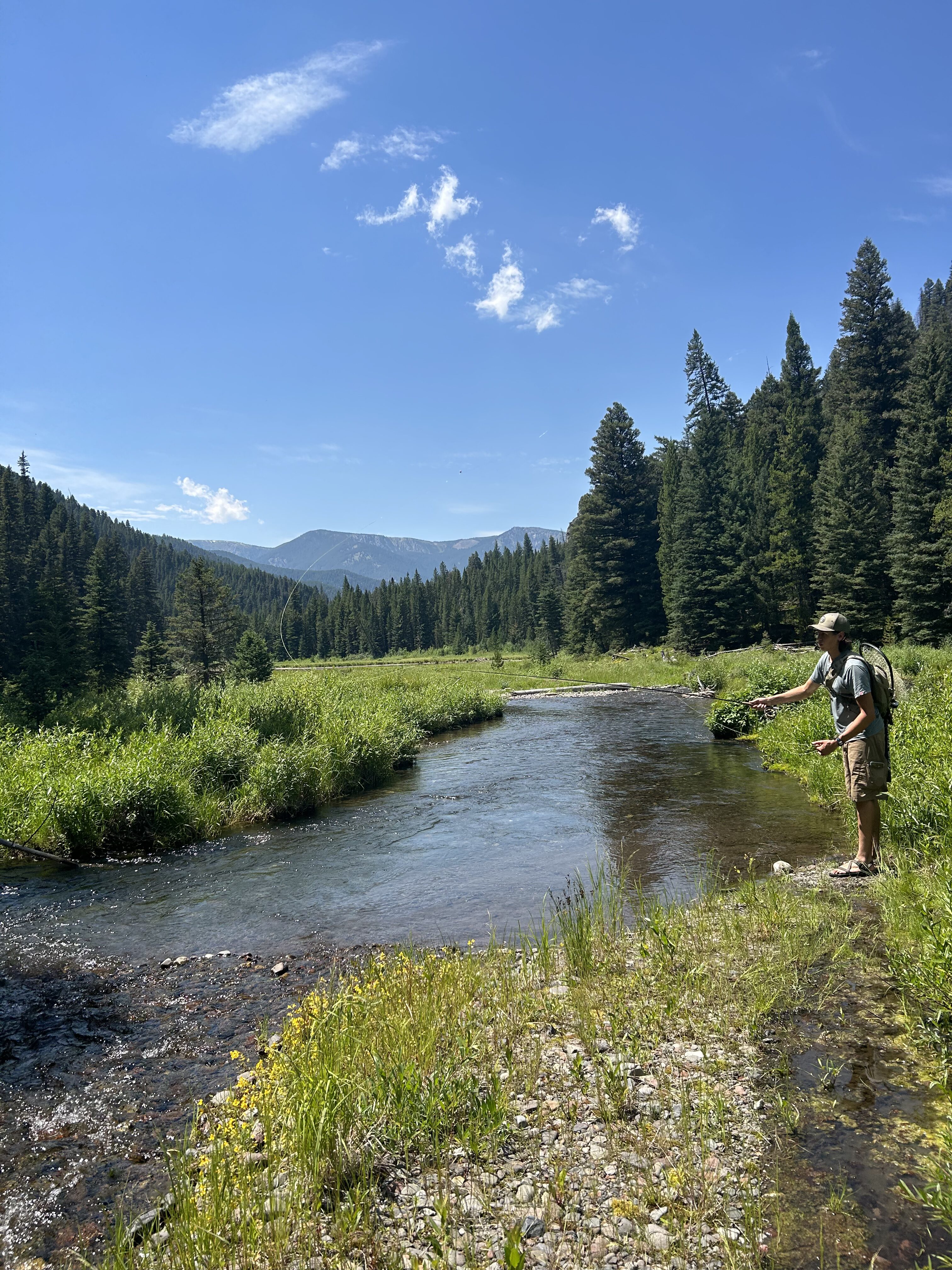
Wanblee Ozuye fly fishing along the banks of the Berrie River. (Photo by Brittany Boles)
Eventually, the walls dividing my two worlds began to crumble after I was invited to lunch with a community of Indigenous scientists seeking a way to maintain their Indigenous identities and values while conducting research at an R1 institution. At that lunch, I was challenged to blend those two worlds in my research. Try as I may, there are Western Ways of thinking that fundamentally do not mix with Indigenous ones. However, in attempting to blend worldviews, I’ve found that I can acknowledge the unique values and strengths of each.
By blending these two worlds, the question emerged, “How can I use the Indigenous values I have learned to guide the rest of my research while maintaining scientific methodologies?” From there, I drew on my lived experiences, which have fed my Nagi and scientific understanding, to inspire me to incorporate Indigenous epistemologies into my research.
The first lesson that I reflected on was the idea of being a good Relative to both my Human and Wildlife communities. If I want to help my water Relative, I need to be a good Relative to it. To respect my River Relative, I could not think of the River as an abiotic entity, as I had been taught to think of water scientifically. I needed to acknowledge the River’s Spirit and its ability to give life. When you respect the River as a Relative rather than an abiotic thing, you can begin to connect with it. In acknowledging the River, I also needed to acknowledge the Fungi, Bacteria, Biota, and Animal Relatives across the land, whose lives maintain the health of their home ecosystem. Their homeland is also mine, which connects my life to these Relatives in nature.
I then thought about how I could be a good Relative — by listening attentively, spending time together, and recognizing the challenges a Relative navigates. I learned that I needed to spend time with the River, get to know the landscape that funnels the water into the riverbanks, and begin building a relationship with the surrounding ecosystem. In all the free time a busy graduate student has, I would try to spend time in the watershed.
I went hiking, fishing, hunting, and foraging there. These activities allowed me to get to know my Relatives in the place I was studying. Spending time in these ways allowed me to see what forces influence the water, learn its seasons, and introduced me to its community of plants, mammals, bugs, and birds, all of which have jobs maintaining the balance of life in that place. Being fully present and immersed allowed me to see how I fit into that balance of life. I was able to transition from an outside scientific observer to a very small part of the watershed’s circle of life.
Studying the Berrie River in winter with my friend and field assistant, Holiday Holcomb. Photo By Jordayn Solliday.
As I slowly built my relationship with my River Relative and its community, I was reminded of the Spirits of the Water and the cultural importance of respecting them. I reflected on my ceremonial experiences again. Ceremony includes prayers and gifts to the spirits. I began to think of my research as its own ceremony for the River.
Each visit to the River started by clearing my energy with a smudge, offering tobacco, asking the River Spirits for permission to do my work that day, and saying a prayer with my chanupa (ceremonial pipe). I’m sure I wasn’t doing everything correctly, but that was beyond the point of these actions. To me, the ceremony was the energy and prayer within these actions.
I prayed, asked Wakan Tanka (Great Spirit), Unci Maka (Grandmother Earth), and my Ancestors to help my River Relatives, to help me understand the sources that influence the River’s health. I prayed for our Human Community to see the River and recognize how the River’s health and well-being are tied to the health and well-being of the Community. This process allowed me the space to listen to my Nagi, my Relatives in nature, and maintain my Indigeneity within my life and research.
Today, I use both Indigenous and scientific methodologies, enabling me to draw on the strengths of both epistemologies. Working in this way, I can use Western Science to collect water samples to understand the River’s vital signs, so we, as a community, can take informed actions to maintain the health of our Unci Maka and her water. Simultaneously, I’m maintaining my relationship with the water, respecting its spirit, and feeding and nurturing my Nagi.
Acknowledgements:
Jill Falcon-Ramaker Ph.D., Richard Moves Camp, Bruce Long Fox, Paula Long Fox, Sweeney Windchief, Russell Paul Conti, Brookelynn Conti, Brittany Boles, Kibbe Brown, Ed McGaa, Ivey-Camille Manybeads Tso, Alexander Cotnoir, JoRee LaFrance, Buffalo Nations, Wyatt Cross Ph.D., Nate Heili, Jordyn Solliday, Holiday Holcomb, Wes Cousins, my Ceremonial Community, and all the relatives who have taught me over the years.
This website uses cookies to provide you with an improved and personalized experience. By using this site you agree to our use of cookies. Please read our cookies policy for more information on the cookies we use and how to delete or block them.

 All Topics