The D.C. Clean Energy Transition: Structural Inequality and Energy Justice
This 5 minute video examines Washington, D.C.’s clean energy transition through the lens of structural inequality and energy justice. How major climate initiatives like Clean Energy DC and Solar for All are designed to reduce emissions and expand renewable energy access, while also questioning who truly benefits from these policies and who remains excluded.
Washington, D.C., the capital of the United States, positions itself as a national leader in sustainability and climate policy. Through initiatives such as Clean Energy DC and the Solar for All program, the District has committed to reducing greenhouse gas emissions and expanding access to renewable energy. D.C.’s clean energy transition has become central to the city’s sustainability agenda. Agencies such as the District Department of Energy & Environment (DOEE) often frame these policies as evidence of environmental leadership and technological progress. However, beneath these ambitious goals lies a critical question: who benefits from the clean energy transition, and who remains excluded?
The truth is that these programs risk reproducing structural inequalities. They often privilege homeowners, higher-income households, and those with greater access to capital. This trend reveals a clear disconnect between stated policy intentions and lived realities.
D.C. energy policies
The District has not been subtle about its ambitions. When Mayor Bowser signed the Clean Energy DC Omnibus Amendment Act in 2019, she declared it would “solidify Washington, DC’s place as the national leader in the fight against climate change.” DOEE Director Tommy Wells echoed this framing in a subsequent progress report, stating that the District had “established one of the most progressive track records in the nation for sustainability” and that “our successful efforts are providing models for other urban cities across the United States.” The Clean Energy DC plan itself describes D.C. as “a leader in energy innovation and in fighting climate change.” This language positions these policies as much a matter of municipal identity as environmental necessity.
To understand how inequality emerges within the clean energy transition, it is necessary to examine the policies that structure it. D.C.’s strategy, outlined in the Clean Energy DC plan, sets ambitious targets for reducing greenhouse gas emissions, including a 50% reduction by 2032 and a transition toward 100% renewable electricity.
The plan identifies three major sources of D.C.’s emissions: buildings, energy supply, and transportation. To reduce emissions in these sectors, the District adopted stricter building standards, reduced energy use requirements, and moved to limit natural gas in new construction. At the center of this effort is the Solar for All program, administered through the D.C. Sustainable Energy Utility. Solar for All aims to expand solar access for low- and moderate-income households while reducing energy costs. The program seeks to deploy enough solar to benefit 100,000 households and allows eligible homeowners to install solar photovoltaic systems at no cost.
The program was intentionally designed to target households earning at or below 80% of the area median income, according to Thomas Bartholomew, associate director for policy and compliance at the DOEE. This choice reflects a deliberate effort to reduce energy burden while advancing broader climate goals.
Solar for All and Clean Energy DC share similar goals: decarbonizing the city’s energy supply, promoting equity, and supporting a transition toward renewable electricity. Solar for All serves as the practical mechanism for implementing the equity goals embedded in Clean Energy DC. Together, these policies are promoted as evidence of the District’s commitment to environmental sustainability and social equity.
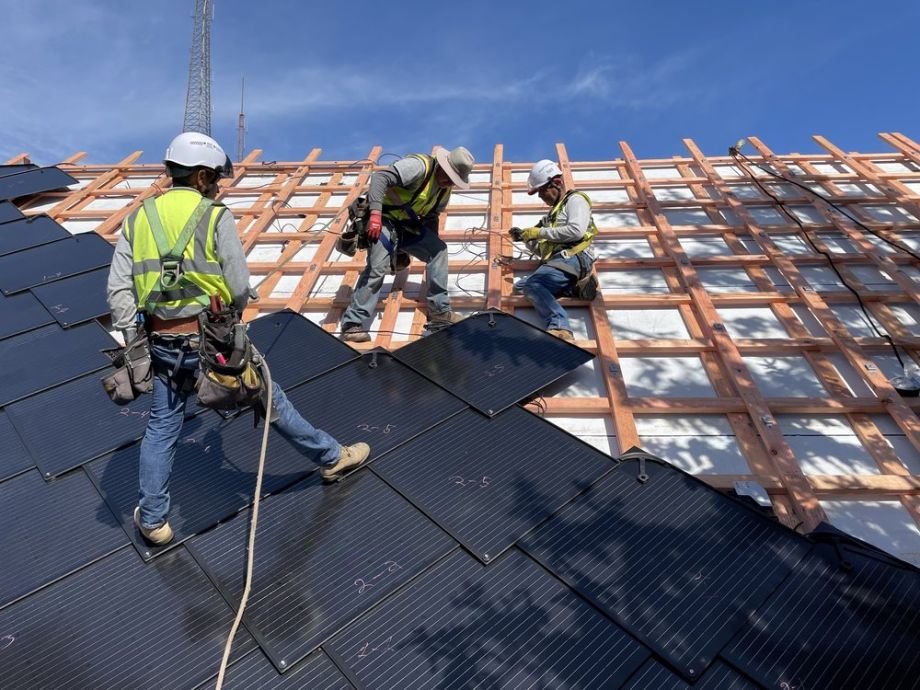
Workers install solar panels on a roof. (Photo courtesy Flywheel Development)
Where the inequality emerges
Although these initiatives signal progress at the policy level, their structure and implementation shape who can realistically access their benefits. Research shows that solar adoption remains concentrated among higher-income households and homeowners, while renters and low-income residents face structural barriers such as upfront costs, lack of property ownership, and limited access to financing.
Because rooftop solar remains closely tied to homeownership, large segments of the population remain excluded from direct participation in renewable energy generation. As Bartholomew noted, without targeted initiatives such as Solar for All, the benefits of renewable energy policies would largely flow to higher-income households. This reflects a broader structural pattern across the United States. As a result, the clean energy transition risks reinforcing existing socioeconomic divides even as it seeks to reduce environmental harm.
Energy burden, defined as the percentage of household income spent on utilities, is another major dimension of inequality. In Washington, D.C., this issue is especially visible in Wards 7 and 8, where residents face higher rates of poverty and housing insecurity. Local affordability data shows that low-income households spend 7.5% of their income on energy costs, more than four times the share spent by higher-income households. One-quarter of these households face severe energy burdens exceeding 15%, limiting their ability to benefit from the clean energy transition.
These disparities are further shaped by race and historical disinvestment. In Washington, D.C., Black, Hispanic, and low-income households experience energy burdens approximately 70% higher than white households. These patterns show that energy policy remains deeply tied to broader structural inequalities, including housing disparity, racial inequity, and uneven access to capital.
Key stakeholders
Understanding these inequalities requires examining the roles and influence of key stakeholders. Insights from Thomas Bartholomew offered a practical perspective on how these policies are implemented in the District.
The District Department of Energy and Environment designs and administers D.C.’s sustainability agenda, including Clean Energy DC and Solar for All. DOEE genuinely pursues equity goals, coordinating outreach, targeting low-income households, and working to reduce energy poverty. However, the agency operates within structural constraints it did not create and cannot fully undo, the housing inequality, the dominance of monopoly utilities, and the deep link between homeownership and access to clean energy. Its programs can work at the margins of these systems without fundamentally restructuring them.
Pepco, the District’s monopoly utility provider, controls energy distribution infrastructure and pricing. This gives the company significant influence over how energy is delivered and who can access it. The DC Sustainable Energy Utility serves as an intermediary. It implements programs such as Solar for All and energy efficiency initiatives. Bartholomew’s experience highlights the complexity of implementation. Expanding Solar for All required more than enrolling residents through direct outreach. It also required coordination with utilities to ensure energy credits were accurately applied to household bills.
The DC Sustainable Energy Utility serves as the operational backbone for programs like Solar for All, directing investments toward low-income communities. Yet even DCSEU’s targeted efforts face the same structural limits. As Bartholomew noted, implementing Solar for All required extensive coordination with utilities just to ensure energy credits reached residents’ bills, a reminder that well-designed equity programs must still navigate infrastructure and institutions that were never built with equity in mind. The result is a system in which meaningful but incremental progress coexists with persistent inequality.
Meanwhile, environmental justice organizations and residents, especially in Wards 7 and 8, advocate for greater inclusion and more equitable access. These dynamics reveal a central conflict: a systematic power imbalance. These stakeholders operate within broader economic systems that shape access to capital, homeownership, and political influence. Institutions hold disproportionate power over policy outcomes, while communities with fewer resources remain excluded from fully participating in the benefits of the clean energy transition.
Communication strategies
Communication strategies shape how these policies are understood and accessed. Government agencies and program administrators rely on outreach campaigns, public meetings, and partnerships with community organizations to promote participation in clean energy programs.
Programs such as Solar for All use targeted outreach to reach low- and moderate-income households. Bartholomew emphasized that building trust remains one of the greatest challenges in this process. Many residents were initially skeptical because the benefits seemed “too good to be true.” This skepticism reflects a broader history of disinvestment and mistrust in government institutions.
These challenges make communication more difficult. Complex application processes and limited awareness often prevent eligible residents from participating. As a result, even well-intentioned programs can fail to reach those who would benefit most. This exposes a gap between policy design and lived impact.
These insights show that equity requires more than policy design. It also requires sustained efforts to address structural barriers and build trust within historically underserved communities. Communication itself becomes a source of power. It shapes what information is shared and who can act on it.
Summary
Ultimately, Washington, D.C.’s clean energy transition reveals a fundamental tension between environmental progress and structural equity. While initiatives such as Clean Energy DC and Solar for All aim to reduce emissions and expand access, their outcomes remain shaped by systems of housing, income, and institutional power. Government agencies frame these policies as inclusive and forward-looking, yet their implementation depends on utilities, intermediaries, and eligibility structures that can still limit access for the communities they claim to support.
Insights from Thomas Bartholomew reinforce that equity requires more than ambitious policy. It requires continuous adaptation to real barriers such as affordability, trust, and administrative complexity. The true measure of Washington, D.C.’s clean energy transition lies in whether it transforms the systems that determine access to energy or leaves existing inequalities intact beneath the surface of progress.
This website uses cookies to provide you with an improved and personalized experience. By using this site you agree to our use of cookies. Please read our cookies policy for more information on the cookies we use and how to delete or block them.

 All Topics