‘Chautauqua butterfly’ advocates seek support for bat colony recovery
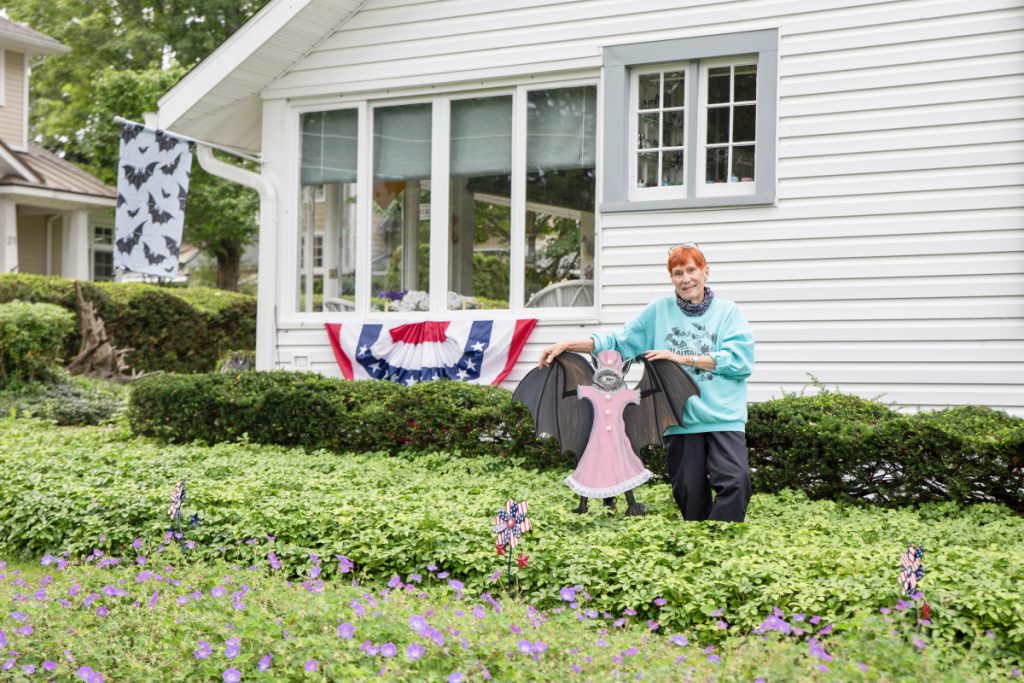
Bat advocate Caroline Van Kirk Bissell led the Bird, Tree & Garden Club’s bat chats from 2000 to 2018, at the Chautauqua Institution in Chautauqua, New York.
According to Caroline Van Kirk Bissell, teenage bats are like teenage kids.
“They don’t know what they’re doing, and they’re in the wrong place at the wrong time,” she joked.
In the last month, Bissell — who led the Chautauqua Institution’s weekly bat chats from 2000 to 2018 — rescued four of what she refers to as “Chautauqua butterflies” across the grounds. Armed with a bag full of supplies including a butterfly net, a flashlight, and Tupperware, she has recovered bats from all kinds of nooks and crannies.
“I’ve used every method imaginable just to make sure that the little guys are well protected and released,” she said.
Bissell said she especially wants to educate younger people about bats before they hear misconceptions that scare them.
“I love educating, because there’s so much people don’t know,” she said. “When you get to be older, that’s our job: to impart wisdom to younger people that you can use going through life.”
For the past 20 years, bats have been threatened by white-nose syndrome, a fungal disease that originated in Europe and was unknowingly brought to North America by cavers traveling between continents. It was first detected in Albany, New York.
The Center for Biological Diversity estimates 6.7 million bats have died from white-nose syndrome since 2006. (Photo courtesy Jonathan Townsend)
“Our little bats still have no immunity to it. Bats from London, no problem. They grew up with an immunity. They have no trouble fighting it off,” Bissell said. “Our little guys didn’t.”
The Center for Biological Diversity estimates 6.7 million bats have died from white-nose syndrome since 2006. Bissell told the story of a man who turned his barn into a bat sanctuary and opened it up to educational trips in Ripley, New York.
“He put seven bat houses on the outside of the barn and the bats moved in, so I was taking field trips down there, and we have two people on each bat house. One would be a pencil and paper and the other would be a clicker, and we tallied 1,700 bats at the highest number,” Bissell said. “When the fungus hit, it dropped down to 40.”
Although Bissell said the local bat population is still far from its original number, it does seem to be increasing.
“This year, we did a count in July, and it was up to 550,” she said.
But Bissell noted enthusiasm for bats has declined as they became less visible around the area. She said, “Everybody loved bats. When you would come here for a short period of time, you would be told how awesome bats are, and you would see the contagious energy that Chautauqua had about their bats.”
Although Bissell said she was unsure if the passion for bats would ever be restored in full, she is pleased to see the bats’ slow return.
“They are making a comeback, which we thought wasn’t going to happen because (white-nose syndrome) really wiped them right out,” she said.
Now, Bissell said she hopes to see the Ripley bat farm become an official bat sanctuary and educational center. The Buffalo Bat Habitat, a conservation organization based in Buffalo, New York, seeks to buy the 84-acre property and use it to support the bat population.
Jonathan Townsend is a bat biologist who first came to Chautauqua in 2003 as an undergraduate researcher. He is advocating for Buffalo Bat Habitat to buy the farm from the current owners, Lewis and Dorothy Barnes, who are growing older and want to move closer to their children.
Townsend said he was close with Lewis and Dorothy after the decade he spent monitoring their bat colony. The house has been in Lewis’ family since before the Civil War.
“Our vision is not just to protect the bats, but create something bigger and very unique and special to the region, where it’d be a nature center that has a focus on bats, but also would help to memorialize Lew’s family’s history and that colonial period family history,” Townsend said.
Townsend said saving the farm would also preserve a Native American burial site and create a veterans’ memorial garden.
“We’d be morphing environmental and cultural and historical aspects together in the nature center,” he said. “We’d be protecting the bat colony, protecting the structures [and] creating publicly accessible nature trails that people can come and use.”
Townsend, who did his own doctorate research at the Ripley farm, said education would be a “huge component” of the sanctuary.
Bissell said she hopes to see the Ripley bat farm become an official bat sanctuary and educational center. Buffalo Bat Habitat has applied for grants to cover part of the cost of buying the farm. They are currently trying to raise about $500,000 to cover the remainder. (Photo courtesy Jonathan Townsend)
“We are engaging in research in a number of different levels, and I’d like to expand upon that, which helps people with research, but it also helps us understand a little more on bats at that particular colony because there’s something special about those individuals that have allowed them to persist in the face of white-nose syndrome,” he said. “Understanding that might help us help other bats throughout the continent that have been impacted by that disease.”
Townsend said Chautauquans could also participate in educational visits to the sanctuary.
“That would be an option for people from the Institution to have someplace on the shores of Lake Erie that they can actually come and visit, and maybe stay the night and see the bats and enjoy the miles of the nature trails that we’d be putting in,” he said.
Buffalo Bat Habitat has applied for grants to cover part of the cost of buying the farm. They are currently trying to raise about $500,000 to cover the remainder. Townsend said he hoped to see continued projects, such as genetic research and radiotracking to identify hibernation patterns, and for agricultural land to become more natural and focused on native plants.
Townsend said he wanted people of all ages to be able to come and enjoy the area while they worked to conserve bats. He emphasized how Chautauquans’ love of bats helped his own journey in becoming a biologist and conservationist, and he hoped to see their concern for bats sustained even when they were less present.
“ … This was a place you could come and have bats fluttering around your head all night,” he said. “I think that special emphasis on bats and bat conservation has really carried through.”
Another version of this story was published in The Chautauquan Daily on Aug. 25, 2026. The Chautauquan Daily is the official newspaper of Chautauqua Institution and is published six days a week over its nine-week summer season. Our Planet Forward Chautauqua Reporting Fellows are generously supported by the Chautauqua Institution’s sustainability initiative and GW’s Berl Brechner Fund.
This website uses cookies to provide you with an improved and personalized experience. By using this site you agree to our use of cookies. Please read our cookies policy for more information on the cookies we use and how to delete or block them.

 All Topics