
 All Topics








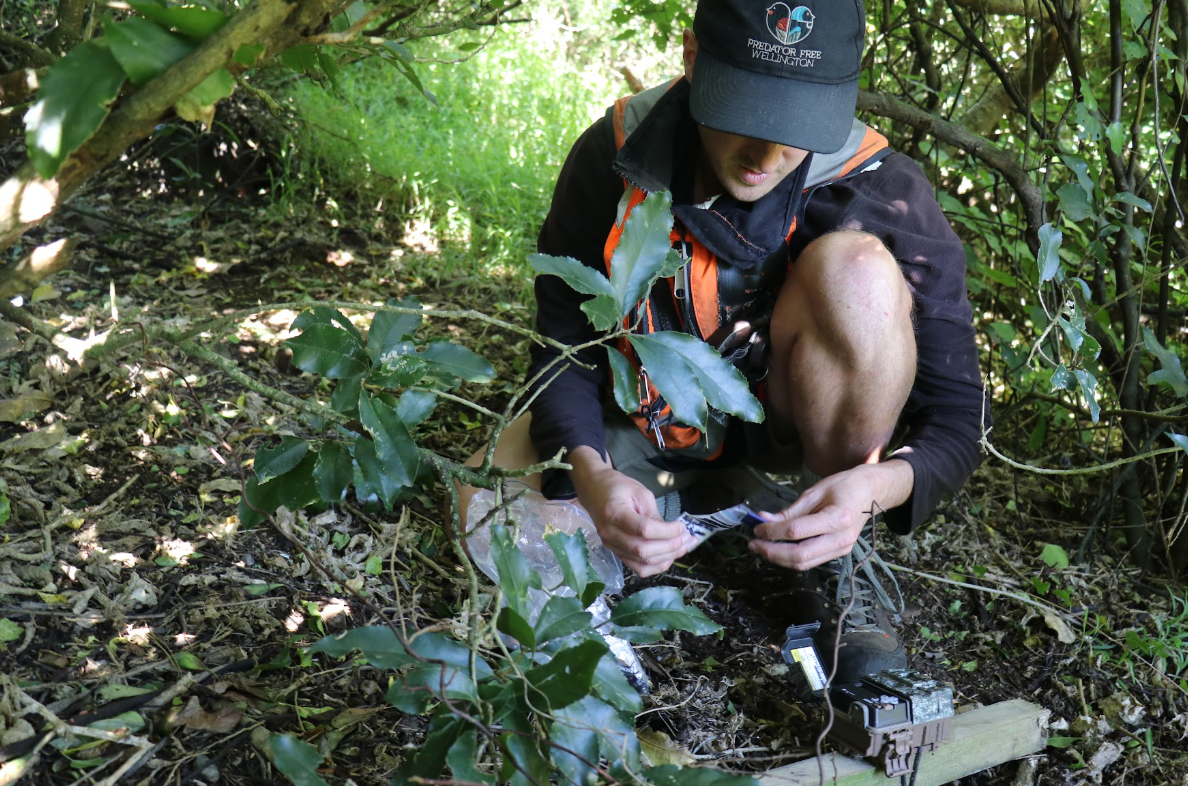
PFW Field Operator Sam Morris resets a rodent trap and trail camera on the side of Wellington’s Mount Victoria.
Emma Henry

October 22, 2026
Emma Henry
By: Emma Henry and Megan Fahrney
The instant the thick black glove drops onto the metal plate, the trap slams shut with a bang, reverberating across dense foliage. Our guide, Sam Morris, laughs as we jump back in surprise, reaching down to carefully reset the springs on the metal snare. Rodents can be quite clever, as Morris well knows.
“Rats are very fickle,” Morris says. “Our team now is just so highly trained. We’re like dogs. You just send us in an area, and we’re like, ‘Where’s the best rat spot?’”
He carefully retrieves the glove from the wooden box, ensuring his fingers steer clear of the trap’s deadly jaws. As he adjusts his orange vest, we gather our gear and continue into the bush.
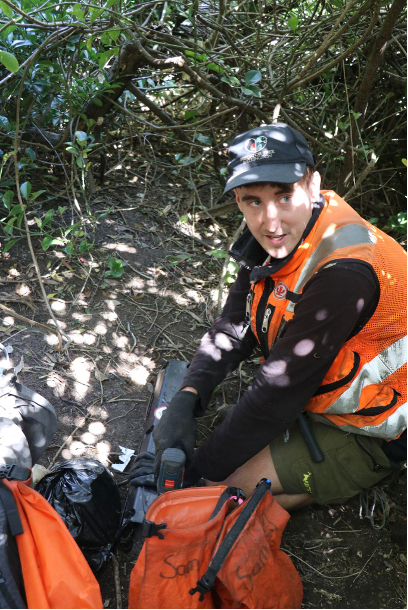
Morris is a field operator for Predator Free Wellington Te Whanganui-a-Tara, or PFW, a nearly decade-long project dedicated to making New Zealand’s capital the first predator-free city in the nation. Efforts like these position Wellington as one of the world’s only cities where biodiversity is increasing.
New Zealand’s isolation provides a unique opportunity to rid the country of invasive species. Predators like rats, which arrived with Western Europeans, largely prey on native birds and invertebrates, many of which are only found on the islands of New Zealand (also known by its Māori name, Aotearoa). Due to predation and factors like land-use change and pollution, the Ministry of the Environment’s three-yearly update reported that the country has one of the world’s highest rates of biodiversity loss.
PFW’s city-wide effort will cover 30,000 hectares (around 74,000 acres) and benefit more than 200,000 residents. Since its inception, the initiative has cost around 4 million New Zealand dollars ($2.3 million) per year. In March, the Department of Conservation (DOC) awarded PFW a NZ$5.5 million grant (over $3 million), signaling increased government confidence in localized eradication efforts as a cornerstone of New Zealand’s national conservation strategy.
Faced with mounting biodiversity loss, the New Zealand government launched Predator Free 2050 in 2016, a nationwide effort to eliminate invasive predators and restore native ecosystems over the next three decades. PFW operates as a localized example of this broader mission.
“Our job in that vision is to develop a pathway for urban spaces, so we had to figure out how to do this in our capital city,” PFW project director James Willcocks said.
Today, Predator Free 2050 aims to accomplish the complete removal of introduced rodents like rats, stoats, ferrets, weasels and possums, with dozens of local predator-free groups popping up across the country. Major partners alongside the DOC include the Predator Free New Zealand Trust, local and regional councils, NGOs like the World Wildlife Fund, and iwi and hapū (Māori tribes and sub-tribes).
In Wellington, that national vision comes down to the day-to-day work of volunteers and trappers, whose efforts on neighborhood hillsides and backyard fence lines have become a bulwark of conservation in the city.
New Zealand’s isolation has benefited the island’s native and endemic species. Eighty-five million years ago, the mostly submerged eighth continent, Zealandia (Te Riu-a-Māui), broke away from the ancient supercontinent of Gondwana, creating the Tasman Sea. Eventually, only about 5% of Zealandia’s landmass remained above sea level, forming New Zealand’s North Island, South Island, Stewart Island and New Caledonia.
Within the roughly 62 million years between the island’s geological separation and human contact, New Zealand’s biodiversity evolved uniquely, dominated by bird species such as kiwi, giant moa and kākāpō, as well as predators like Haast’s eagles. As a result of a largely avian-dominated environment, New Zealand evolved to harbor only a few species of native mammals: bats and marine species like seals and dolphins. With few predators, many birds evolved to be ground-dwelling species, relying on invertebrates and fruits to survive.
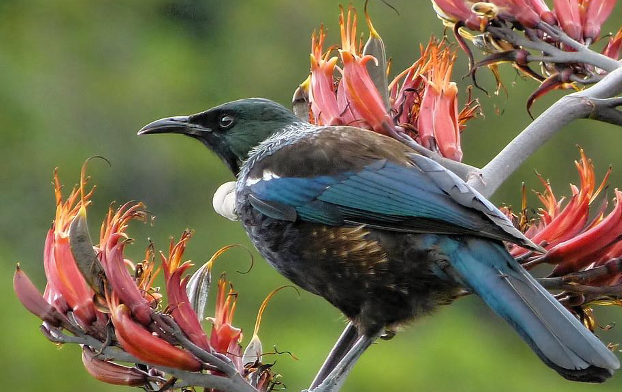
Without the ability to fly, many of New Zealand’s bird species and other terrestrial creatures became particularly vulnerable to introduced predators. By the 1400s and 1500s, Haast’s eagles and moa became extinct due to habitat loss and overhunting.
The New Zealand Ministry for the Environment estimates that 75 animal and plant species have disappeared since the arrival of humans. Some estimates suggest that the nation has lost 40 to 50% of native bird species, half of which are attributed to predation by introduced mammals. Today, nearly 4,000 of New Zealand’s native species are threatened or at risk of extinction.
Before government-sponsored efforts, anti-predator sentiments grew in the country around the late 1800s, when conservationists began advocating for island sanctuaries to protect native bird species.
Predator Free NZ Trust credits several predator invasions in the 1960s to the rise in predator-free initiatives. By the 1990s, some of the earliest attempts at predator eradication using brodifacoum, an anticoagulant rodent poison, were conducted on Breaksea Island (Te Au Moana). Early island-scale experiments such as these helped shape the strategies that would eventually evolve into a coordinated national campaign.
Morris crouches in the brush below, sliding artfully through the slippery dirt into a ditch. He grasps for a bait station just out of arm’s reach under a tree, nestled among a tangle of vines and branches.
“This is prime rat habitat,” Morris says. “This big fallen tree, lots of holes, lots of vines covering everything. … This is just rat heaven.”
Though PFW also targets mustelids and possums, rats are the most pervasive in areas of the city where the team is active.
Morris cracks open the bait station, a hollow black tube, and begins to fill a center console with brodifacoum toxic bait in the form of fluorescent blue pellets — rat poison.
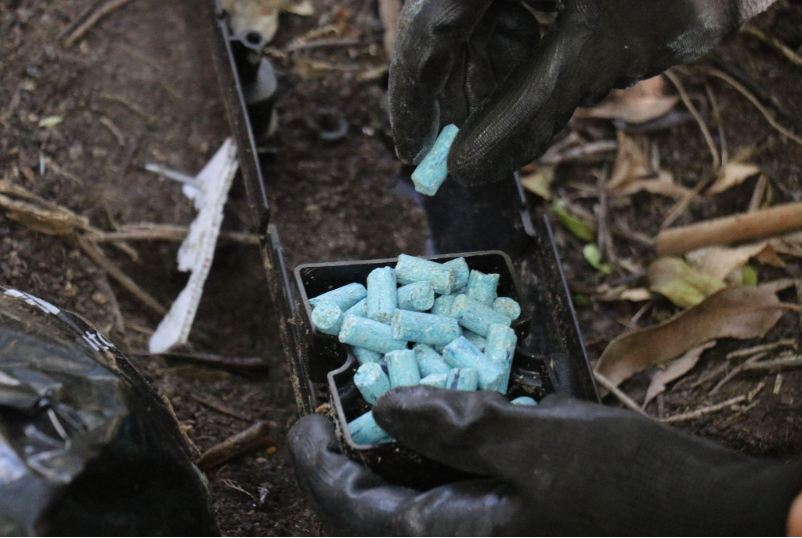
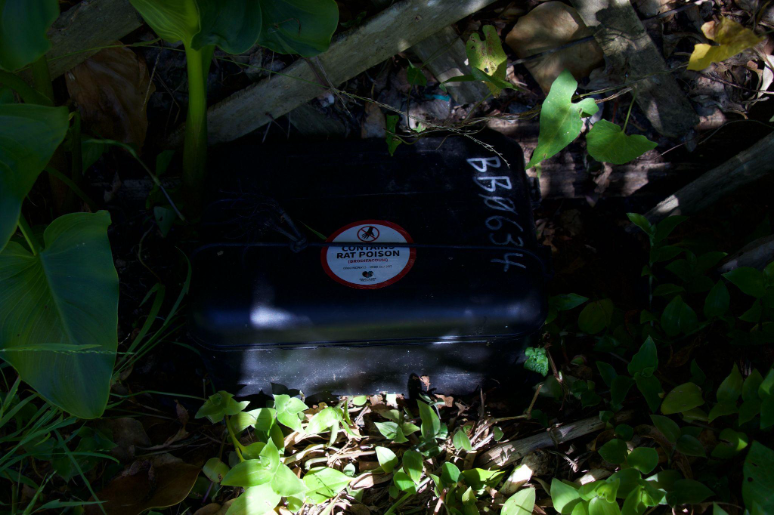
Rats are lured into the stations by strong-smelling foods such as peanut butter or mayonnaise, consume the pellets and typically die a couple of days later. This way, the zone’s still-living rats do not suspect the poisonous pellets were the source of their friends’ downfall. Outsmarting the critters is key.
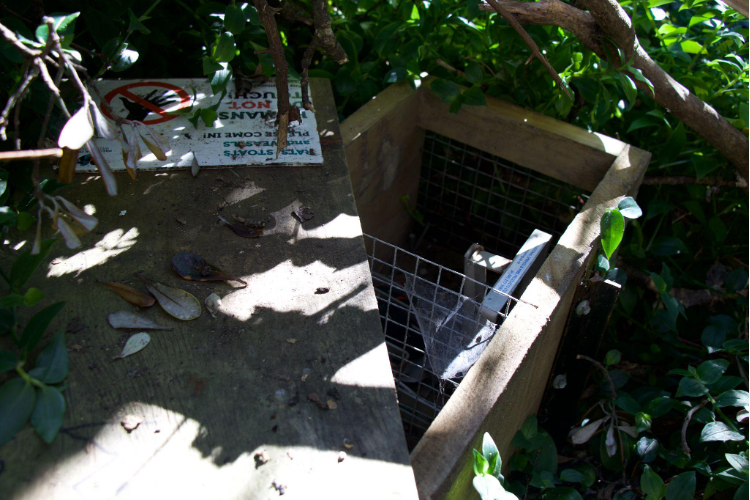
Snap traps, wooden boxes with a metal snare, remain the team’s other primary method of eradication. The predator is drawn into the box by the smell of food and instantly exterminated upon stepping onto the metal plate. The team uses bait stations more frequently in large-scale eradication efforts as opposed to traps, which require more upkeep to be reset after each kill.
“Bait is kind of a good method to really do a knockdown,” Morris said. “Say you’re dealing with one or two pesky rats, then you can kind of work a lot more with traps.”
Morris and PFW’s other field operators spend their days refilling bait stations, resetting traps and monitoring predator activity across Wellington. They use an app to track their progress on an interactive map complete with every bait station and trap they have placed in the city.
In addition to extermination efforts, the team tracks rat presence with motion-activated cameras and what are called chew cards — playing card-sized pieces of plastic smothered in a strong-smelling, tasty spread that rats like to gnaw on. These methods allow the team to monitor their progress in particular zones. If a camera catches a snapshot of a rat or the remains of a chew card are found, the field operators know there is more work to do in that location.
Sprawled across the forest floor, resetting a snap trap, Morris explained the concept of another tracking tool at the team’s disposal: the sniffer dog.
Sally Bain regularly takes her two highly-trained dogs, Rapu and Kimi, trekking across Wellington to smell for rats. The trio is called all over the country for their rat detection skills, Morris said. Other dogs trained to sniff for different predators are also asked by the team for their services.
“There’s a hedgehog dog, there’s a stoat dog … there’s all sorts of other dogs,” Morris said. “And then you have ones that are trained to sniff out native species.”
PFW operates on both public and private lands, tasking community outreach officers with receiving permission from every household the team works on the property of. Most of the time, residents are very supportive of the team’s work and allow them on their land, because, as Morris said with a chuckle, “No one really wants rats, you know?”
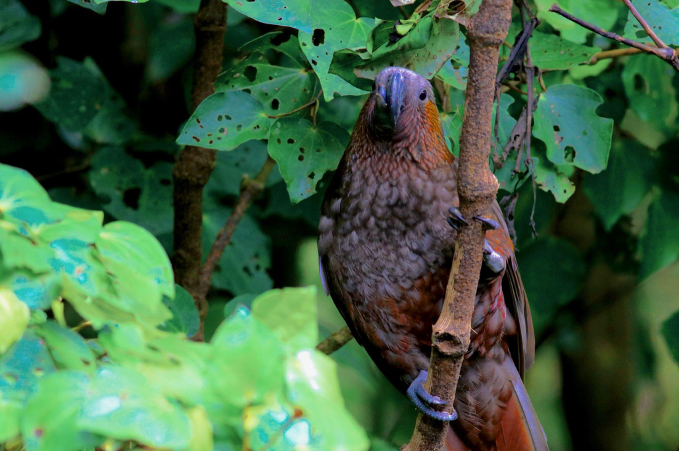
When 58-year-old Wellington resident Tony Darroch was growing up, he had never heard a tūī’s call. This iconic native bird has distinctly complex, varied vocalizations in the form of clicking, singing and whistling.
“People talked about tūīs as a native bird, but we never saw them, never heard them,” Darroch said. “Over time, the conversation changed from talking about tūīs in the abstract to saying, ‘I know someone who heard one.’”
Today, the cry of the tūī is commonly heard across Wellington.
Conservation efforts in Wellington over the years contributed to the rebound in tūī presence in the city. Darroch said the mission of bringing back the tūī motivated him to volunteer with PFW.
The goal of eliminating every predator from the city is dependent upon grassroots resident support. In addition to paid field operators and staff, PFW relies on a network of volunteers like Darroch and partnerships with nearly 50 community trapping groups across Wellington, according to the PFW website.
The initiative is overwhelmingly popular among Wellington residents. In PFW’s most recent biannual survey, 96% of Wellington residents expressed their support for the elimination of introduced predators, up from 86% at the outset of PFW, according to Willcocks.
“People power is a phenomenal thing,” Willcocks said. “You get everyone moving in the same direction, doing the same thing. It’s pretty awesome to be part of.”
PFW’s popularity is hardly surprising, as many New Zealanders feel a deep affinity for the indigenous species as a symbol of national identity. Stephen Hartley, co-director of the Centre for Biodiversity and Restoration Ecology at Victoria University of Wellington, said he feels this unique relationship resonates across Wellington and with the mission of PFW.
“I think New Zealanders do feel a strong affinity to the natural environment,” Hartley said. “They’re quite proud of the species there are because most species you find in New Zealand, they’re not found anywhere else in the world.”
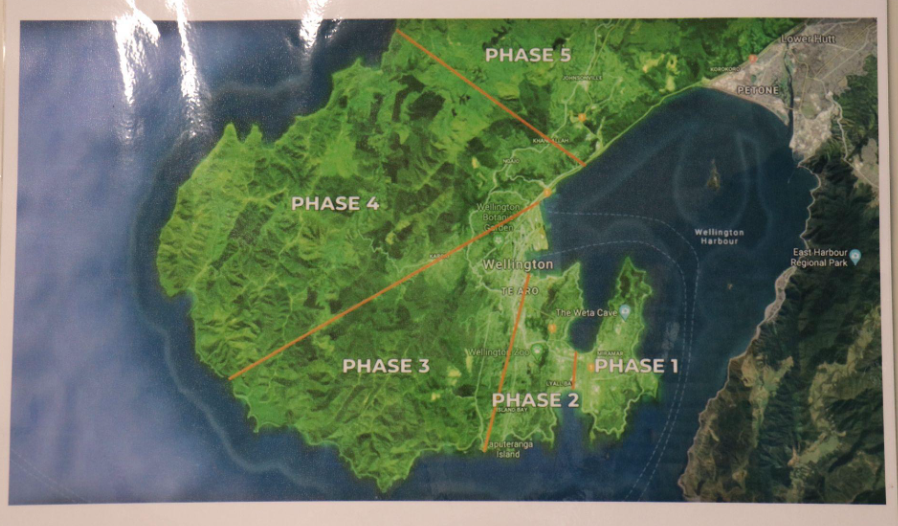
Since its launch in 2017, PFW has seen impressive results. In November 2023, the team announced that Wellington’s Miramar Peninsula (Te Motu Kairangi) was 100% predator-free, marking the completion of Phase 1 of the project.
Miramar, located southeast of central Wellington, witnessed a dramatic increase in native bird and insect species. According to PFW’s 2024-2025 Impact Report, native bird detections have increased by 136% in Miramar since 2017. Native invertebrates also rebounded, like the native tree wētā, a type of insect, that saw a 200% population growth.
“The evidence is just irrefutable,” Willcocks said. “If we remove these introduced predators, then our native wildlife just thrives.”
An interactive map and dashboard created by PFW illustrate zones that are completely clear of rats, partially clear and those in which elimination efforts are not yet active.
Phase 2 is underway, covering zones from the suburbs directly west and south of Miramar to the central business district of Wellington. The complexity of elimination efforts has increased with Phase 2, as it is of greater urban density than Miramar. The team hopes to complete Phase 2 by June 2027.
“The awesome thing about … being in a city is that we have a generation of children growing up who will conceivably never see a rat, but they will see kākā, they will see kārearea, they will see kererū,” Willcocks said. “That’s the intergenerational change we’re trying to create.”
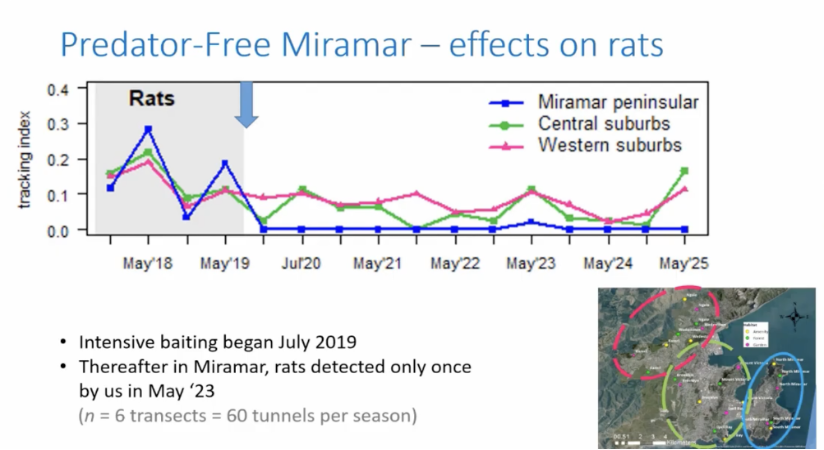
Hartley tracks the effects of PFW’s trapping efforts on invertebrate and reptile populations like tree wētā and copper skinks alongside the decline of urban mammal populations.
“The key contrast we often look at is what’s happening in Miramar compared to the rest of Wellington,” Hartley said. “When they started, Miramar and the rest of Wellington had similar levels, and then the eradication began and within six months, we weren’t seeing any rats.”
Phases 3, 4 and 5, which include some of the central city and northern rural areas, are not yet active. As it reaches later phases, PFW plans on partnering with community groups and Capital Kiwi, a conservation organization dedicated to returning wild kiwi to Wellington, which are currently active in Phase 3, 4 and 5 regions.
PFW field operator and Zealandia tour guide Ellen Carlyon touches each branch we pass gingerly as she guides us through the wildlife refuge’s trails. Occasionally, she turns on her phone flashlight and presses it up against hollow, metal rods used to suspend walkways and bridges.
“We have a native forest gecko that is often in these pipes. They’re so sweet,” Carlyon says. When we approach a small corner of Zealandia’s lake, formed by the Lower Karori Dam, she gasps in shock when a pāteke/brown teal emerges from the brush. Even in this fenced sanctuary, largely free from predation, these species are still a rare and welcome sight.
At more than 500 acres, Zealandia has become both a sanctuary and a blueprint. Founded in the 1990s, the project transformed the former Karori Reservoir into one of the world’s first fully fenced urban ecosanctuaries.
Today, the sanctuary has a 500-year vision to restore the area to its original, pre-colonial ecosystem. But Zealandia officials like CEO Danielle Shanahan and conservationists like Carlyon say the sanctuary’s influence extends far beyond its borders, eliciting a powerful “halo effect,” with native birds steadily dispersing into Wellington’s suburbs and green spaces. That resurgence helped inspire ambitious citywide efforts like PFW and Capital Kiwi, which aim to turn isolated conservation successes into an interconnected urban ecosystem.
Shanahan said that this teamwork is essential to the success of conservation work across the nation.
“All over the world, we’re seeing declines in nature. But here, we are reversing this extinction experience,” Shanahan said. “For me, it’s a personal story as much as a professional one. It just makes my heart sing.”
As Carlyon guides us deeper through Zealandia’s forest, she points out the footprints of a kiwi pukupuku (little spotted kiwi), a species once extinct from the area for over a century.
“Predator Free is almost seen as New Zealand’s moon landing,” Carlyon says. “It shows you what the bush and the birds can do if you just give them the chance to do it.”
Across the globe, the International Union for Conservation of Nature and Natural Resources (IUCN) reports that over 48,000 species are at risk of extinction. Urbanization is the third most frequently cited threat to species on the IUCN Red List. Cities often create environments dominated by habitat fragmentation, pollution and human development. In Wellington, these trends are being disrupted as organizations position urban areas as potential sites of ecological recovery rather than obstacles.
According to Zealandia’s 2016-2035 strategy, the sanctuary hopes to see international recognition for the wider Wellington area as the “most nature-connected urban area in the world” within the next 10 years. That vision extends far beyond Zealandia’s fence line.
Conservationists say projects like PFW represent the next phase of the city’s restoration efforts by applying lessons learned inside the sanctuary to a large urban landscape. Together, the projects have created an increasingly visible example of how cities might rebuild biodiversity by integrating conservation directly into daily life.
“Wellington’s job was to develop a pathway for urban spaces, peopled landscapes in New Zealand,” Willcocks said. “We are working more in the international arena, and I would love to see us continue to supplement our blueprint and our methods so they can be replicated in other parts of the world.”
While New Zealand’s ecological conditions are unique, Wellington could serve as a global model for urban ecological restoration rooted in community-building and science.
To Shanahan, a visible connection between people and nature allows communities to reap economic, social, health and environmental benefits.
“We hope cities thrive because they’ve seen what’s happened here and are inspired to do this in their own way that’s right for them,” Shanahan said. “That sense of community is what will give us resilience as we head into a really uncertain future.”
A project of

in collaboration with