Providing consistent access to clean drinking water remains a challenge in many parts of the world. In 2024, 2.1 billion people worldwide still lacked safely-managed drinking water services, showing the scale of the challenge despite advances in water treatment technologies.
At first, the engineering goal may seem straightforward: remove harmful contaminants from water. In practice, the challenge is more complex.
For example, a recent study examined household water treatment systems using pre-filtration and ultraviolet-C light (UVC) disinfection in rural communities in Colombia and Mexico over a 12-month period. The systems were developed with community feedback and designed around differences in source-water quality, household needs, treated-water storage and household distribution.
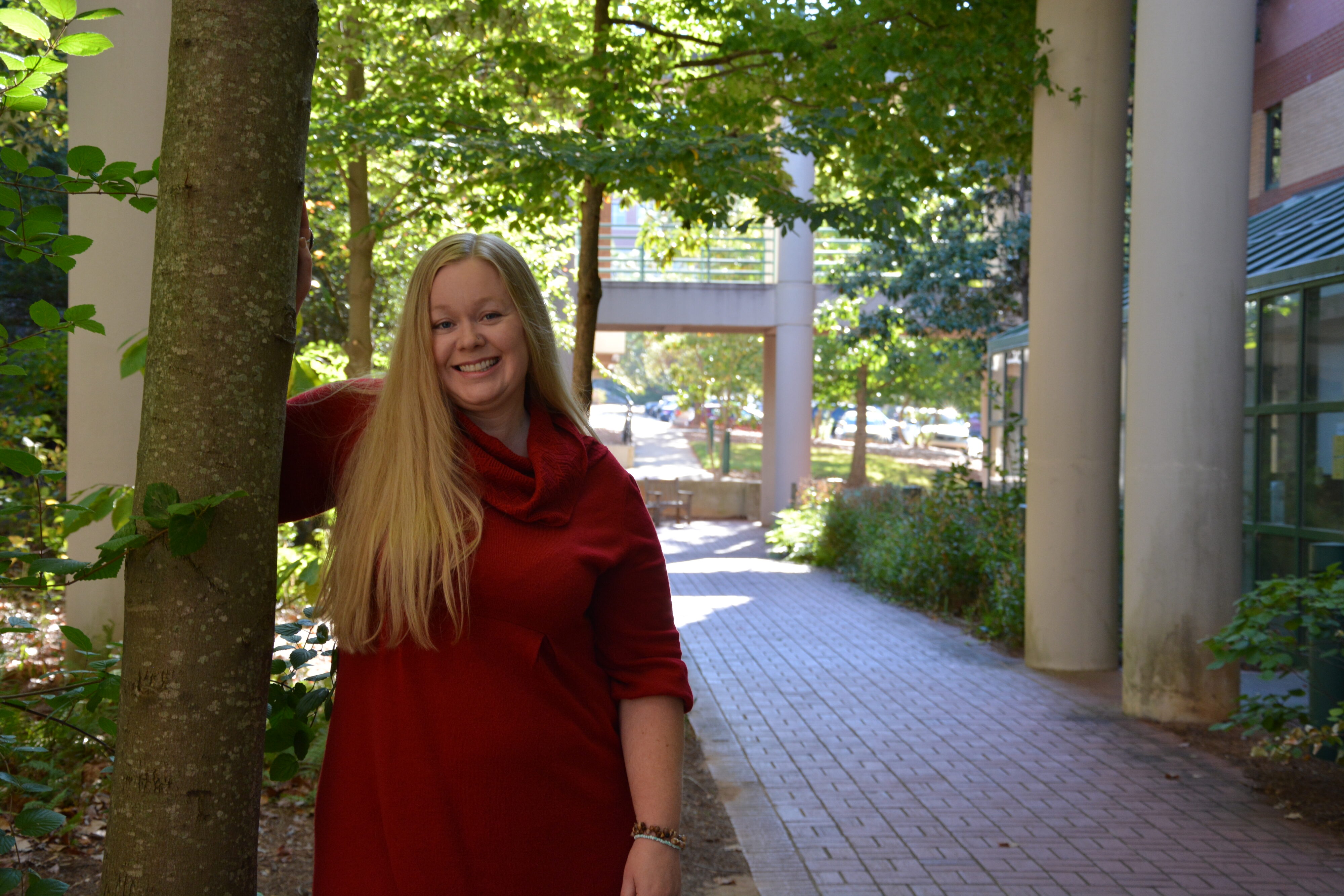
John Tharakan, Ph.D., professor of chemical engineering at Howard University. (Photo courtesy of John Tharakan, Ph.D.)
This study illustrates that well-designed water treatment involves more than proving that a technology can clean water in a lab; it must account for the conditions of the setting, long-term performance and factors that would affect people’s daily use of it.
John Tharakan is a professor of chemical engineering at Howard University whose work includes water treatment and conservation, engineering ethics and sustainable development.
He specializes in designing appropriate technology, an approach aimed at matching a technology to the resources, infrastructure and needs of a community.
I spoke with him about what makes a drinking water treatment technology not only effective in theory but also appropriate for the people expected to use it and the place where it will be used.
This interview has been edited for length and clarity.
Ajani Moss: Early in your career, did you think about sustainability the same way you do now? What has changed the most in how you understand it?
John Tharakan: I think it definitely has changed in terms of what sustainability encompasses, but sustainability has always been part of my thinking. Even as an undergraduate, when I was being educated in the ’70s, we were thinking about the environment. We were thinking about appropriate technology.
The context of where the problem was [being addressed] really made a big difference in terms of the sort of solutions you could offer. We can say we want a reverse osmosis system to clean water, and the reverse osmosis system delivers perfectly potable water, but it’s expensive. It requires energy to operate. It has a lot of maintenance issues.
AM: You mentioned that this way of thinking started when you were an undergraduate. What first drew you to chemical engineering and sustainability?
JT: What actually got me interested in sustainability was my interest in brewing beer. Brewing is a biochemical process.
As an undergraduate, I became curious about how this could be applied to solve, say, an energy problem. One of my projects as a senior undergraduate was coming up with a bioprocess to enzymatically degrade starches to make alcohol, so that the alcohol could be used as a fuel and reduce India’s dependence on foreign oil.
AM:You spoke a little about this already when you mentioned reverse osmosis, but going a little deeper:When evaluating a watertreatment technology for a particular community, what factors do you consider beyond whether it can technically clean the water?
JT: Essentially, what you’re looking to see is: Can the technology be understood by the local community? Can the technology be maintained by the local community? Can the local community afford the technology?
All of these different aspects of tech that go into whether a technology is chosen, how it is implemented, how it is adopted, whether it’s maintained, and whether it actually succeeds — all of these different factors affect that success.
AM: Now, to talk a little more about a specific project, can you tell me about Howard’s Engineers Without BordersWater Is Life projectin Choimim, Kenya? What did that experience teach you about designing water solutions for a specific community?
JT: The community of Choimim is fairly remote. It’s an agricultural community. They have no electricity, and they’re quite far from the closest electrical line, so they had a huge water availability issue.
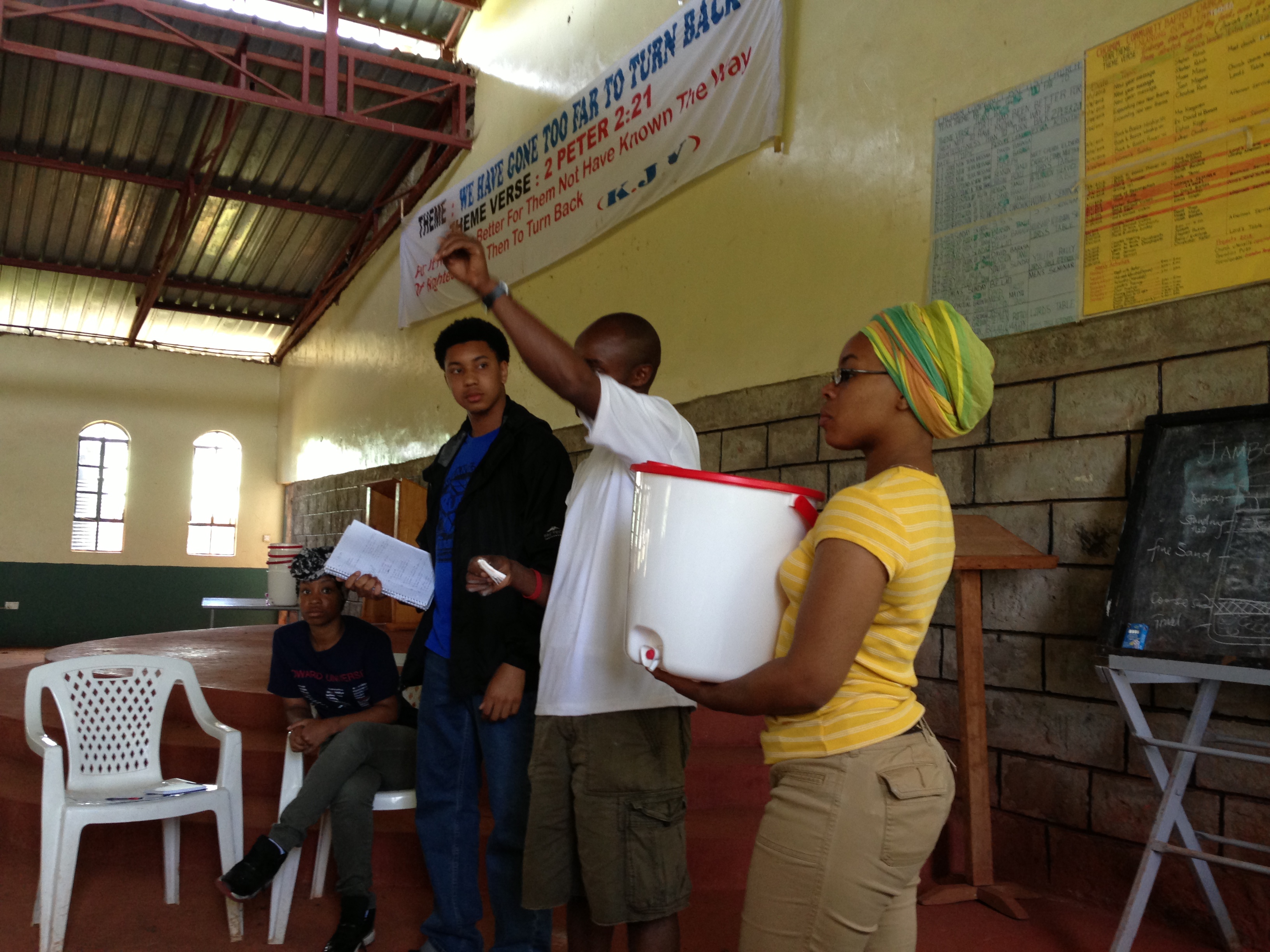
The community actually needed some storage capacity. [A] part of the project was putting out a couple of water tanks. Then the other thing was [that] the community needed clean water. One of the most commonly used filtration systems is called a biosand filter, which is a very simple thing. It has two or three layers of gravel, coarse [sand], and fine sand.
The team decided that this is something that would fit there because the materials required were all available locally. The design was not complicated, [and] it wasn’t very expensive.
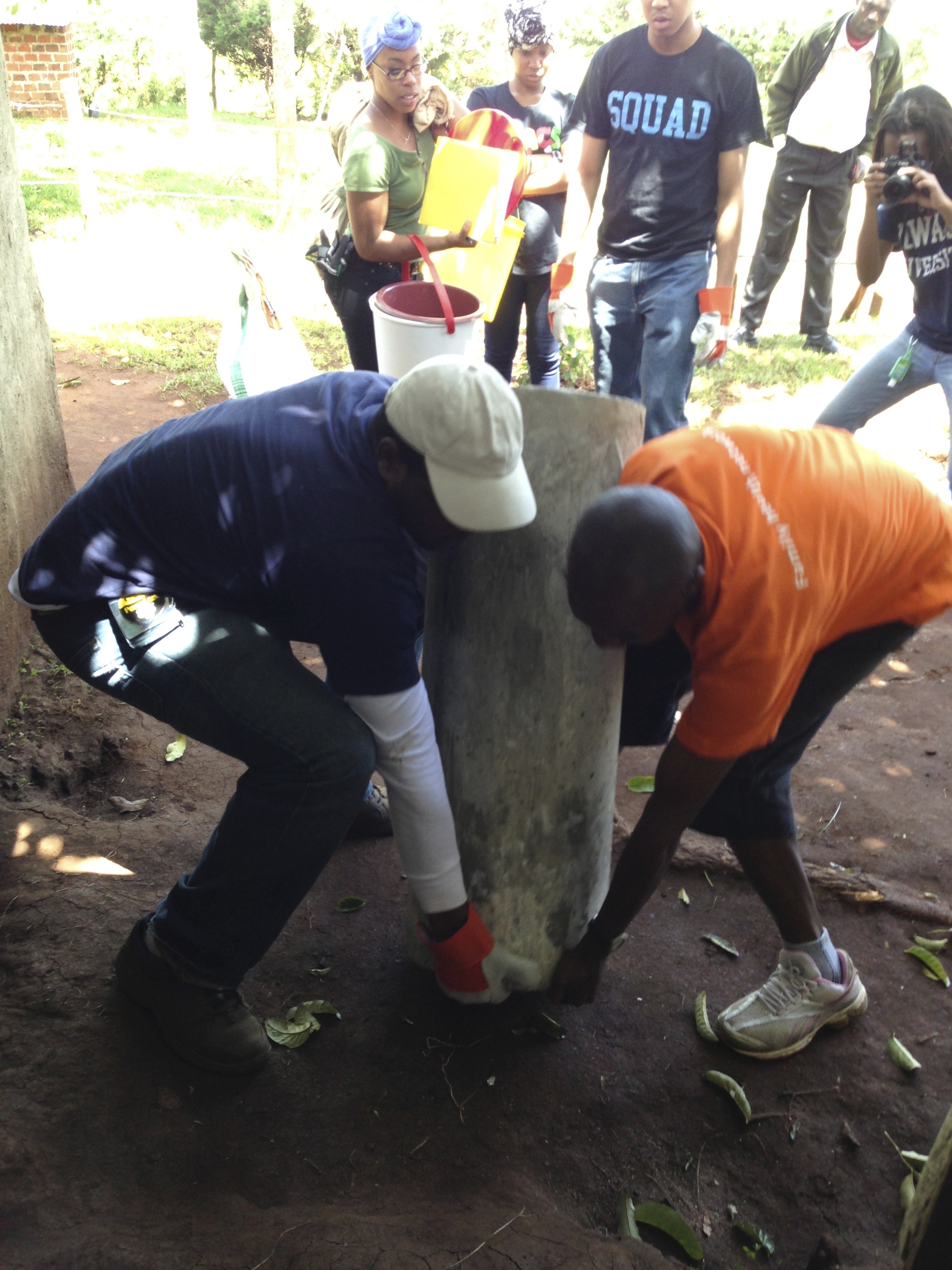
We asked the community, “Where do you want these things?” We put one in the school, [one in] a local health clinic, and [one in] an orphanage. We held a couple of workshops where the students, who had learned how to make these biosand filters, taught the community how they could make, operate and maintain them.
Tharakan’s team leads a community workshop and training on the operation and maintenance of the biosand filters. (Photo courtesy of John Tharakan, Ph.D.)Installation of a biosand filter in a community member’s home. (Photo courtesy of John Tharakan, Ph.D.)
AM: What have communities taught you about engineering that you could not have learned in a lab or classroom?
JT: Communities teach you that you have to be able to listen. You have to treat the community as an equal partner in the development of that solution. So it’s always important to respect the traditional knowledge that might be there.
AM: In class, you introduced me to thinking beyond “cradle to grave” for a water treatment technology, considering “cradle to cradle.” What does that mean?
JT: “Cradle to grave” implies that you have something that is created, is used, lives a useful life, and then dies and has to be dealt with. A grave has to be created for it.
When you think about “cradle to cradle,” what you’re thinking about is [that] the outputs from any process or any use have to be considered as inputs to something else. In “cradle to cradle” thinking, there are no waste streams. Everything is a resource stream.
AM: To close, after everything you have learned through research, teaching and working with communities, what is one thing you wish more people, not only engineers, understood about solving water problems?
JT: What are the capabilities of the community to address their own problem, and how can we build that capability, whether it’s technologically or socially or in some other way?
Building that capacity should be our objective, because I think sustainability eventually depends on having communities of sustainable people who are able to live sustainable lives.
This website uses cookies to provide you with an improved and personalized experience. By using this site you agree to our use of cookies. Please read our cookies policy for more information on the cookies we use and how to delete or block them.


 All Topics