Architects of the forest: Agroforestry in the Brazilian state of Minas Gerais
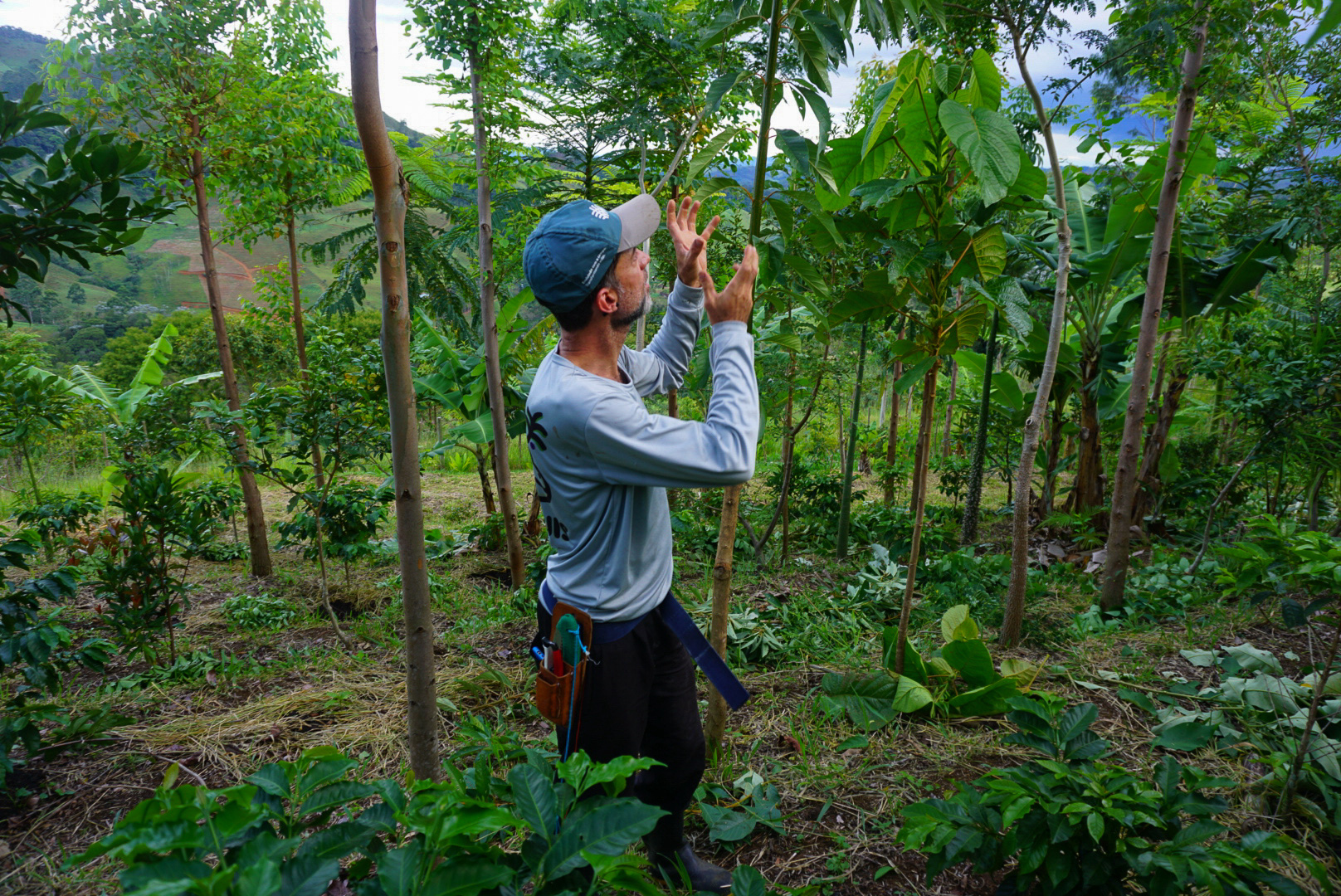
Leandro Santana Moreira explains how he follows the principle of stratification by cultivating plants at multiple different vertical levels to mimic the natural organization of a forest.
Close to the border of the Serra do Brigadeiro State Park in Minas Gerais, Brazil, Leandro Santana Moreira stands in the middle of his forest pruning what he himself planted. Leaves, branches, and sometimes whole trees fall to the ground around him. Everything gets pruned: Coffee plants, banana trees, and juçara palms — a close relative of açaí — are just a few of the more than 100 species on Moreira’s farm. After they’ve been cut, the organic material is spread around the root systems to help nourish what continues to grow.
The land that Moreira now stands on looks vastly different from when he first began working on it 16 years ago. Back then, it was nothing but a pasture, deforested of its native trees, its soil degraded and abandoned after having been grazed by livestock. Now, it is a lush ecosystem of interspersed crops and native trees that resembles a forest much more than a traditional farm.
Moreira’s land offers an example of the sustainable farming practice known as agroforestry.
“We work as if we were architects of the forest,” he said, placing down his machete.
Agroforestry isn’t what initially drew Moreira to the Serra do Brigadeiro. He first came here in 2004 as a master’s student in animal biology from the Federal University of Viçosa, about 40 miles west, where his research focused on the muriqui primate species.
“I felt a strong need for better integration between rural production work and the vision of conserving the forest, of trees and natural resources,” Moreira said. “So I began the work here with that vision. And because of that came the interest in agroforestry.”
According to Moreira, he inherited a “very challenging scenario” when trying to adopt a more conservation-minded approach in a region so heavily impacted by human presence and monoculture.
“The areas were becoming poorer in natural resources, soil quality, and production,” he said. “The products were becoming more limited. That made me question why this type of production should continue. There had to be another way to produce, one that sought environmental richness, not environmental impoverishment.”
Restoring a natural order
The Serra do Brigadeiro lies in the heart of Minas Gerais’ Atlantic Forest. The Atlantic Forest is considered the most heavily degraded biome in Brazil, with an extensive history of deforestation dating back to Portuguese colonization in the 16th century. Older than the Amazon Rainforest, the Atlantic Forest is a global biodiversity hotspot home to 1 in 14 of the world’s plant species and 1 in 20 of its vertebrate species.
The Atlantic Forest originally stretched from the northeastern Brazilian state of Rio Grande do Norte down the coast to Rio Grande do Sul in the south of Brazil, with inland swaths sweeping into Paraguay and Argentina. As of 2025, however, only 24% of original forest cover remained, and it’s heavily fragmented due to high population density along Brazil’s seaboard. Today, an estimated 70% of the nation’s 213 million residents live in what was once Atlantic Forest, including in the metropolitan areas of São Paulo and Rio de Janeiro.
Daniel de Carvalho Nocera, a postgraduate researcher in agroecology at the Federal University of Viçosa, explained how the consequences of deforestation extend far deeper than the disappearance of tree cover by altering soil composition.
“In tropical systems, in most cases, the majority [of the carbon] is in the vegetation. The soils generally do not have that much organic matter,” he said. “When land use changes, moving from a biodiverse forest with trees dozens of meters tall to an annual monoculture with small, short-cycle plants, we invert this balance, eliminating a large carbon reservoir in the aboveground biomass and creating a deficit.”
In 2022, the Atlantic Forest was recognized as one of the 10 United Nations World Restoration Flagships, with the goal of restoring 15 million hectares of forest by 2050. In the meantime, agroforestry farmers and organic producers like Moreira are taking restoration into their own hands. A key part of Moreira’s planting strategy is to follow the natural design of a forest.
“We plant at high density, we plant with high diversity, and we plant respecting the principles of stratification and succession,” he said. “There are different stages — different moments — of the plants. There are plants that will remain for only a few years and then leave the system and there are others that will remain for many years and will grow slowly.”
Where others may see a wild, untamed jungle — especially compared to the sea of clean, defined rows of monoculture coffee plantations that surround his land — Moreira sees a highly evolved order. According to him, it “is a design that considers time and space.”
Coffee plants, banana trees, and juçara palms are just a few of of the more than 100 species that Moreira cultivates on his farm. (Olivia Lohrer)
In a little over a decade and a half, Moreira has already seen what he calls the “systematic benefits” of his work. For one, when the land was pasture, the air was drier. Since restoring the forest ecosystem, Moreira has noted a considerable increase in humidity that more closely resembles the historic climate of the Atlantic Forest. Additionally, he has seen a spike in biodiversity through the presence of animals that were missing when he arrived. The biggest impact, however, has been on the soil.
“The result of this entire process we carry out is soil formation,” he said. “Conventional agriculture goes in the opposite direction — it loses soil. Here, we create soil.”
According to Carvalho Nocera, the introduction of trees in agroforestry systems enhances soil quality through a process called “nutrient cycling.”
“When a plant grows, whether a tree, shrub, or another type, it goes through a vegetative period in which it captures carbon from the atmosphere and nutrients from the soil, forming its aboveground structure,” he said. “When it dies or drops leaves, branches, or fruits, it returns these nutrients to the soil in the form of organic matter.”
By pruning his trees and placing the organic material by the base of the root system, Moreira actively accelerates this process.
Rooting out ‘descrença’
While ecology backs these techniques, Moreira and the other residents of the Serra do Brigadeiro don’t always see eye to eye on the value of his vision. According to him, the greatest challenge of agroforestry hasn’t been the physically demanding labor, but the social skepticism he has faced.
“The most challenging part has always been — and still is — people’s trust,” Moreira said. “We are outside of the traditional culture, and because it is still the beginning of our products and results, I think the greatest pressure is what we would call in Portuguese ‘descrença.’ The people do not believe.”
But Moreira believes that the best way to encourage the wider adaptation of agroforestry in the region is to show people that it’s not only environmentally friendly, but economically viable.
“Our coffee was first harvested last year, in 2025,” he said. “We already have an organic, certified, specialty coffee with very good flavor and a high price as well. I understand that, given the capitalist system we live in, if I don’t have products that are valued externally, we will not be considered successful here. If we manage to produce very good coffee, at low cost and organically, we can spark significant interest in this type of system.”
Currently, Moreira is commercializing four products: coffee, dehydrated banana, juçara pulp, and mushrooms. In the near future, he plans to distill essential oils for sale as well.
Moreira views gaining greater cultural support for agroforestry as an important mechanism to restore the Atlantic Forest. He believes that this involves getting people to understand that agroforestry “is a vision that enriches the environment as a whole, including the human part because humans will also benefit. We witness the positive environmental changes, and at the same time, we can harvest the fruits.”
While Carvalho Nocera echoed this sentiment, he also emphasized the complexity of wider adaptation of agroforestry in the region. His research seeks to understand how different levels of complexity shape the quality of agroforestry systems across Minas Gerais, and he has found that there is “no single model” that can be implemented.
“Each farmer has absorbed principles of agroforestry systems and applied them to their own reality, resulting in highly diverse systems,” he said.
That diversity can pose a challenge to scalability. According to Carvalho Nocera, “the more complex and biodiverse a system is, the more difficulties and challenges there are in implementing it on a large scale. But it is entirely possible to design simpler agroforestry models for large-scale implementation without major limitations.”
Despite not believing that agroforestry is a “panacea,” or a cure-all for the problems associated with deforestation, Carvalho Nocera sees great potential for agroforestry systems in Minas Gerais as “a form of agriculture that can simultaneously produce and regenerate. And in the Atlantic Forest in particular, which is already a highly threatened biome, it presents itself as an alternative to connect these small properties as well, increasing biodiversity across the ecosystem in a more general way.”
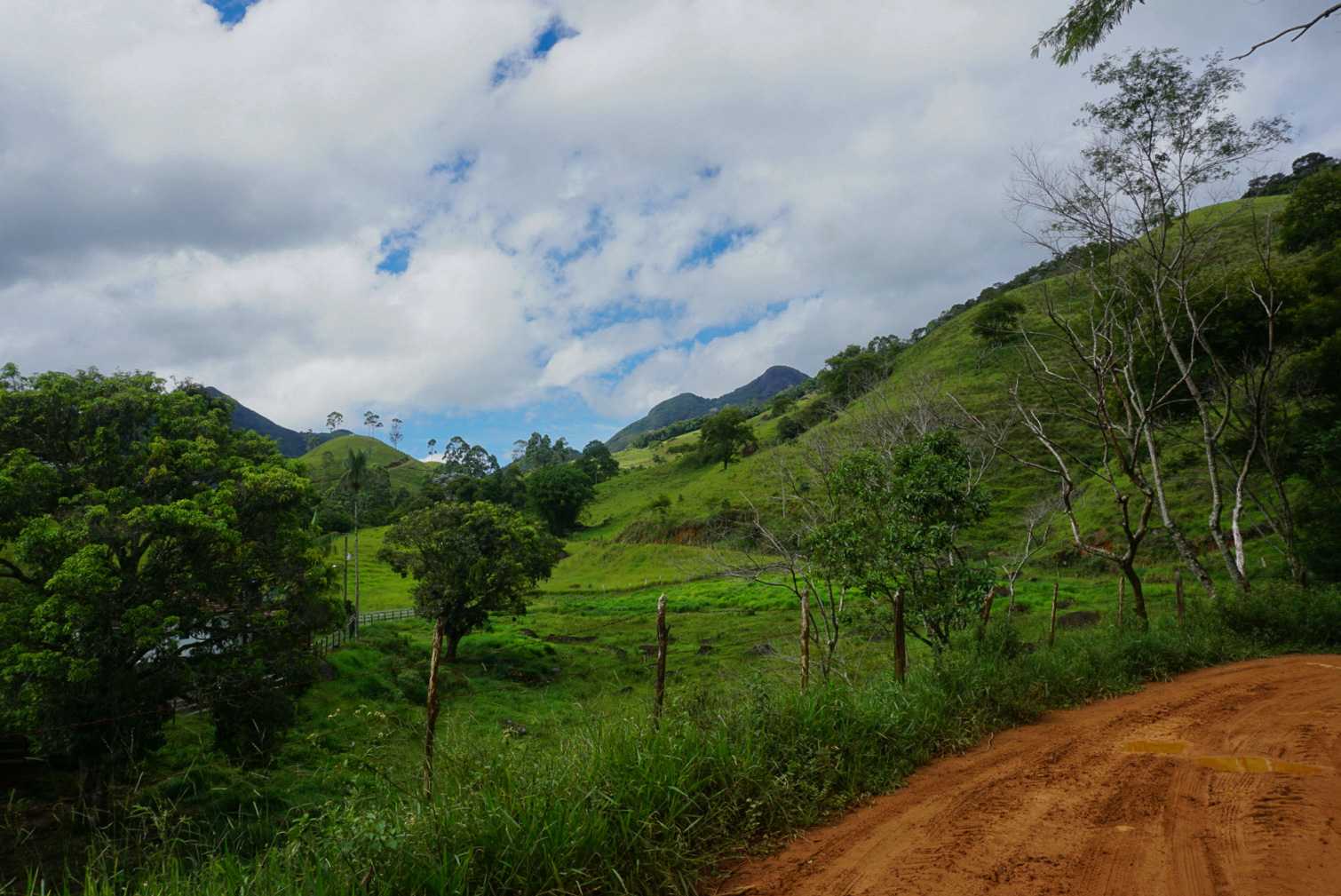
Pastureland and coffee farms stretch across the hills that border Serra do Brigadeiro State Park in Minas Gerais, Brazil. (Olivia Lohrer)
As for the future of his own farm, Moreira’s hopes are simple. “Independent of my existence or not, I hope that this land becomes a beautiful forest in the future,” he said.
In a region long defined by extraction and exploitation, Moreira views agroforestry as more than just a means of production. “From a personal, emotional, and even spiritual point of view, it is work that makes a lot of sense for the human experience. This is a system that welcomes us. We participate in this system. I am part of this system.”
Machete in hand, moving between the trees as he continues to prune, Moreira describes his role in the system not in terms of management or domination, but in terms of reciprocity. “Working with each plant, learning from them, seeing the system flourish overall — it is a great gift for the soul,” he said.
This website uses cookies to provide you with an improved and personalized experience. By using this site you agree to our use of cookies. Please read our cookies policy for more information on the cookies we use and how to delete or block them.



 All Topics