

 All Topics










Star Scott, Green Labs Program Manager at the University of Georgia.
Courtesy of Star Scott.

Marley Hinrichs
Planet Forward Correspondent | University of Georgia
October 23, 2026
Courtesy of Star Scott.
Planet Forward Correspondent | University of Georgia
Innovation begins with good, rigorous research. This is especially true in the culture of the University of Georgia, ranked No. 1 in the U.S. for research-based commercial products. However, research labs can come at a great environmental cost, consuming up to 10 times the resources of a classroom or office, often without the researcher’s knowledge.
“It can be really conflicting for the scientists to also know that in some inadvertent and unintentional way, they may be contributing to some of the problems they’re trying to solve,” said Star Scott, a program manager at the University of Georgia.
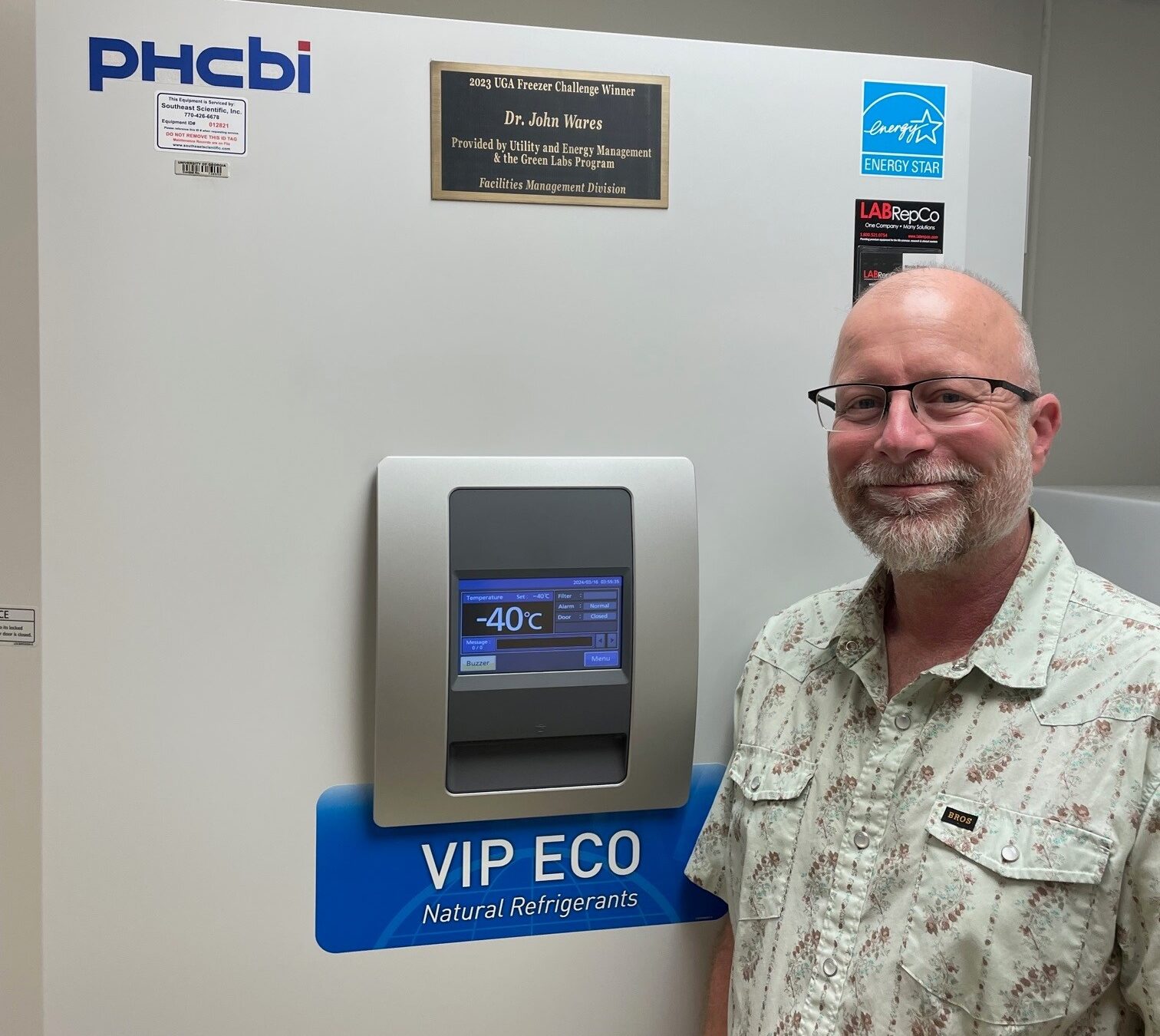
Scott was working in wildlife biology and ecology research when she realized that innovative research can come with major sustainability tradeoffs. This led her to join the UGA Green Labs task force in 2015.
The initial advisory report promised at least $187,000 worth of savings for the university, by reducing energy, water, and waste disposal costs. Enforcing an initiative for the approximately 1,900 qualifying research labs was a big undertaking.
With only 14 full-time Green Labs employees across the across 33 programs in the U.S., the wheels of change can seem to turn slowly, but with teams like the one at UGA, this small community can make lasting institutional change in major research institutions.
“We’re asking people to change,” Scott said. “So, just by nature of existing, it is often challenging, because we’re humans. Humans don’t want to do anything differently.”
As a researcher, Scott knew how immersing yourself in a research project you’re passionate about can make it difficult to worry about sustainability efforts, especially when you’re not receiving the feedback of a water or power bill.
“We don’t want to take your focus off of your research, but we do want to let you know the impact of your research and how maybe we can help mitigate that a little bit… We don’t want to give them a whole other job to do,” she said.
This is why the Green Labs team begins their job with all the research done already. Once a research lab opts into the program, Scott’s team comes with data on what small behavioral modifications will work with the lab, and they are implemented one at a time. She compares it to your mom reminding you to turn off the light when you leave the room; it’s an easy change, and once you’re prompted to do it, it becomes second nature.
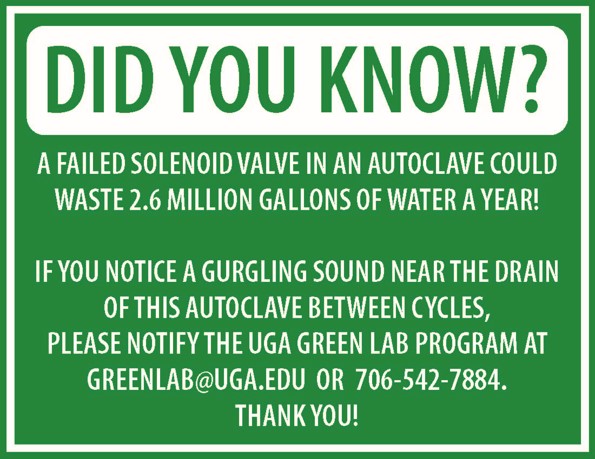
For example, autoclaves used for sterilization are often shared resources among several research labs, and therefore might struggle for an individual to take responsibility for their upkeep. This is why Green Labs placed informational stickers on autoclaves across UGA, calling for reports of faulty valves that waste millions of gallons of water annually. The first week of the program found three faulty valves, saving a total of $74,000 worth of water annually.
Some of the Green Labs’ programs have to deal with the diversion of waste coming from labs. This comes with the help of Athens-Clarke County’s Center for Hard to Recycle Materials (CHaRM), and their free Teacher Reuse Store. Green Labs facilitates the donation of old lab glass from UGA labs, straight into K-12 classrooms in the Athens community, serving future scientists.
“The difference is, instead of them watching one experiment happen at the front of the classroom,” Scott said, “they’re getting supplies that are allowing them to actually do hands-on experiments throughout the classroom.”
Along with waste diversion and resource management, Green Labs also seeks to prevent sustainability issues before they even reach UGA, through sustainable procurement efforts. This includes avoiding purchasing hard to recycle materials, and supporting manufacturers that reduce waste and produce under ethical conditions. These efforts not only target environmental issues in research, but also the university’s bottom line.
“We don’t even have to say ‘sustainable.’ We can just say ‘efficient,’ because it’s the exact same thing… If you are running an efficient lab, the dollars that you get, your grant awards that you get, are going to go further,” Scott said.
The allocation of grant funds are especially important for researchers, as it has become an increasingly competitive process, with 2.5 to 3 times the number of applicants for a comparable amount of money from 20 years ago. Sustainable research can give scientists an advantage in the application process, through initiatives such as the Bringing Efficiency to Research (BETR) Grants initiative, which works to factor efficiency into grant requests. There are also several U.S. Federal Codes that embed efficiency into qualifications to receive federal grant money.
As the only full-time employee dedicated to UGA Green Labs, Scott hopes to see and contribute to a continued positive impact toward the scientific community. Scott has seen an increased demand for sustainable science in the UGA research community in the last decade, with labs now reaching out to Scott’s team for help to optimize their research’s sustainability.
Said Scott: “I think there’s like a real culture shift happening, and I think UGA has a real opportunity to champion this the way we champion football and a lot of other things because it is really cool.”

Director of Academic Adventures | Planet Forward

A project of

in collaboration with