As El Niño threatens communities, corals give scientists glimpse into historic patterns
In Isla Vista, California, students at Universtiy of California Santa Barbara and Santa Barbara City College live on the bluffs that overlook the ocean. Many residents are concerned about this year’s "Super El Niño."
This year’s El Niño is earning itself the title of “Super El Niño,” and new research shows the weather events are intensifying.
According to the National Oceanic and Atmospheric Administration El Niño-Southern Oscillation (ENSO) tracker, there is a 75% chance this event will be the strongest since 1950. The phenomenon is causing droughts and floods around the world, which are predicted to get stronger in the coming months.
Scientists recently found a new way to investigate historic El Niño patterns, looking beneath the ocean’s surface. A collaborative research study revealed that El Niño variability is out of the ordinary, and the last 40 years have been stronger than trends in pre-industrial records. Evidence from the coral records on the Galápagos Islands shows a 36% increase in El Niño intensity over that time period.
“El Niño describes the tendency of the eastern and central equatorial Pacific to get warmer than usual every few years,” said Julia Cole, chair of the Department of Earth and Environmental Sciences at the University of Michigan and lead author of the study. “It’s a pattern of interaction between the ocean and atmosphere that drives climate variations on a year-to-year time scale. It’s the most important source of year-to-year climate change on the planet.”
The consequences of a stronger-than-typical El Niño event are far-reaching and likely to be felt globally due to the influence that the Pacific Ocean has on Earth’s weather regulation. However, some of the worst impacts are expected to be felt along the Southern California coastline where residents are already bracing themselves for this winter’s storms.
“When you rearrange the temperatures of the tropical Pacific, that’s a huge piece of real estate,” Cole said. “And so even a little bit of warming across such a large area is a lot of energy.”
The study revealed an increase in interannual variability of sea surface temperature in the modern era compared to the preindustrial era, as observed by analyzing the chemical composition of corals along the Galápagos Islands. Variability as a metric in this study refers to how much the El Niño-Southern Oscillation (ENSO) cycle changes in strength from year to year or, as Cole describes it, a measure of how extreme the climate can get.
“If the range is low, then the extremes are not too bad,” she said. “But if the range is high, then you’ve got something like what we’re looking at now — really strong events coming through.”
What ancient corals can reveal
In order to reveal El Niño patterns dating back to before the industrial era, the researchers analyzed coral samples from the Galápagos Islands. They took core samples from 13 corals, including living and ancient ones with a time period spanning at least 20 years because El Niños occur on an intermittent, irregular basis.
According to Samantha Stevenson, a co-author of the study and assistant professor at the Universtiy of California Santa Barbara’s Bren School of Environmental Science and Management, corals are one of the best “paleothermometers,” something that can be used to estimate past temperatures.
“You need something that is sensitive to climate variations, in the right place to sense it, and it needs to grow fast enough to record the signal that you are looking for,” Stevenson said. “They live [off the coast of] tropical islands that are really strongly affected by El Niño events, the chemical compositions of their skeletons respond to local conditions, and they grow quickly enough that you can actually get measurements every month or two throughout the course of El Niño and La Niña events.”
Researchers measured the ratio of both oxygen isotopes and of the elements of strontium and calcium present in the coral skeletons, which vary in response to ocean conditions such as temperature and chemical composition.
A missing signal
By analyzing one millimeter at a time, the team saw that the variability in El Niño events had strengthened in the last 40 to 50 years, deviating from a pattern of lower intensity visible in the older samples.
“What surprised me, I think, was how consistent the story stayed,” Cole said. “It was low variability before 1850 and then much higher in the last 40 to 50 years. And that difference was so stark.”
The researchers then cross-referenced their data with that of other climate models. They noticed, however, that the models hadn’t picked up the same increase in variability that the corals had.
“We know that there are a lot of issues with the representation of El Niño events within models, and I think that’s what’s going on. The models are missing a real signal,” Stevenson said. “It’s maybe not necessarily what we want to see because it means that we have more work to do to improve the models, but it’s important because now we have more data that we can use to compare with the models.”
Stevenson and other researchers are now investigating differences in climate models to improve predictions involving El Niño strength. According to Cole, models have historically given mixed answers about whether a warming climate will strengthen or weaken El Niño patterns.
“Only recently are we starting to see a pattern that most of the models simulating future climate are showing stronger El Niño system variability,” she said.
This stronger variability is expected to lead to a range of ecological and human impacts – including flooding, drought, food insecurity and health concerns – globally, but El Niño’s strong spatial pattern means that some of the most direct consequences will be felt along the Eastern Pacific.
El Niño events hit students near coast
In Southern California, El Niño years typically bring warm water temperatures. In late September, an olive ridley sea turtle nested on Seal Beach in Orange County, marking the first time sea turtles have nested on the U.S. West Coast. This year’s Super El Niño likely contributed to warmer ocean temperatures suitable enough for the tropical species, according to NOAA.
Additionally, states and countries along the Eastern Pacific edge are likely to experience a very wet winter. In September, California Gov. Gavin Newsom declared a state of emergency to elevate preparedness for this El Niño.
“Here in Southern California, we worry a lot about winter weather during El Niño because storms get steered further South,” Stevenson said. “We can expect flooding, increased coastal erosion due to storm surge, that kind of thing.”
For many UCSB and Santa Barbara City College students living in the 1-square-mile student community of Isla Vista, renting a unit on the beachfront road Del Playa can be a dream come true. With balconies that hang over the bluffs and overlook the Pacific, these homes serve as the perfect place to host a party on a sunny day. When the winter storms roll through, however, they are also the most at-risk in terms of property damage and students’ personal safety.
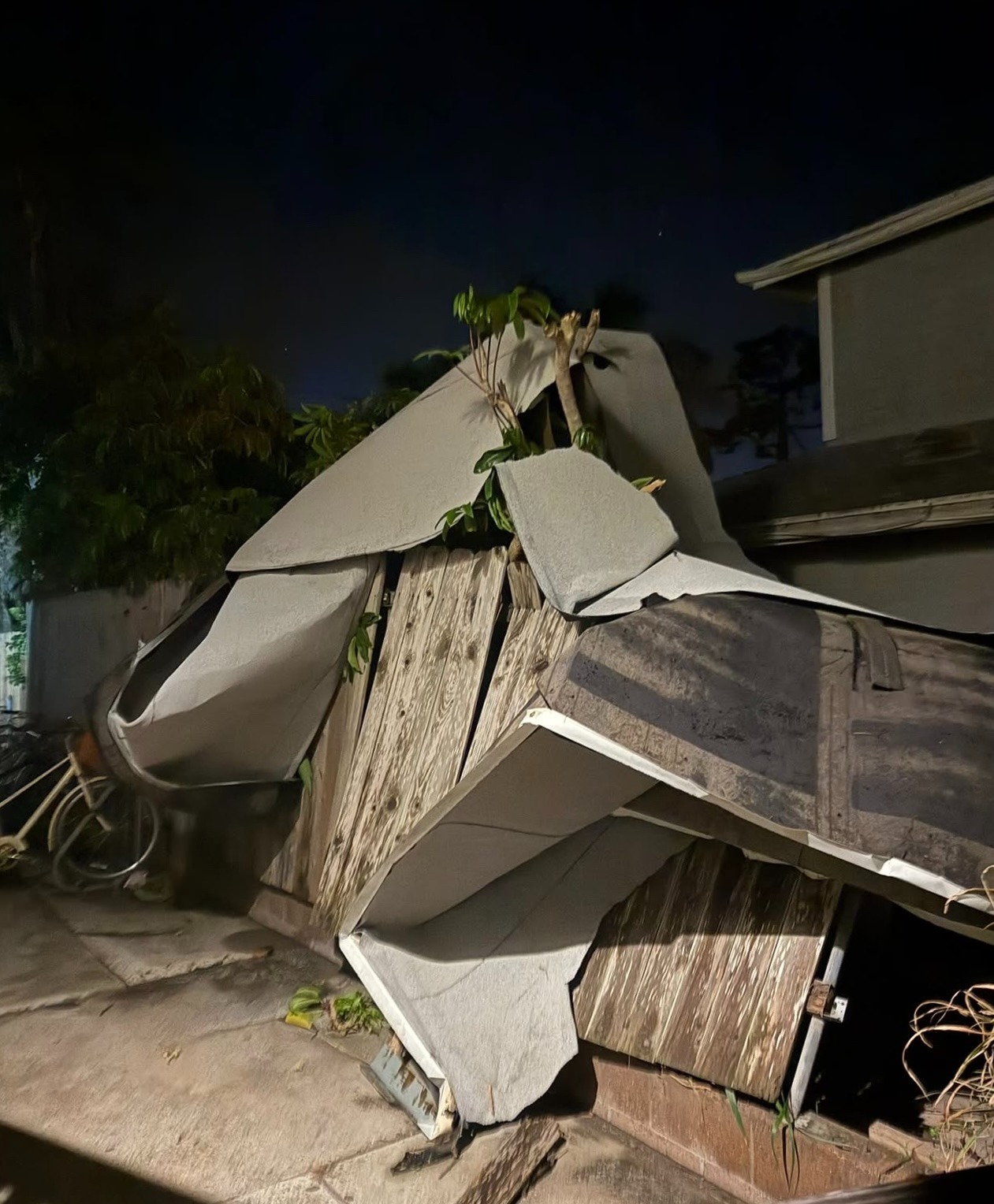
Last December, strong winds during a winter break rainstorm ripped the roof off of the building where UCSB student Bella Nassiri lives.
“We were all home and one of my roommates came back to the apartment on Dec. 26. She sent a bunch of videos and our ceiling was rotted, water all over the floor in the living room and kitchen, and outside of our neighbor’s house was a piece of our roof,” she said.
Nassiri drove four hours from her hometown of Monterey to check on her belongings. When she arrived, she realized the extent of the damage.
“Our unit, the one next to ours and the ones below us all experienced water damage. They had to tear everything out and we had to move out for a whole month, which sucked,” Nassiri said.
Damage to the property that UCSB student Bella Nassiri and her roommates were living in last December as a result of a strong winter storm. (Courtesy of Bella Nassiri)
Nassiri worries about what this year’s Super El Niño could mean for her and other students living on Del Playa.
“I’m really scared that it could happen again and now obviously the storms that are coming could be way bigger,” she said.
Moving to Del Playa last year, Nassiri was excited to be living right on the beach, saying that her spot on the lease felt like it was “meant to be.” Now, her concerns about the Super El Niño are compounded by the fact that it’s her final year of college. After watching the emotional toll that last year’s disruption took on her neighbors during their senior year, Nassiri hopes to avoid a similar situation.
“Now it’s my senior year and I just want to make the most of my time here,” she said.
The larger pattern at play
Cole indicated that one of the hurdles of the study was that people tend to “attribute El Niño to natural causes and warming to human causes.” The team searched for evidence that identified any natural explanations of the dramatic increases in variation in the coral record.
The team could not find an alternative, natural explanation, Cole said.
Historically, there have been varied answers in the models about whether a warming climate would strengthen or weaken El Niño. The results here align with more recent models. Cole said what they saw in the “strength of the variability reconstruction parallels global warming,” and “the cause of global warming, we know it’s due to human-produced greenhouse gases.”
This finding comes as federal funding for climate research has been depleted over the last two years. Cole hopes the study will “add fuel to the fire to argue strongly for moving away from fossil fuels and taking climate mitigation more seriously.”
This website uses cookies to provide you with an improved and personalized experience. By using this site you agree to our use of cookies. Please read our cookies policy for more information on the cookies we use and how to delete or block them.



 All Topics