
 All Topics









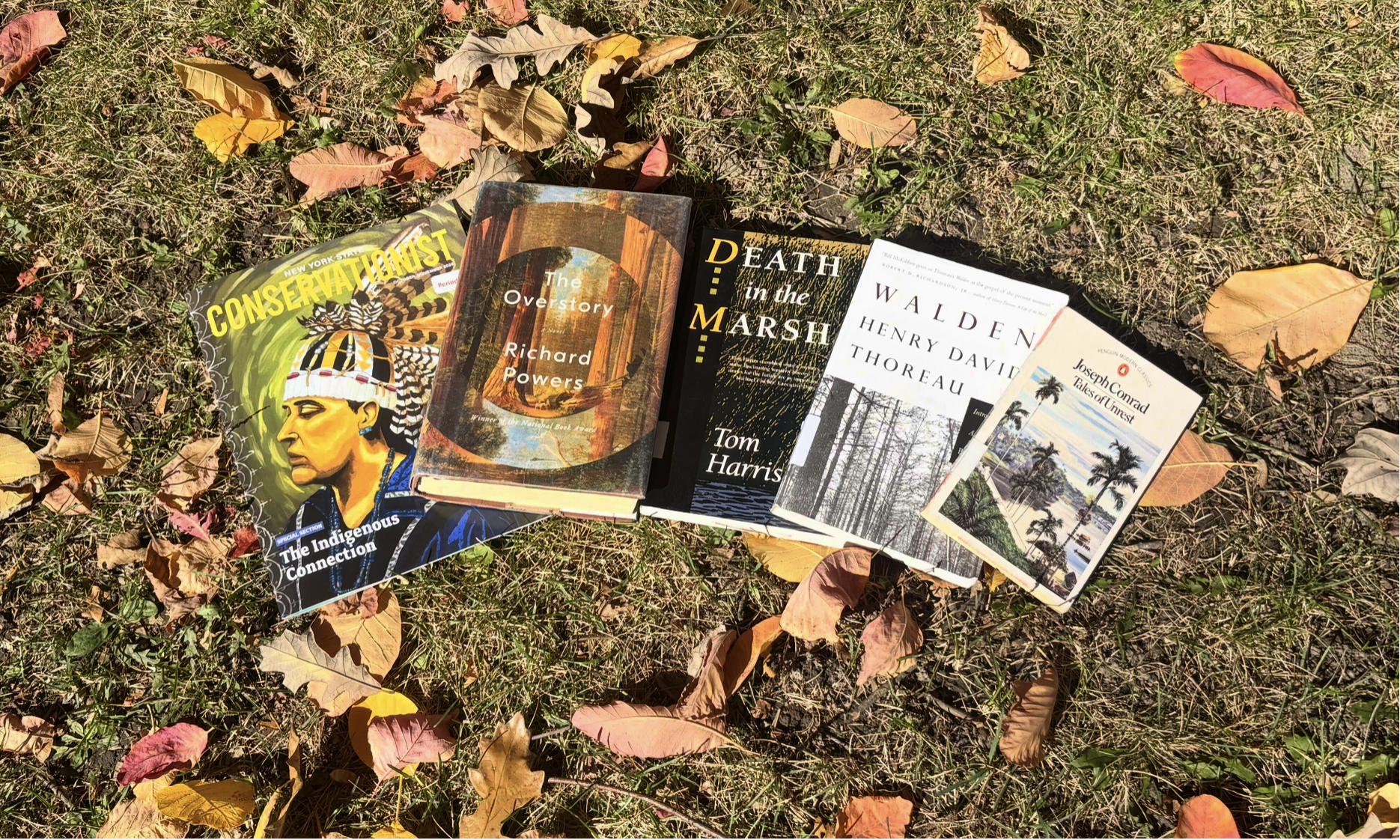
The relationship between people and our environment has been explored in countless books.
Kai Arrowood

Kai Arrowood
Planet Forward Correspondent | Middlebury College
October 20, 2026
Kai Arrowood
Planet Forward Correspondent | Middlebury College
“I also figured that ice had something to say, was another kind of speaker that regularly went unacknowledged; but if I am being honest, I knew next to nothing about how to listen to it.”
– Elizabeth Rush, “Glacial Longings.”
How humanity views its relationship with the natural world is complex. Even before the recognition of climate change, societies and cultures throughout history lacked consensus on key questions. Are we, humans, somehow above the environment? How exceptional are we? Are we trying to save the environment for its own sake, or are we trying to save it to save ourselves? Is it even harmful to admit that everything we do to fight climate change is, inherently, selfish and human-centered?
Climate scientists and activists, of course, constantly grapple with the issue of prioritization. But they are not the only ones dedicated to navigating these questions. As most primal human conflicts tend to seep into literature, so has the eternal debate around human exceptionalism. Contemporary environmental writers, alongside their peers in laboratories and field sites, have to identify their own moral codes. Because the medium of writing has such a power to persuade and inform, fiction is a fascinating battlefield for this controversy to play out. As the world determines potential solutions to ecological devastation, writers are determining what will make a reader empathize. Should environmental writing center the human experience, or should it center the environment?
Anthropocentrism’s simplest definition is human-centered ideology. The term is used across countless disciplines: anthropology, environmental philosophy, animal ethics, biology, religion. Each cultural and academic context in which anthropocentrism is mentioned changes its definition. There isn’t agreement on key facts – what a human is, where humans are centered, who places us at that center, and who is excluded from that center.
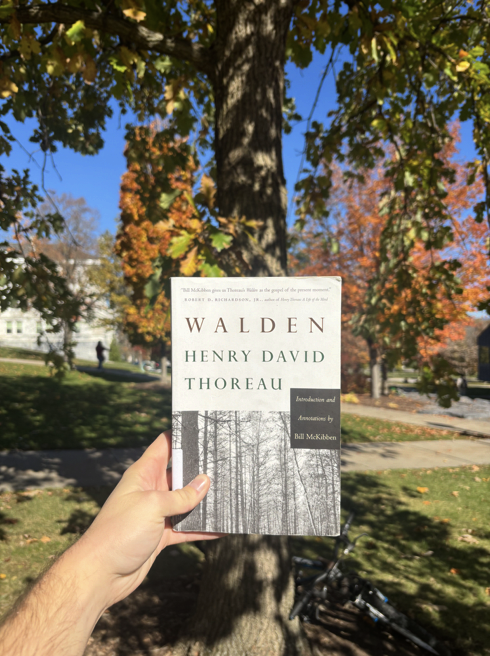
Despite the term’s mutability, anthropocentrism is often held responsible for the environmental crisis. If we, humans, place ourselves at the center of the world, of the sciences, of moral discussion, it creates a fatal egoism. There is, according to French philosopher François Julien, an “obvious ecological danger in the selfishness of a species as dominant as humans.” It is possible that anthropocentric thought is the reason we are in a climate crisis. Our incessant self-prioritization has made us far too willing to sacrifice everything “non-human.”
Anthropocentric writing similarly centers human experience. In doing so, many critics and theorists argue that environmental writing loses its potency because it immediately de-centers the environment and prioritizes human life in the hierarchy of the narrative.
Does focusing on the human cause environmental writing to lose sight of its mission? What is the mission of environmental writing? Through conversations with writers Nathaniel Rich and Megan Mayhew Bergman, who have published both fiction and nonfiction on the climate crisis, I tried to explore these questions.
Nathaniel Rich is an author and essayist, and has written several books, both fiction and nonfiction. His 2018 piece, “Losing Earth,” took up an entire issue of New York Times Magazine. Megan Mayhew Bergman has written several novels exploring the interactions of gender, climate, and human connection to the natural world. She has written climate journalism for the Guardian for nearly a decade. My conversations with the two of them expanded my understanding of the role of the writer and reader and the role of fiction in the fight against climate change.
Now more than ever, climate change is baked into human experience. It is an unavoidable fact of life amid extreme weather, disappearing coastlines, and increasing loss of biodiversity. In correlation with this surge in ecological destruction, there has been a surge in environmental writing.
In both fiction and nonfiction, environmental writing can follow a specific “formula,” according to Rich. Environmental fiction tends towards dystopia, a foreboding example of what would happen if we do not act. Environmental journalism and advocacy writing pushes the reader to act in a very specific way, identifying a problem, its solution, and a call to action.
“I think there’s an importance to that kind of formula. It’s important that we have great climate activism and thoughtful and creative climate activism. But I feel that that only reflects a small fraction of how we think about and worry about and perceive climate change,” Rich said.
For Rich, fiction is a space to explore the psychological intricacies of climate change in the human experience. Environmental narratives are starting to lean less towards masculine adventure and landscape domination – think Hemingway and Conrad – and more towards the complexities of daily life in an ecologically degrading world.
“What is the knowledge of (climate change) doing to us? You know, what does it mean to live?” Rich asked. “How does that infiltrate our lives? How does that change the way we think about the future, the way we think about our society, our values?”
For Mayhew-Bergman, fiction is a great mode of existential navigation.
“I think we’ve greatly underestimated the spiritual impact of environmental degradation and the toll of human guilt. And the stress that this is all gonna cause us, I think right now, that’s more easily modeled in a fictional universe,” she said.
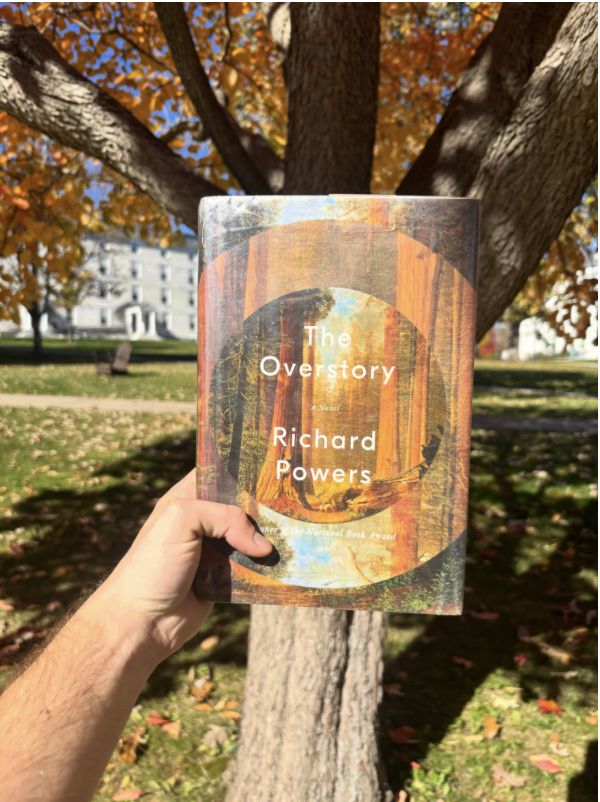
Novels like Charlotte McConaghy’s Migrations, Richard Powers’ The Overstory, and Charlotte Wood’s Stone Yard Devotional all follow human protagonists: a woman tracking the last flock of arctic terns, nine Americans connecting with trees, an ex-climate activist who joins a convent. Their exploration of ecological grief could be defined as anthropocentric – the human experience is the crux of its narrative. But existential environmental fiction exists alongside countless other genres. In Mayhew-Bergman’s career, she has written about both people and the natural world.
“I think nonfiction is a great way to get facts out into the world. And I think fiction is an excellent way to explore existential questions and hypotheticals,” she said.
These two creative impulses – to explore the realities of environmental change and the human response to it – don’t necessarily contradict each other. Humans are, after all, part of the environment. Both Mayhew Bergman and Rich explained that the human connection to the natural world is becoming increasingly fraught, but increasingly intimate. Addressing climate change through the eyes of a human is effective because it is impossible to identify where human suffering ends and ecological suffering begins.
“I think we fail to really perceive and accept the interconnectedness of life on the planet,” Mayhew-Bergman said.
Exploration of the human experience through environmental fiction, in this case, allows the writer to illustrate how deeply entwined we are with the natural world.
It is also important to note the near-impossibility of stepping outside of the realm of human perception. In Layna Droz’s article, “Anthropocentrism as the scapegoat of the environmental crisis: a review,” she emphasizes the limits of our empathetic range.
“We, as embodied human beings, perceive and make sense of the world from our perceptual human standpoint,” she writes. “We cannot avoid living, perceiving and thinking from within our human body and cognitive system.”
If we define writing as relaying through language our perception of the world, it is a difficult task to extract anthropocentric thinking from what we write.
Much of environmental writing is especially intended to inspire action, to transform the passivity of the reader into an active form of empathy. It is difficult to reach a reader using only data and facts about natural systems and the challenges they face. As social animals, humans often need something sapient to hold onto. We attach and project ourselves onto human characters, we see our own desires reflected in their goals, and relate to descriptive accounts of others’ experiences.
Mayhew-Bergman wrote an article in 2020 on the fight to save the endangered North Atlantic right whale. In 2019, she wrote another piece, about the Florida home insurance crisis. Of the two, the one centering human experience in Florida achieved a viral status, receiving countless reposts across environmental forums online, and was selected as an Editor’s Pick by the Guardian. Her story that centered on the North Atlantic right whale, although “well-received,” did not send out such shock waves.
“It was a staggering lesson in readership behavior or human behavior, which is, I think, that the average reader needs a human story to attach to or a perceived sense of consequence. I don’t want that to be true. I don’t think that’s exclusively true,” Mayhew Bergman said. “I think the average reader is often going to be more emotionally affected by the distraught scientist that works on an endangered species than the endangered species itself.”
Mayhew-Bergman’s observation places the environmental writer at a crossroads. Should they prioritize reaching a wider audience, or should they prioritize a story that has a smaller chance of attaining virality, simply because it is not tied as closely to the human experience? The realm of human experience is intertwined with the realm of non-human experience. Good environmental writing, of course, should speak to both. For Bergman, good fiction recognizes how climate change has been “metabolized” into human experience.
“For fiction, and environmental fiction, lazy environmental fiction tends to use climate change as a plot point, and informed environmental fiction understands the way it has been happening, and has applied pressure to places and people,” Bergman said.
For Rich, the realities of climate change are so prevalent to this era that any writing, “environmental” or no, should address it.
“I don’t think any novel that I read by any writer, a contemporary novel, that doesn’t convey some sense of the environmental crisis that we’re in or at least the sense of dread or weirdness, or the sense of a creeping decline, feels to me false in a way. I feel like that’s become the fabric of our reality. I feel like all writing is environmental writing, or vice versa,” he said.
Mayhew-Bergman and Rich have both taught, and are involved in writing communities like the Breadloaf Environmental Writers Conference. Their exposure to the changing landscape of environmental writing gave me a sense of what to expect from the coming decades.
“I think increasingly there are writers who are bringing some of these ideas into the substance of their writing in ways that I find are more accessible, the emotional and cultural ramifications of these problems,” Rich said.
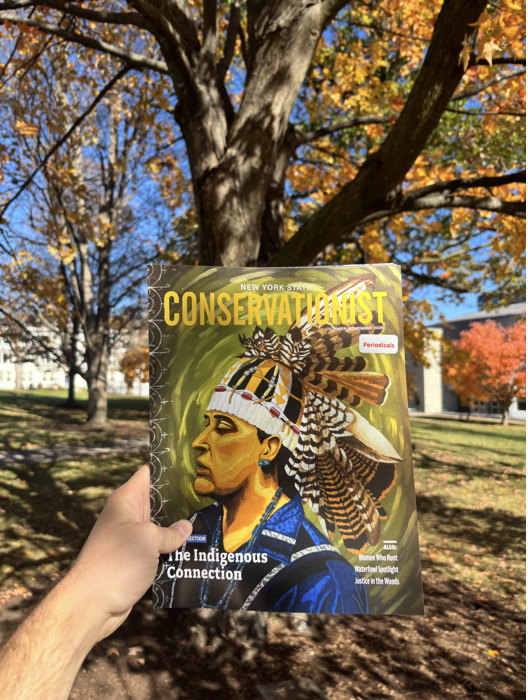
Writers are also becoming more diverse, bringing a wide array of human experience to their work. Gone are the days of Jack London, Henry David Thoreau, and Ernest Hemingway, where white men were the only ones given a platform to discuss the natural world. Increasingly, publications and readers are making space for the environmental perspectives of Indigenous communities, of people of color, of women, and of queer people.
“I think the nature movement, the environmental writing movement, for a long time looked one way and supported a pretty narrow type of writing. When I choose the faculty for the [Breadloaf] Environmental Writers Conference, you can kind of look back over the last eight years and see how it’s changed over how it was when it first started,” Mayhew-Bergman said.
Anthropocentric writing is expanding as the definition of human becomes more inclusive. Recognizing the diverse ways humans interact with and feel about the environment doesn’t always have to be a selfish glorification of the human experience.
This diverse and emotionally complex approach to the environment offers modern readers a new way of understanding climate change and their interconnectedness with it. If anthropocentric writing is unavoidable, it can be modified to create a beautiful and rich narrative that honors the nuances of human existence amid ecological devastation.
“I do think there is a real act of service in meeting people where they are and making it easier for more people to join a climate conversation, including those with whom we disagree,” Mayhew-Bergman said. “I think a lot of environmental writing has a sort of purity test to it that keeps people out. And I think we’re at the point where we can’t afford to keep anyone out.”

College of Charleston
A project of

in collaboration with