Lessons from local Detroiters on ending food apartheid
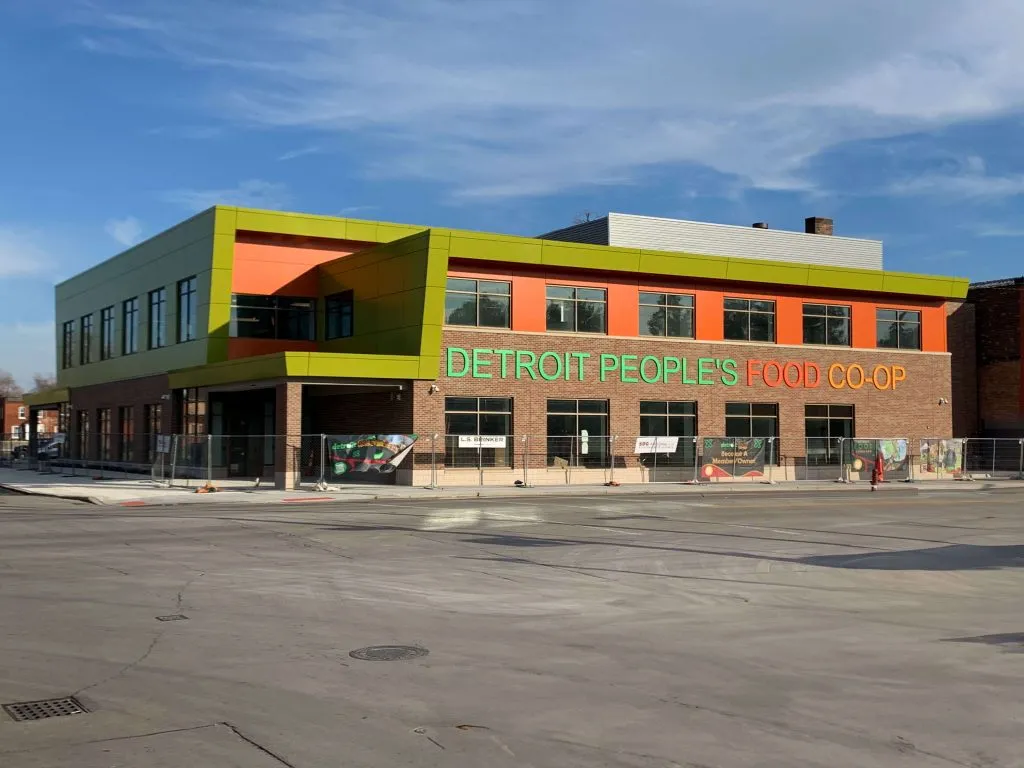
The Detroit People’s Food Co-Op is a grocery cooperative owned by the community aiming to provide improved access to healthy food and food education to Detroit residents.
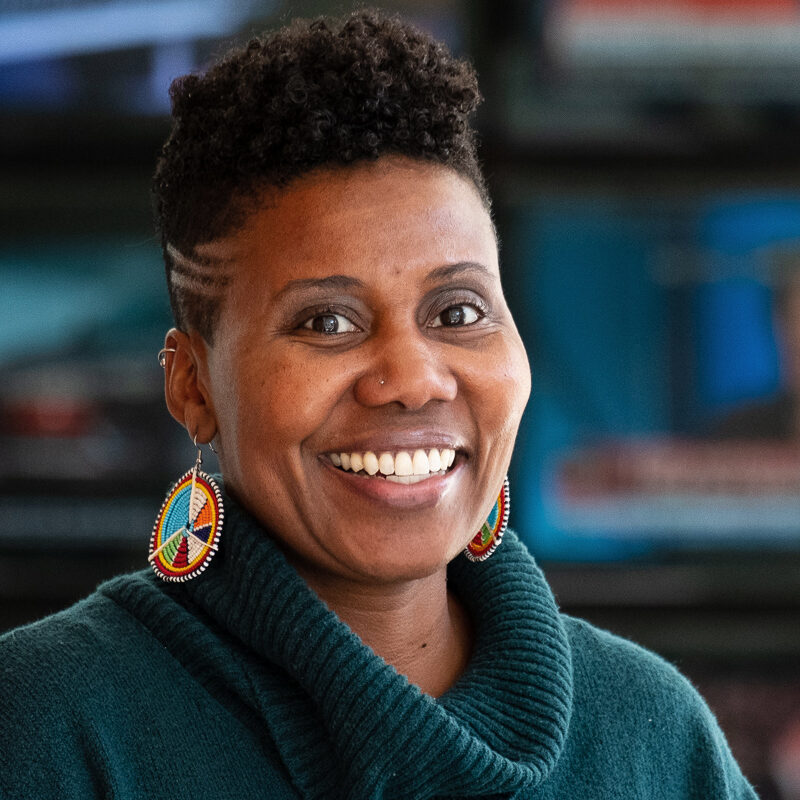
In the following conversation, Tyler, an environmental justice and food systems lecturer at the University of Michigan School for Environment and Sustainability, unpacks the flaws of our dominant food system. Despite mass production and inequitable control over food access, local communities are successfully fighting for food sovereignty and transforming Detroit away from a food apartheid and toward a sustainable system that centers on community over profit.
The interview below has been edited for length and clarity.
Ariza Nanji: What has your experience been as an organizerthese past two years?
Shakara Tyler: It’s been rough— mainly due to diminishing resources. It is also the relational harms that we commit against one another. It is really difficult in movement spaces where we want to be on the same team, but it’s hard to feel like we’re on the same team because there’s a lot of conflict and a lot of psychological, sometimes physical violence, directed toward one another.
AN: Which resources are diminishing?
ST: Grant dollars are on the decline due to HR1 and other fascist proposals to sequester resources from movement spaces in retaliation to the work that has been done. There’s just less cash flow. Less revenue or money is moving through movement spaces, which is very strategic for the fascist agenda. I would also say other resources, like infrastructure. Resource mobilization goes beyond financial capital. The amount of infrastructure that we transfer to community organizations or individuals that were doing radical justice initiatives is happening less.
AN: Over the last few years, a growing number of urban farms and gardens have sprouted across Detroit. What’s driving the growth of these urban farms?
ST: The growth is happening because people are doing the work with or without resources. This is what we call community self-determination, where we will unapologetically do what has to be done with the resources that we have, in service to the visions that we know to be true.
AN: Who are the communities in Detroit that are leading these initiatives?
ST: When I speak of communities, I’m speaking of grassroots communities. The composition of these communities is very diverse. Detroit is a majority Black city, so there are lots of Black folks within these communities that I’m speaking of. It is class-diverse. It is led by women. It’s also diverse in terms of abilities. There’s a really beautiful mosaic of people in these communities representing many aspects of human living.
AN: What about food allows for this diversity?
ST: My lived experience has taught me how food is what some people call the great equalizer. Food brings everyone together, almost down to the same level, because everyone has to eat. Because of the isolation that we’ve come to know over the past few decades, because of how capitalism and other systems of oppression have restructured the world, many of us want to be with other people enjoying good food. Whether it’s like potlucks or collard green cook-offs or harvest parties in gardens, I’ve seen how food has been this intimacy builder among people from many, many, many different walks of life or from many different backgrounds where we can come together in one space and share food, and then share stories that come with the food and then perhaps share skills. So many, many, many things come from just sharing meals together, because relationships can be built when food is at the foundation of a shared space.
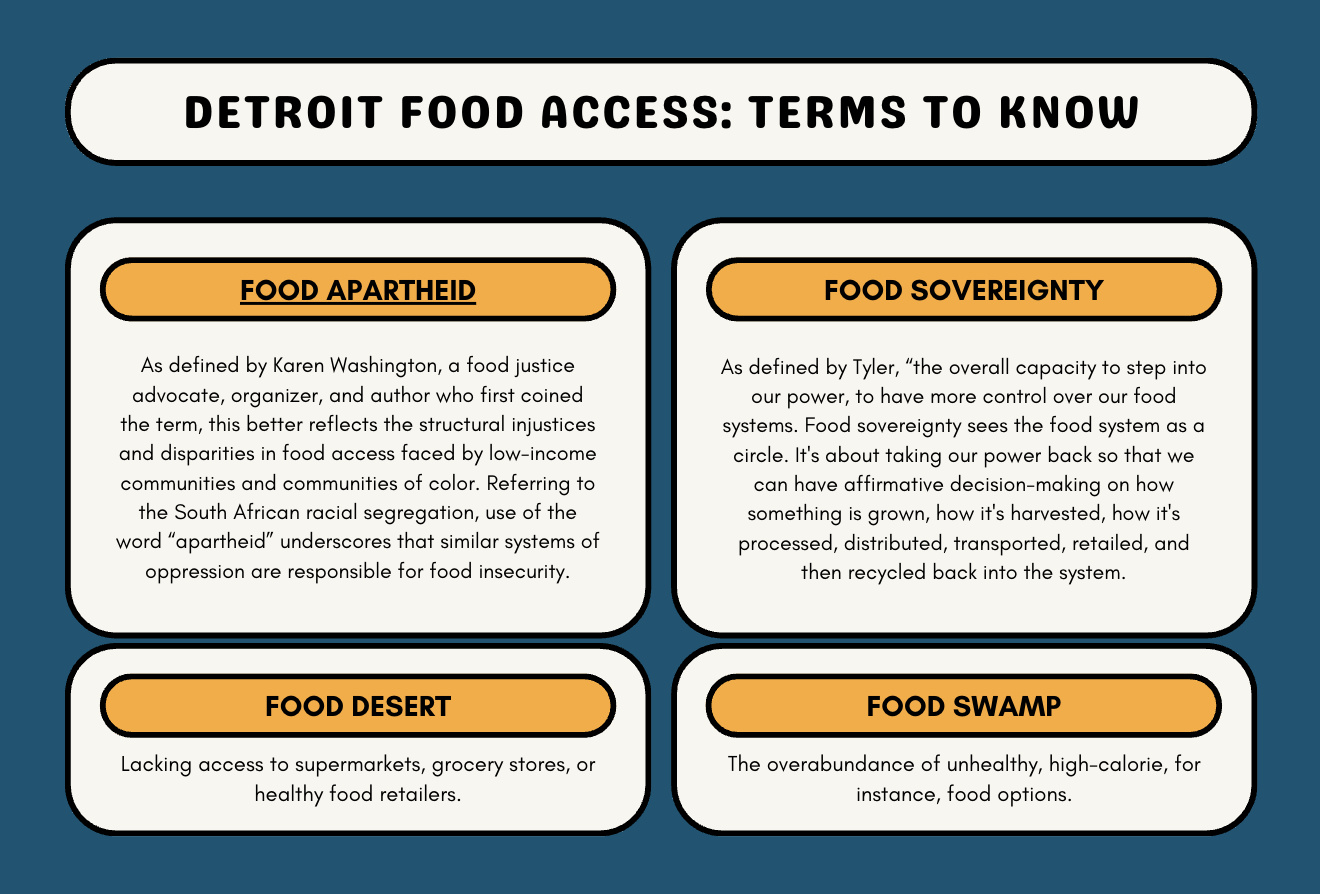
AN: The city of Detroit has often been referred to as a food swamp and a food desert. What do these terms mean in the context of Detroit?
ST: The grassroots community that I identify with doesn’t consider it to be either one of those. Food deserts and food swamps just assume that places like Detroit just so happen to be with no fresh food options in the city. There were active, strategic political decisions made that created the conditions for the Farmer Jack grocery store to be the last grocery store in the city of Detroit. Now, of course, we have other grocery stores in the city, many, many years later. But it’s still an example of food apartheid, because Whole Foods and other small grocery stores- if the quality is right, the price is not. If the price is right, the quality is not. In Detroit, we say food apartheid because there’s been the redlining phenomenon that has been strategically orchestrated according to maps and geopolitical locations where food access points are located beyond the specific communities that will benefit from them in the majority of terms.
AN: How has the community responded to the lack of food access points:
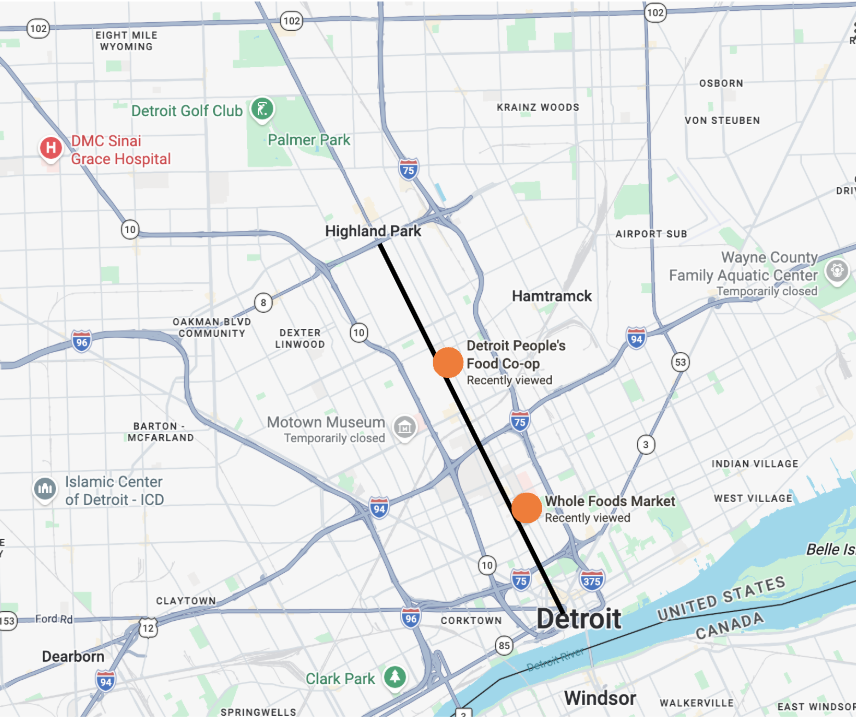
ST: The Detroit People’s Food Co-Op, which is now located in the Detroit Food Commons, on the corner of Wilbert and Euclid, has been a needed response to the food apartheid, because the north end part of the city is what, by the USA definition, is a food desert. There are no high-quality grocery stores in that area, and so the Detroit People’s Food Co-Op is the one high-quality, fresh, affordable, culturally relevant food source for many people.
Detroit People’s Food Co-Op and Whole Foods are the two prime grocery stores located on Woodward Avenue, the main street of the city. (Ariza Nanji/Google Maps Image)
AN: Why are these labels of food swamp or food desert used?
ST: The terms are academically generated, and so they come from a very external viewpoint that overly analyzes these communities for their academic research or for corporate industry profit. I do believe that these terms are used because they sound good in academic journals, and they also depict, within a capitalist framework, the reality as they see it. Those that have the power, arguably, use the food desert and food swamp terms as a way for them to keep the power.
AN: Why does scale matter for equitable access to healthy food?
ST: When you have a relationship based on trust and transparency with local farmers, and, you know, you can ask questions about the operation, that eliminates a lot of guesswork that industrial supply chains often have because the scale is so enormous. We’re not operating at 500 lettuce heads per week, so we are in the advantageous position to have the relationship to be able to go at a slower pace and a more transparent pace. When you have a relationship, when the retailer and grower have a relationship, the overall ecosystem is stronger.
AN: What does the Detroit food system look like for a consumer?
ST: Local food access in Detroit, depending on who you are and where you are in the city, it’s going to look very different. It all depends on your means: transportation, work schedules and other circumstances. I can’t really generalize across all Detroiters. Overall, access for communities I work with in Detroit revolves around cooperation, care and culture, where you don’t always have to go to a store to get access to a healthy meal. There are mutual aid networks in place to get people what they need that are all based on authentic relationships within organizations and across organizations. Not to say that it’s perfect. There are many gaps, but we are knowledgeable of those gaps, and we’re actively working to fill them, which is what matters. We aspire to have everyone seen and held and heard and cared for. And all of that is based on the important work of relationship building.
AN: What five things can we learn from food justice organizers?
ST: The relationship matters most. It’s the people over profits methodology that’s really important.
Going at the speed of trust is important.
Leaning very heavily into ancestral value systems.
When you arrive at a topic and/or a space or a community, do the background work, do the historical research around what has already been done, who the key players are that have done it, and what questions did they leave behind.
Deep listening.
Staying in deep relationship with the community after the quote-unquote project has ended.
This website uses cookies to provide you with an improved and personalized experience. By using this site you agree to our use of cookies. Please read our cookies policy for more information on the cookies we use and how to delete or block them.


 All Topics