New Zealand scientists hope to revolutionize geothermal energy from greater depths
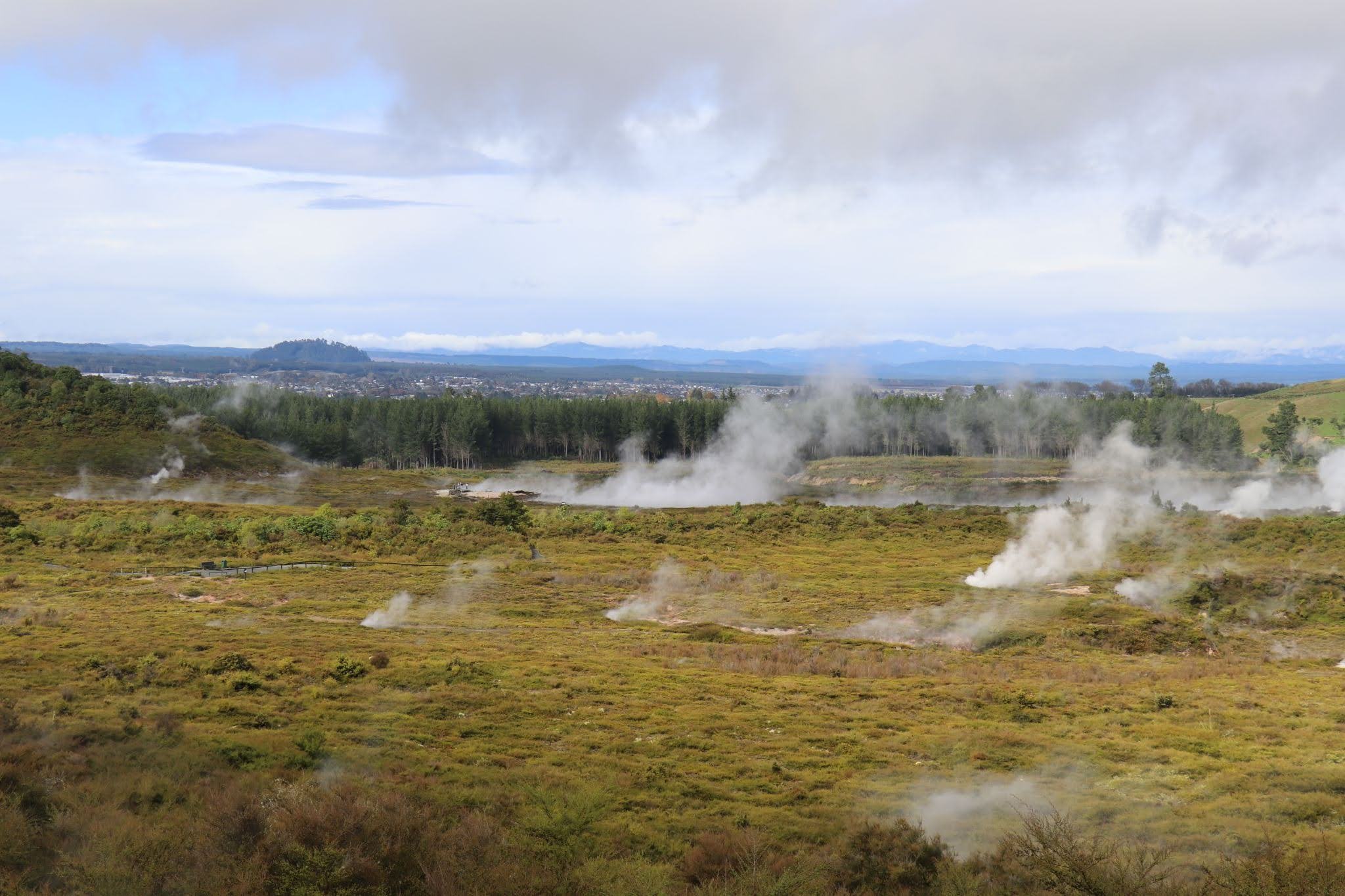
Craters of the Moon Geothermal Walk, located north of Taupō, has evolved over 700 years. The name is inspired by the impact of the Wairakei geothermal power station, which increased geothermal activity and pressure in the area, leading to the formation of new craters and steam vents.
In the volcanic heart of New Zealand’s North Island, steam billows through open fields and curls above the cratered earth. Bubbling kilometers beneath the surface, an energy powerhouse has long remained out of reach, trapped under crushing pressure and extreme heat.
This power source, known as superhot or supercritical geothermal, could revolutionize the world’s clean energy transition, and New Zealand is rushing to tap it by early 2027.
New Zealand has long stood at the forefront of geothermal development. Home to the world’s second geothermal power station and among the few nations where traditional geothermal supplies a significant share of national electricity, the country has spent decades harnessing heat from volcanic systems.
Now, a nationwide initiative is pushing geothermal exploration into uncharted territory, unlocking the potential to triple the country’s geothermal energy. If successful, New Zealand could become one of the first countries to commercially harness supercritical geothermal energy and serve as a global leader in next-generation geothermal development.
Geothermal comprises only a fraction of the world’s total energy supply, constrained by geography, high costs and technological barriers to deeper drilling. Nations are racing to develop clean energy alternatives to fossil fuels and cultivate home-grown energy independence, catapulting New Zealand’s supercritical exploration to international importance.
History of geothermal energy in New Zealand
Geothermal energy is produced from reservoirs of hot, pressurized water under the Earth’s crust. To obtain geothermal energy, wells are drilled into these reserves, pumping hot water to the surface. The water is depressurized as it travels upwards and converted to steam, which is then used to produce energy at a power plant by spinning a turbine to run a generator. Leftover water is injected back into the Earth and excess steam is released from a cooling tower. This method creates a closed-loop system where the same water is used repeatedly to extract heat. In extraction wells, excess water is discharged into nearby bodies of water, drainage ditches or discharge wells.
The process harnesses natural heat from the Earth’s core to produce clean, constant energy. This heat is generated nonstop, so geothermal energy is not dependent on weather, season or time of day, unlike renewables such as solar and wind.
Optimal locations for geothermal energy production are where these hot water reservoirs are easiest to access, generally where water is close to the surface and the Earth’s crust is permeable. Cracked, porous rock allows water to flow most easily underground. Volcanic areas and those with tectonic plate boundaries tend to have the best conditions for accessing this energy.
In addition to New Zealand, the United States, Indonesia, the Philippines, Iceland, Türkiye, Kenya, Japan and Mexico regularly produce geothermal energy. The U.S. produces the highest quantity of geothermal in the world, at 3.7 megawatts as of March 2026, according to Global Energy Monitor’s Global Geothermal Power Tracker.
Yet geothermal energy accounts for less than 1% of the world’s energy output, and its production is concentrated in a small number of countries.
New Zealand has historically served as a trailblazer, with the indigenous Māori communities first recognizing the value of geothermal, or waiwhatu, resources centuries ago. Many Māori consider geothermal lands to have spiritual significance and rely on them for their healing properties, cooking and bathing.
Mana Newton, group chief executive of the Tauhara North No. 2 Trust — a Māori land trust which manages land on behalf of the Ngāti Tahu–Ngāti Whaoa iwi tribal group — said their origin story centers on geothermal features.
“Geothermal is extremely important to us,” Newton said. “It is a huge part of our mana motuhake journey, a huge part of our reconnection journey.”
In their tradition, ancestor Tahu Matua traveled from a hot area to Aotearoa, New Zealand on the back of a waka, or canoe, named Manu-nui-a-Rangi. Tahu Matua settled at Orakei Korako by the Waikato River in the North Island, where his descendants established the iwi. Upon his arrival, he sought heat underground. As a result, his descendants are deeply connected to geothermal landscapes and activity, regarding them as taonga, or treasures.
Newton said his people have lived on and been supported by geothermal since Tahu Matua’s arrival in A.D. 1250. When European colonizers arrived in the late 1800s, they exploited Māori land ownership and valuable geothermal resources through various government decrees.
The Wairākei Power Station, launched in 1958 in the Taupō Volcanic Zone of New Zealand’s North Island, is the world’s second geothermal power station. The initiative gained traction, in part, out of a desire for energy independence brought about by World War II. Today, the Wairākei Power Station continues to operate as one of 17 geothermal power plants in the country. Approximately 20% of New Zealand’s total electricity demand is met by geothermal, according to Earth Sciences New Zealand (ESNZ).
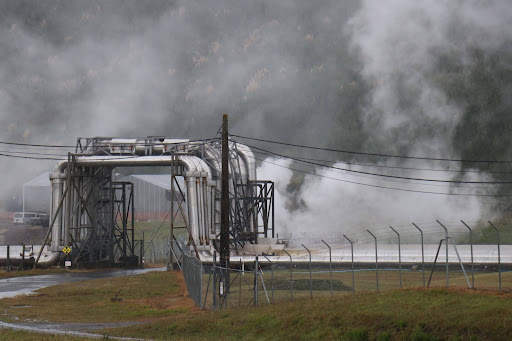
The geothermal steam field at Wairākei Power Station spans roughly 25 kilometers, with wells averaging 600 meters in depth. According to the New Zealand Geothermal Association, over 290 wells have been drilled in the field, with 73 currently producing and 19 injection wells in operation. (Photo by Emma Henry)
Contact Energy, a private company, and Mercury, a company owned in part by the New Zealand government, operate many of the geothermal power stations in the country. Tauhara North No. 2 Trust purchased its own geothermal power station in 1997 and continues to operate several power stations in the Taupō region in partnership with Mercury.
“For us in particular, the things that are important to us are our ability to have sovereignty over our energy, sovereignty over our food, sovereignty over our lands and resources — not so that we can be selfish with resources and just keep [them] for ourselves, but ultimately so that we can reinvest into our people,” Newton said.
Reaching supercritical energy
Opportunities to explore geothermal power are increasingly viewed as a bedrock of New Zealand’s renewable energy future. New Zealand’s progress ushered in a new wave of investment in advanced geothermal projects.
While research into the country’s geothermal ambitions has been underway since the 2010s, the effort accelerated in 2024 when the government announced plans to fund exploratory drilling for supercritical geothermal energy in the Taupō Volcanic Zone.
Unlike conventional geothermal systems, which rely on steam and hot water located closer to the surface, supercritical geothermal energy targets reservoirs buried 4 to 6 kilometers underground. Reaching these fluids requires drilling projects capable of withstanding extreme temperatures exceeding 700 degrees Fahrenheit and pressures around 3,200 pounds per square inch.
Under these conditions, water enters a supercritical state, behaving simultaneously like a liquid and a gas. According to Geothermal: The Next Generation — a project funded by New Zealand’s Ministry of Business, Innovation and Employment — these supercritical geothermal fluids could provide approximately three times the energy produced by conventional geothermal systems.
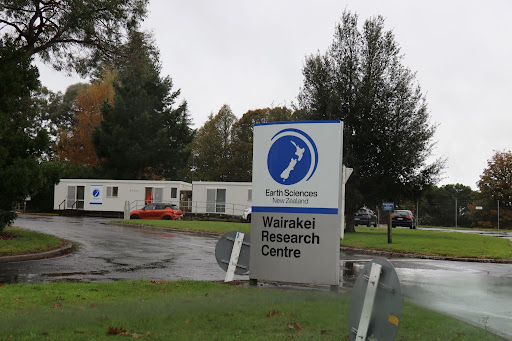
The ESNZ office near the Wairakei geothermal power plant on New Zealand’s North Island. ESNZ is a public research institute committed to fostering sustainable solutions to climate change. (Photo by Megan Fahrney)
Iceland remains the only other country to attempt access to supercritical geothermal systems through the Iceland Deep Drilling Project. While it was the world’s first major attempt to access supercritical geothermal resources through ultra-deep drilling, the operation was terminated in 2009 when engineers unexpectedly struck magma at a depth of about 2.1 kilometers.
During a second phase, completed in 2017, engineers successfully drilled to nearly 4.7 kilometers and reached temperatures above 800 degrees Fahrenheit under supercritical conditions. Researchers described the project as the first confirmed drilling operation to penetrate an active supercritical geothermal reservoir.
To move supercritical geothermal from theory to commercial reality, projects titled “GeoShot NZ” and “DeepHeat” are addressing two pressing challenges: engineering technology for ultra-deep drilling and scientific understanding of supercritical fluids and sustainability.
“So the opportunity for Mercury, and I guess the rest of the industry, is to really understand how we might best use the resource,” Robert Rankin, senior project manager at Mercury and project director of the technical design team for GeoShot NZ, said. “We know that there’s heat down there. We know the heat is shallow in the…Taupō volcanic zone. So that is a real strategic advantage to New Zealand. What we don’t understand is how to best harness that resource.”
New Zealand absorbed the projects’ goals into the country’s national geothermal strategy, including an ambition to double the country’s geothermal energy use by 2040. If successful, New Zealand could become the first country in the world to commercially tap supercritical geothermal power.
GeoShot NZ: Solving the drilling challenge
Previously known as the New Zealand Supercritical Geothermal Project, the government rebranded GeoShot NZ to accelerate exploration of next-generation geothermal energy. The government-backed project is designed to test whether the country can access supercritical geothermal energy.
Isabelle Chambefort, a geologist and general manager of energy at ESNZ, serves as the science advisor for GeoShot NZ and the principal scientist and research program leader for DeepHeat and the former Geothermal: The Next Generation project.
“For the first time, we’re seeing a true national collaboration on an exploration project,” Chambefort said. “It’s very exciting.”
GeoShot NZ is structured around three primary teams: governance, technical design and an independent international review panel. The governance group includes government representatives, Māori leadership, university researchers and energy industry stakeholders.
“There’s a lot of interest in the project; there’s a huge amount of passion because it’s so new and interesting. Because we’ve never gone there before,” Rankin said.
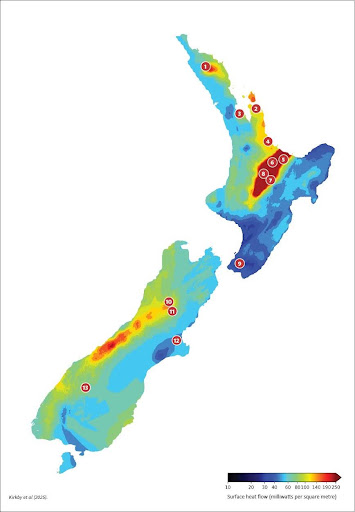
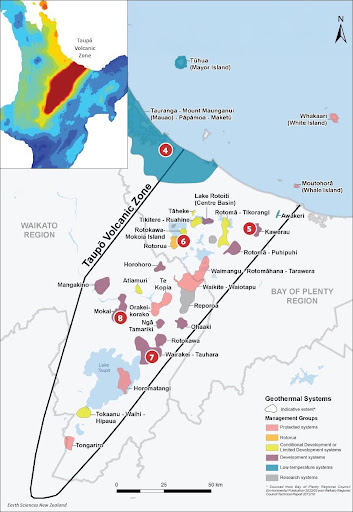
Figure 1 (left): Heat map of New Zealand displays surface heat flow measured in milliwatts per square meter. Known geothermal hotspots appear in red. (Credit: Kirby et al. and Earth Sciences New Zealand) Figure 2 (right): Map of the Taupō Volcanic Zone, with the relevant section of the heat map inset in the top left of the image. Rotokawa can be found above #7, or the Wairakei zone. (Credit: Earth Sciences New Zealand)
The project’s first planned drilling and well site is at the Rotokawa geothermal field near Taupō, operated by Mercury NZ in partnership with Tauhara North No.2 Trust and ESNZ. Of the NZ$60 million allocated through the Regional Infrastructure Fund for next-generation geothermal development, approximately NZ$5 million has been earmarked to initiate drilling at the site.
According to Kānoa, large sources of geothermal heat exist at shallower depths in the Taupō Volcanic Zone. The Rotokawa geothermal field also offers strategic advantages, benefiting from “decades of operational data, advanced geophysical imaging and robust infrastructure.” Scientists and board members hope to begin drilling within the next year, with hopes of drilling two additional wells if the first is successful.
DeepHeat: Mapping the science of supercritical energy
Alongside exploratory drilling, ESNZ launched DeepHeat, a research program that backs science with the potential to benefit New Zealand’s economy, environment and society. The program brings together researchers from Victoria University of Wellington and the University of Auckland, alongside international partners from the U.S., Switzerland, Japan and Iceland.
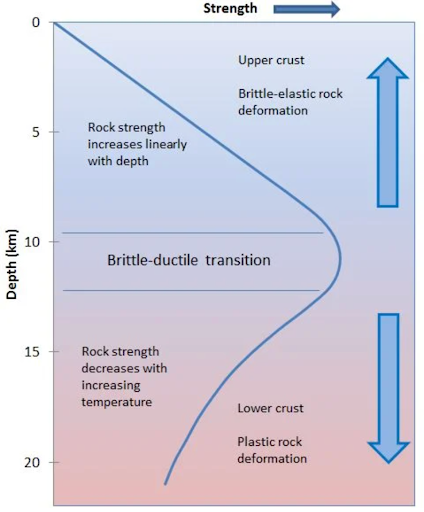
Figure 3: Brittle-ductile transition and rock strength with depth. In geothermal areas, the BDT is found closer to 5 kilometers. (Courtesy of Michael Blackam, “Geomechanics and Environmental Effects of Hydraulic Fracturing,” 2015)
Much of the project centers on understanding how supercritical fluids move through the Earth at depths that remain largely unexplored. Researchers aim to build detailed reservoir models and evaluate how wellbores, or the drill holes used to access geothermal resources, might perform under extreme heat and pressure.
Finn Illsey-Kemp, a geophysicist at Victoria University of Wellington and associate investigator for DeepHeat, hopes to create a 3D map of the brittle-ductile transition zone (BDT). This is where rock shifts from cracking under pressure to slowly bending and changing shape.
“It’s like the difference between bending a Mars bar out of the fridge compared to one that’s been in your pocket,” Illsey-Kemp said.
In most parts of the world, the BDT lies roughly 10 or more kilometers below the surface. In geothermal regions, the BDT can rise to depths between 2 to 5 kilometers. Supercritical drilling hopes to hit the sweet spot in the Earth’s crust, which requires drilling near the BDT.
Drilling too far above the BDT increases the risk of fractures and human-caused earthquakes. Too far below it, rock can slowly deform and close drillholes. Building 3D models could help map the underground geothermal reservoir at Rotokawa in greater detail.
“The amount of excitement around this project, with both programs going at the same time and having a shared purpose, I think it’s going to be really fun to be a part of,” Illsey-Kemp said.
Supercritical benefits and drawbacks
As governments and energy companies invest more heavily in next-generation geothermal projects, attention is turning to the advantages and risks of accessing supercritical resources. As one of the world’s first large-scale efforts to explore these systems for commercial use, the long-term impact of these technologies remains largely theoretical.
Supporters argue that the technology could dramatically expand the amount of power generated from a single well, potentially producing up to 10 times the amount generated from traditional geothermal wells. In volcanic regions like New Zealand and Iceland, the resource could provide large amounts of energy with a relatively small land footprint.
Across the globe, expanded use of supercritical geothermal energy could also strengthen domestic energy supplies and reduce reliance on imported fuels. This is especially attractive as global electricity demand rises and governments seek more resilient energy systems.
According to Chambefort, supercritical geothermal projects are likely to be entirely carbon neutral, with heat as the only true extraction. Water drawn from geothermal reservoirs will be reused in a closed-loop system. While Illsey-Kemp noted that extracted fluids can contain naturally occurring contaminants like heavy metals, the reinjection process is designed to prevent pollutants from leaching into surrounding waterways.
As with any pioneering scientific endeavor, the projects also carry uncertainty and risk. But Chambefort added that New Zealand’s decades of geothermal experience provide a strong foundation and instills confidence.
For Rankin, one of the greatest unknowns remains whether drilling operations can successfully reach supercritical depths.
“The success of getting to those depths will be the hardest to achieve,” Rankin said. “But from an environmental and health and safety perspective, we’ve got the technology to manage the project safely.”
Other concerns include surface disruptions and high upfront costs. Illsey-Kemp cited disturbances from the launch of the Wairakei Power Station, which increased geothermal activity, leading to the creation of new steam vents and craters in existing geothermal fields. Today, the disruptions can be seen at Craters of the Moon Geothermal Walk north of Taupō. However, Illsey-Kemp said these disturbances are now understood and likely to be avoided.
Combined costs for GeoShot NZ and DeepHeat are over NZ$70 million (around $40 million USD) in public funding. According to the U.S. Department of Energy, geothermal systems can become highly cost-effective over time because they produce reliable electricity nearly 90% of the time, though the exploration and drilling phases remain expensive and technically demanding.
Despite the uncertainties, researchers say the potential payoff could be transformative.
“I think it could be a really important research project,” Illsey-Kemp said. “If we’re able to show that it’s feasible to develop these systems, then it could herald new development for this kind of work.”
International implications
International partners that have an interest in their countries’ own geothermal development are closely collaborating on the projects. Scientists from Iceland, the U.S. and Japan are contributing to projects in New Zealand as well as conducting their own research initiatives as members of an international collaboration program.
“All of these countries are testing in different environments with different techniques, but we’re all sharing some of the challenges that we have and we’re all sharing some of the findings to try as well to really accelerate it,” Chambefort said.
Former NZ ambassador to the U.S., Hon. Tim Groser, now chair of the project’s governance group, said there is intense interest in the projects by those who are aware of them, but U.S. awareness is low.
“If we can succeed, then the highly prospective areas of the United States where you get similarly very high temperatures at relatively shallow depths suddenly will come into play,” Groser said. “So it’s of major importance to the energy transition in the United States.”
The funding New Zealand’s government invested in the projects offered a unique opportunity for stakeholders and partners to benefit from the findings without taking on outsized risk.
Mercury, the company partly-owned by the New Zealand government, is a very interested observer of both projects’ findings, according to Rankin.
“Effectively, that’s the key role of government,” Rankin said. “It’s a little too high-risk for an operator to take on board, so it’s a real visionary project from the New Zealand government to de-risk understanding what this project could look like.”
Growing urgency
In the face of increasing energy demands, New Zealand’s Ministry for the Environment instituted a plan to achieve net-zero emissions by 2050. Increasing geothermal capacity could be key to reaching this target. New Zealand currently relies on fossil fuels for a constant energy supply, which other types of renewables cannot provide.
“We still need to use imported coal to provide baseload…The wind doesn’t blow all the time. The sun doesn’t shine, and the rain doesn’t always fall,” Groser said.
The need to transition away from fossil fuels to mitigate the impacts of global climate change is growing more urgent.
New Zealand’s initiative comes at a time when energy independence constitutes a topic of increasing importance to national security. The blockage of oil shipments through the Strait of Hormuz due to the conflict in Iran sent oil and gas prices soaring.
Globally, energy demands are also rising. AI data centers are being built at high rates and require enormous amounts of power. The International Energy Agency projects global energy consumption from data centers will increase 15% per year from 2024 to 2030.
At the 2023 United Nations climate conference, COP28, 133 nations pledged to triple their renewable energy production by 2030 to limit warming to 1.5 degrees Celsius above pre-industrial levels. However, the likelihood of the planet exceeding that threshold has significantly increased, heightening the urgency of commercializing fossil fuel alternatives.
Newton said his community is interested in geothermal as a sustainable energy alternative to fossil fuels.
“For us, the more time, energy and effort that we put into geothermal and understanding how we can have a closed-loop system within a nature setting [that is] man-enhanced but nature-driven, … then that’s an alternative to fuel, that’s an alternative to coal,” Newton said.
Some have dubbed New Zealand’s initiatives a “moonshot” program for its groundbreaking attempts to tap into a predominantly untouched resource. Groser said the country’s innovative geothermal strategy contributes to the larger national initiative to phase out fossil fuels in the next 25 years.
“It’s very clear to me and my colleagues that we are at a moment in history where there’s the beginning of a global reset about attitudes to geothermal power,” Groser said. “For our human race that is capable of sending a person to the moon, if we can’t crack this problem, to me that would be absurd.”
This website uses cookies to provide you with an improved and personalized experience. By using this site you agree to our use of cookies. Please read our cookies policy for more information on the cookies we use and how to delete or block them.



 All Topics