 All Topics






LaCher Bobbie Pacheco and her students enjoy a citrus tea party.
Courtesy of Maria Celis

LaCher Bobbie Pacheco
University of Arizona, Carson Scholar
January 21, 2026
Courtesy of Maria Celis
University of Arizona, Carson Scholar
Imagine failing at your dream job due to lack of materials to teach!
Shortly after graduating from the University of New Mexico with a degree in American Indian Education, I applied for a teaching job in my Pueblo community. In 2017, I was hired as the edible foods garden teacher for grades kindergarten to eighth grade. The garden class was considered an elective to help revitalize healthy eating habits for students.
The school administration was hoping I would collaborate with language teachers and community elders to support language development. I was invited to work with language teachers to develop gardening lessons, but the school was remodeling its garden space. I asked the district for support, but it lacked a school curriculum for the subject.
During my prep hours, I searched for Indigenous gardening practices, but none were published. Without much luck, I was forced to research lesson plans using the Reggio Emilia Approach, built on the idea that the environment is the third teacher, and the Waldorf education model, which supports the idea that children learn through integrated approaches like connection to nature and creativity.
Even with these frameworks, planning for 16 classes was nearly impossible. Every day, I felt like I was failing my students by not knowing how to teach them about gardening. It was easier for us to go on nature walks and engage in discussions while we harvested native plants until we encountered reptiles and inclement weather. The school days were filled with transitions and attendance tracking, and limited teaching.
I was distressed to the point of resigning. Instead, I applied to a Ph.D. program at the University of Arizona focused on Children’s and Young Adult Literature in a Diverse World.
Under the guidance of my dissertation chair, Kathy Short, Ph.D., I began studying picturebooks by American Indian and Indigenous authors. My research focuses on themes of settler colonialism, ecology, and climate anxiety, and I became especially interested in Traditional Ecological Knowledge (TEK) and environmental justice.
As part of my course requirements, I had to enroll in the University of Arizona’s School Garden Workshop. I learned about community and school gardens. The workshop centered on the SGW Almanacs, funded by the Sprouts Healthy Communities Foundation. The almanacs are a free resource for teachers, students, and the community, and they serve as the textbook for the SGW class. My focus was on learning how to create and design curricula. Maria Celis became my mentor.

While working as a student intern for two schools, I worked with Maria to introduce gardening to fourth graders and middle schoolers. While working in the agrivoltaic garden, a fourth-grade student showed me how to measure seed holes using my finger after I noticed students sticking their fingers in the soil then adding a couple of lettuce seeds then covering the hole with a quick sweep.
I was reminded of my youth. When I was a child, I learned how to plant vegetables by watching my parents. The fourth graders were very welcoming and I felt connected to the garden and place.
In time, my grandma’s favorite succulent found me. Purslane is a superfood that grows abundantly in the middle school garden. It has a lemon-like flavor and pairs well with eggs or salads. Some middle schoolers are from Mexico, and purslane reminds them of home and family. We would harvest the leaves and eat them together. Purslane is a gift which invites elementary and middle school students to share about foods and recipes from their communities. We host tea parties and share in celebrating our garden and harvests. A smile is always present when I find the superfood in the garden beds. The taste reminds me of home.
Fostering relationships with plants and students helped me feel connected to my Pueblo community. In my Pueblo, we would harvest vegetables with others and eat our gifts in gratitude. Maria and her husband often bring their outside grill to cook eggs and sauté vegetables.
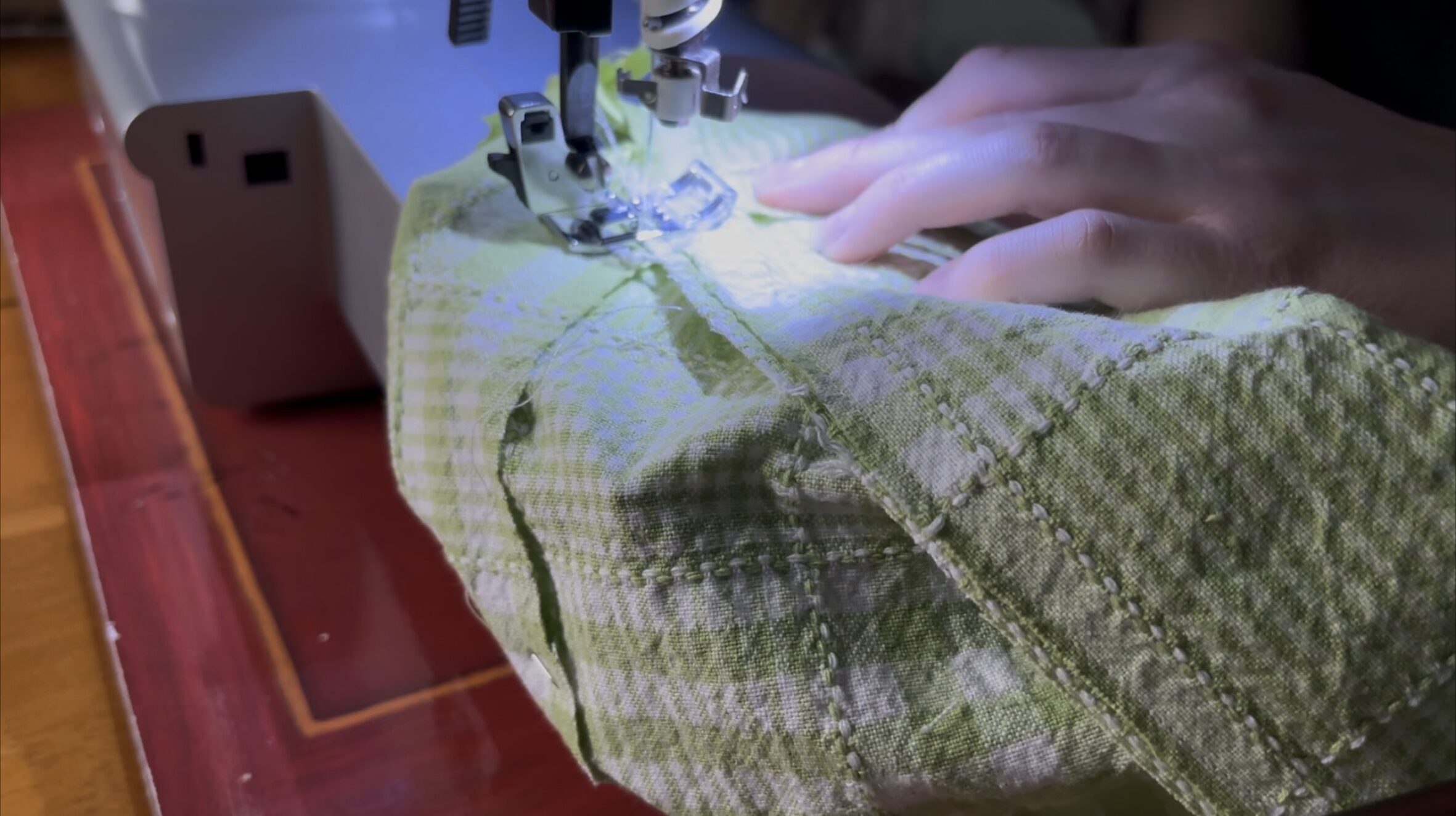
Together with students, we plant vegetables, care for each seedling, and then we harvest them. After gardening, we transition into creating art in the garden. Sometimes we weave textiles or pinch clay into tea cups and soup bowls.
During my favorite Maria lesson, we made pinch pot cups and bowls for our annual citrus tea and stone soup lesson. Afterwards, we molded soil blocks for planting and practicing math.
The garden activities supported my graduate assistantship work in Indigenous Food, Energy and Water Systems (Native FEWS).
While working as a student intern for the School to Garden Workshop, I began communicating with the Service to All my Relations (STAR) Charter School in Flagstaff, Ariz., close to the Navajo (Diné) Nation border.
In January 2025, Maria and I hosted a textile and dyeing workshop to introduce the SGW Almanac to STAR School’s principal, Jeannie Gross, and two Native FEWS educators. We asked Principal Gross if we could design an Almanac for her region, but said she would have to meet with the board before accepting our request.

Almost a year later, in July 2025, STAR School invited the SGW team to its campus to explain the Almanac design process to administrators, board members, and community collaborators. We worked together to adapt it to the Colorado Plateau Region, starting in Leupp, Ariz., where STAR School is located. We began working on a new school-specific almanac focused on gardening using the stars.
As a team, we defined an eco-region for the almanac. We discussed the importance of incorporating a Navajo (Diné) planting calendar, specific to the position of the Big Dipper. Ultimately, the position of the stars inspired us to develop an almanac that will include storytelling and traditional ecological knowledge to track climate change.
This process is an example of reciprocity, storytelling, and decolonial approaches to education.
As a student intern who is learning how to work with tribal communities, I am glad to be able to provide a guidebook that will help edible food and garden teachers with finding resources, offering stories and activities using the stars. This will be the first community-curated guidebook that will invite Indigenous Nations in the Colorado Plateau Region to share information about their shared eco-region, like what native plants can be harvested and when. This Almanac will highlight the past, present, and future.
American University
A project of

in collaboration with