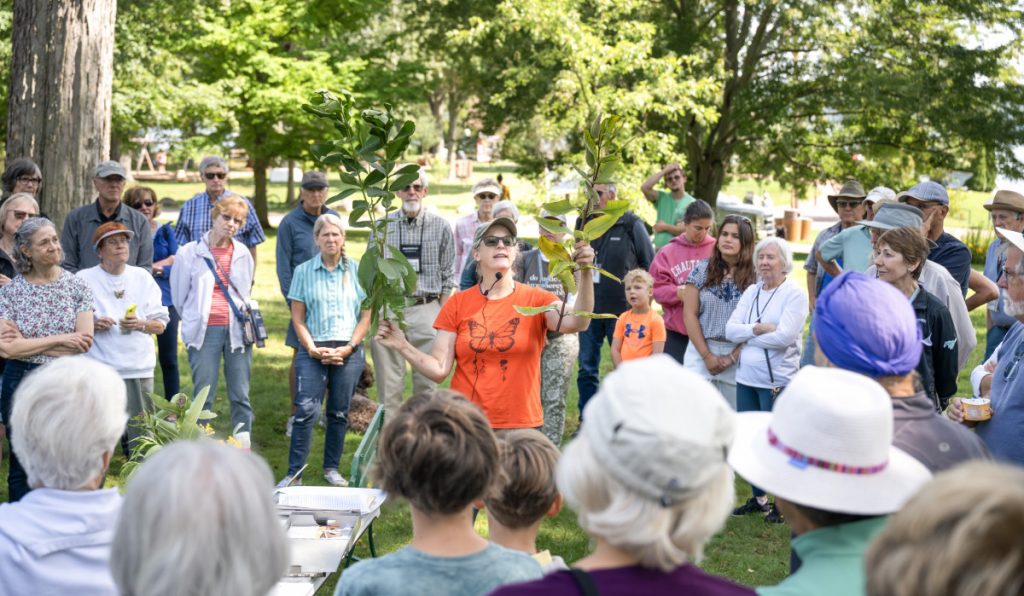
Betsy Burgeson loves monarch butterflies — maybe a little too much, according to her. As the Supervisor of Gardens at the Chautauqua Institution in Chautauqua, N.Y., Burgeson recently gave an educational and enthusiastic tag and release demonstration in a local park to a crowd of captivated community members.
Burgeson and her team collected 429 eggs this season. She said that’s “a little less than last year,” as she tried to curb her egg-collecting obsession, but nationwide efforts to preserve monarch populations have allowed for them to grow extensively.
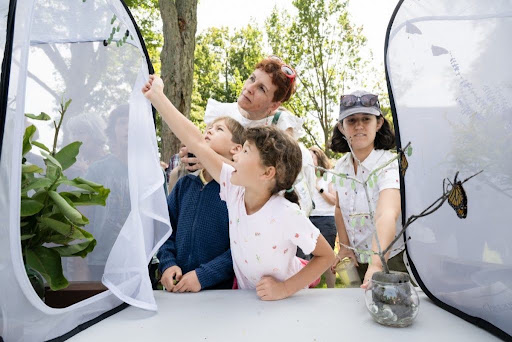
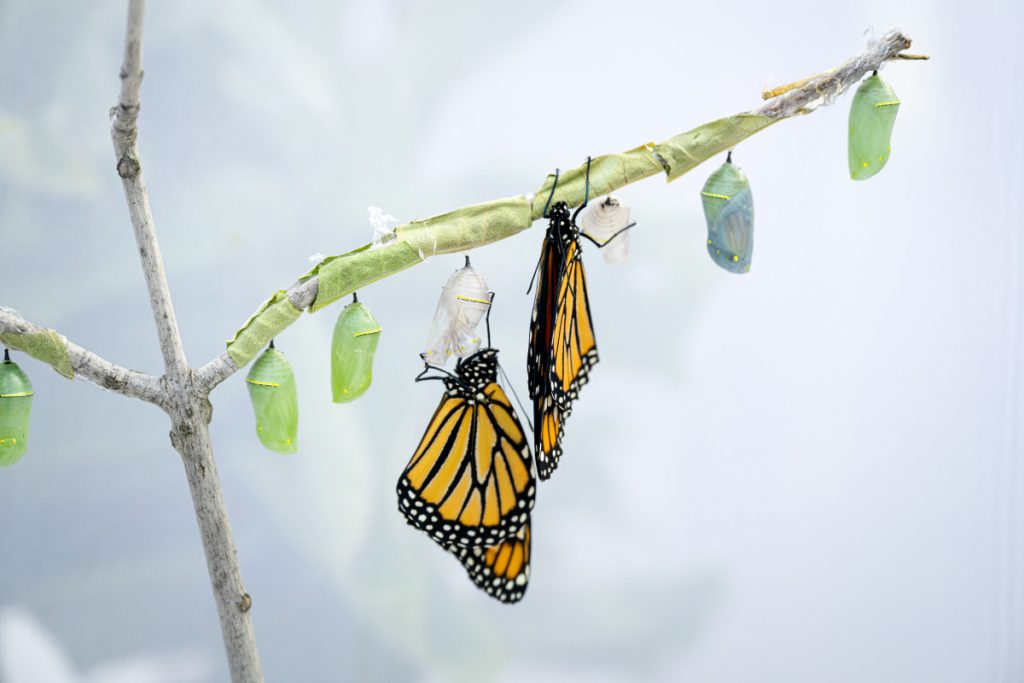
Mulan Ten observes butterflies emerging from their chrysalises. (Guinevere MacLowry)
“There are three times as many monarchs from 2025 to 2026,” Burgeson said. “So, that’s incredible.”
This is the third year Burgeson has done a monarch butterfly release program on the grounds. She has been continually surprised yet pleased by the massive amount of interest from the community.
“Last year, I sent out a thing saying, ‘Hey, I’m going to be releasing butterflies on Bestor Plaza’ — it was late September,” Burgeson said. “I’m like, ‘I’ve got 25 butterflies I need to release,’ and hundreds of people just came from everywhere. I don’t even know how they found out. It’s amazing. That’s why we moved from the Butterfly Garden down to here, so that there’s a lot more space.”
One of the most important aspects of the educational demonstration for Burgeson is the information about the various milkweed species found across the grounds. Some people may mistake the plants for weeds, but Burgeson assured the crowd gathered in Miller Park that the milkweed is there for a reason.
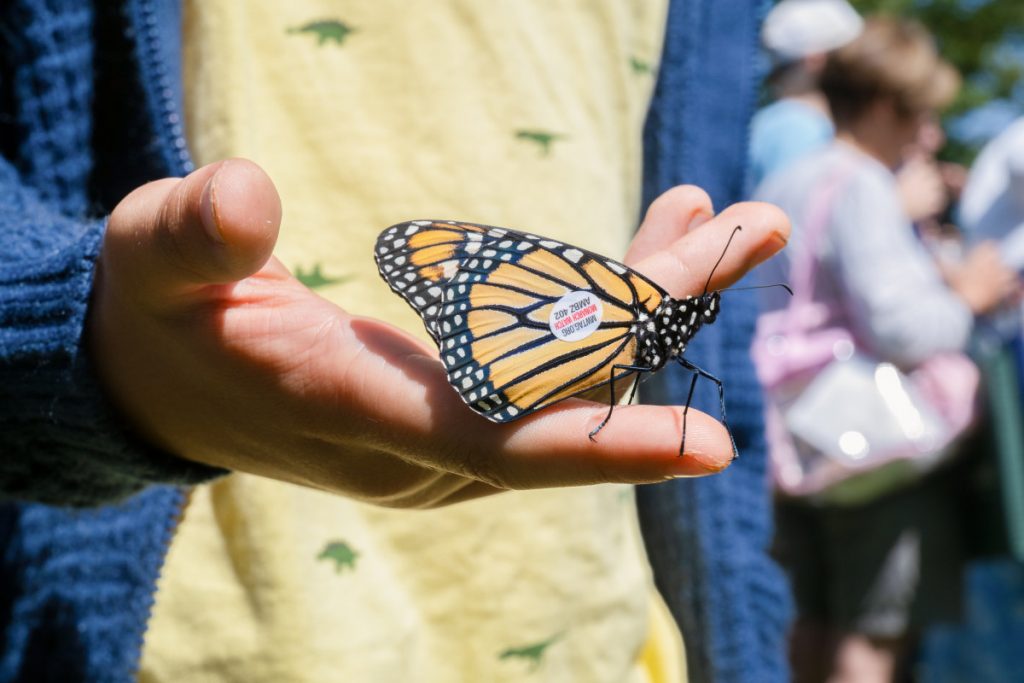
Gabe Faggioli holds a recently tagged and released monarch butterfly, which he named “Geri” on his finger. (Guinevere MacLowry)
“It’s incredible … having people understand why there’s those random milkweeds at this time of year sticking out,” Burgeson said. “It’s not that we’ve missed it; we have intentionally not pulled it.”
Monarch population tracking is a complicated process, but the technology is advancing year after year.
“(Researchers) don’t actually count the butterflies … what they do is they will go up above (with drones) and they take pictures and you can see where the clusters are because instead of green, the evergreen trees from up above are orange,” Burgeson said. “It looks like the trees are rusted. So they outline where the rust is, and they measure that space.”
Burgeson has donated monarch eggs to some Chautauqua County schools so they may observe a butterfly’s life cycle and then release them themselves. She said if people are interested in caring for and releasing any monarchs, she would be happy to distribute some of the eggs.
Butterflies emerging from their chrysalises. (Guinevere MacLowry)
Another version of this story was published in The Chautauquan Daily on Aug. 25, 2026. The Chautauquan Daily is the official newspaper of Chautauqua Institution and is published six days a week over its nine-week summer season. Our Planet Forward Chautauqua Reporting Fellows are generously supported by the Chautauqua Institution’s sustainability initiative and GW’s Berl Brechner Fund.
This website uses cookies to provide you with an improved and personalized experience. By using this site you agree to our use of cookies. Please read our cookies policy for more information on the cookies we use and how to delete or block them.



 All Topics