 All Topics





Lava from Kilauea on Hawaii flows into the ocean.
Marc Szeglat/Unsplash

Camille Slagle
Dartmouth College | Ilíiaitchik: Indigenous Correspondents Program (ICP)
February 18, 2026
Marc Szeglat/Unsplash
Dartmouth College | Ilíiaitchik: Indigenous Correspondents Program (ICP)

Since the illegal overthrow of Hawaiʻi in January of 1893, the United States military has made itself a continual presence on the islands. The overthrow of Queen Liliʻuokalani by American businessmen, supported by U.S. Marines, marked the end of the Hawaiian Kingdom and initiated a political transformation that fundamentally reshaped land ownership, governance, and sovereignty (Lagaso).
Subsequent annexation by the United States positioned Hawaiʻi as a strategic military stronghold in the Pacific, particularly as American expansion and geopolitical interests grew throughout the twentieth century. What had once been an internationally recognized Indigenous nation became increasingly defined through its military value, altering relationships between people, land, and power.
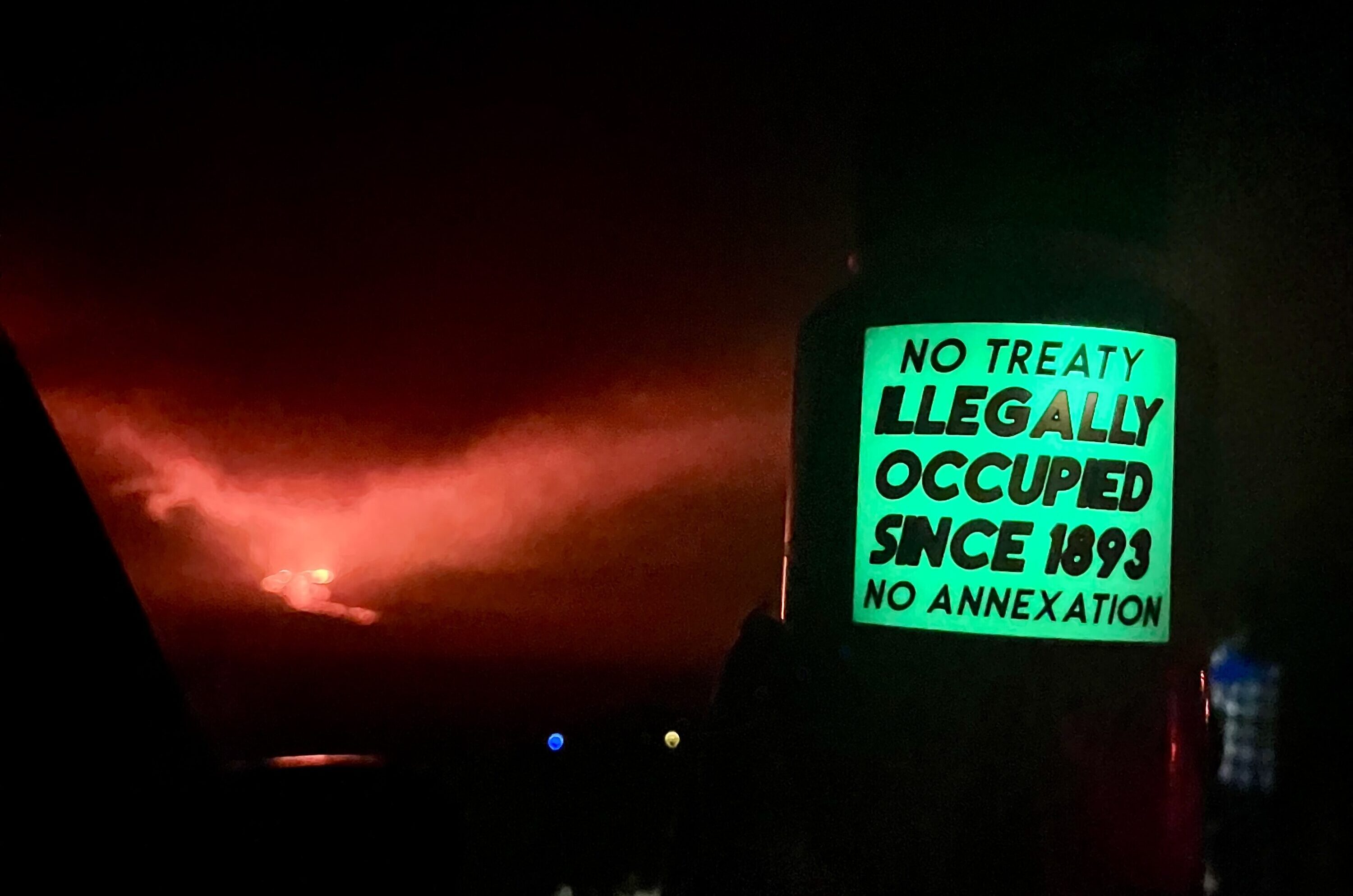
The political transformation of Hawaiʻi reformed land ownership and governance, setting the stage for the islands’ long-standing military role in the Pacific.
On O’ahu, the military occupies 25 percent of the island, and over five percent of the total land throughout the state (Fuatai). Military installations serve strategic defense purposes but have also restricted access to culturally significant lands and contributed to environmental and community tensions, including the historic use of Kahoʻolawe as a bombing range and ongoing debates over training areas and land stewardship (Kaho’olawe Island Reserve Commission).

For Kanaka Maoli/Native Hawaiians, these tensions raise deeper questions about what it means to protect land and people. Protection, within Indigenous worldviews, is rooted not in control or exclusion, but in reciprocity, stewardship, and responsibility to ʻāina, or the land that feeds and sustains life.
In this audio story, you’ll hear from Lynsey Keōpūolani Perrin, Alexis Kawahine Wana, Kiersty Puana McKee, Emma Kaʻilikapuolono Slagle. By centering Native voices, and particularly Native women, this podcast asks what “protection” truly means: Is it military security and strategic dominance, or care grounded in relationship, accountability, and intergenerational balance through Hawaiian volcanism, which has a life and story of its own?
Through storytelling, cultural memory, and personal reflection, we reframe Hawaiʻi not simply as a military outpost, but as a living homeland due to culturally significant volcanism, whose history continues to shape present-day conversations about sovereignty, restoration, and justice.
Ua mau ke ea o ka ‘āina I ka pono—The life of the land is perpetuated in righteousness.
Fuatai, Teuila. From Hawai’i: To the U.S., we’re a giant military station. 24 March 2025. https://mronline.org/2025/03/26/from-hawaii-to-the-u-s-were-a-giant-military-station/
Kaho’olawe Island Reserve Commission. Kūkulu Ke Ea a Kanaloa, Haho’olawe History. n.d. https://kahoolawe.hawaii.gov/history.shtml
Lagaso, Nadine. The truth behind the overthrow of the Hawaiian Kingdom. 17 January 2017. <https://www.ksbe.edu/article/the-truth-behind-the-illegal-overthrow-of-the-hawaiian-kingdom>.
Audio Story Transcript:
CHANT:
ʻAi kamumu kēkē (a sharp, crunching sound)
Nakēkē pahoehoe, kē (The pāhoehoe lava crackles sharply)
Wela i luna ʻo Halemaʻumaʻu kē (Heat above Halemaʻumaʻu, indeed)
Wela i luna ʻo Halemaʻ umaʻu kē (Heat above Halemaʻumaʻu, indeed)
*Fade out*
Camille Leihulu Slagle: E na pua a ka honua u’i, aloha mai kākou (flowers of the beautiful earth, hello to all). ‘O Leihulu ko’u inoa Hawai’i, a no Kailua mai au. My name is Leihulu, and I am Kanaka Maoli (Native Hawaiian) from the island of O’ahu. My wind is ka Malanai, and my rain is ka ‘Āpuakea. As Hawaiians, we cannot introduce ourselves without introducing the land that we genealogically descended from. To be Hawaiian is to speak of land before self — to know that who we are begins with where we come from. ‘Āina is the Hawaiian word for land, translating to “that which feeds,” but in Hawaiʻi, much of our ʻāina has been starved. What happens when that land is used for the taking for military training and testing? What does stewardship mean when the land that feeds us is treated as expendable?
Alexis Kawahine Wana: When I think about my relationship to ‘āina and when (it) comes to the new lava, I think for me it’s mostly a reminder about how flexible and changing our world and our islands are. The ‘āina is a living and breathing entity in every aspect, whether that is the lava, whether that’s the microorganisms in the dirt, or the plants and animals that we subsist on. For me, it was always a big deal in my family to respect the land because without it, we would not survive. For someone like Pele who literally created the land that we live on, she’s top dog, she’s the boss; and so, I feel like I’m always grateful for stories about her as an akua (god) because of how much we rely on her.
Lynsey Keōpūolani Perrin: From a young age, I learned about Pele. I learned about her journey to Hawai’i as she fled her sister Nāmakaokaha’i, and the fierce battles they waged over land, power, and men. I learned about Pele’s chair, her hair, and the way she protects her home and her people. I was taught to never carry pork over the Pali (cliff), or Pele might appear on the side of the road, or even in your car. They say she often takes the form of an elderly woman with long white hair. One night, when I was 17 and driving home late from a friend’s house, I saw a woman standing makai (seaward) of the road, near the ocean. I still wonder if it was her. I think about that moment often, and what message she might’ve had for me. Pele holds great mana (life force) for Hawaiians, and for me. Whenever her fire sparks, I feel her presence, and I am reminded of the strong and powerful line of women that I come from.
CLS: These stories aren’t just tales from childhood; they’re part of how we learn to respect, understand, and stay accountable to ourselves and our ancestors.
Kiersty Puana McKee: Even though they’re probably considered to be religious or kind of like a “folk” story, it’s important to share those stories because they’re real for us as Native Hawaiians but also it just helps with the awareness portion, that it’s not just something that’s happening, like it’s something special to us.
CLS: ʻāina isn’t only inherited, it’s continually remade, especially on volcanic land. These stories shape how we interpret new lava, how we read change, and how we understand our responsibilities in moments of political upheaval. Kīlauea has been relatively active in recent years, and so we shift to how we relate to ʻāina when it is literally in the process of becoming, and how public narratives sometimes miss the cultural truths Native Hawaiians hold.
EKS: I think when Kīlauea erupts, there’s sort of this sentiment that arises, sort of circling around, “How can we control the flow?”, or “How can we stop it?”; whether that be historically through bombing the (lava) tubes or putting up large barriers. Something that can be missing from this take is sort of the acknowledgement that these lands, the flow itself, the volcanoes, in Hawaiian tradition are controlled by the goddess Pele and they’re a part of the long process that has been creating the islands. I think even historically, a part from this, physical attempts to divert the flow have often been pretty difficult and ineffective. We’re not above nature, and nature time-and-time-again has shown us that Pele is alive. We can see it through the active flows, and there is a certain respect that is required there. It’s not simply an infrastructure issue, but it’s a cultural and environmental issue as well. I think oftentimes, adaptation, the mindset of adaptation over domination in these cases can be really valuable.
CLS: Protection begins with a reciprocal relationship, and care for ʻāina is inseparable from care for each other. That worldview stands in contrast to other models of “protection” imposed on Hawaiʻi, or systems that approach land primarily as something to be controlled or secured. Since the illegal United States overthrow of Hawaiʻi in 1893, the military has played a central role in shaping land use across the islands, occupying large areas for bases, training grounds, and weapons testing. These uses have often involved restricted access to ʻāina, environmental degradation, and the displacement of Native communities, all framed under the language of “national security” and protection. In this context, protection is often defined through control, exclusion, and strategic value rather than through relationship or long-term stewardship. So, with that in mind, how do Native perspectives on protection differ from the military’s framing of itself as a protector?
KPM: Native perspectives of protection differ from things like the military and the government in the sense that native protection requires putting the land first, putting the stewardship of the land first, so making sure that everything is perpetuating the land itself, and not for the benefit of the people, but for the benefit of everything else — native plants, native animals, everything. Whereas, the military and other government entities see it as an overprotecting it from other people. Even though Native Hawaiians do kind of see it as that, like weʻre protecting it from people who would do harm to it, but the military is protecting it for their own good as opposed to the good of the environment itself.
LKP: To the Native Hawaiian culture, “protection” boils down to respect, love, and responsibility. We protect what needs protecting: our family, our land, our culture. Protection is not about power or control, it’s about care and reciprocity. The military’s idea of protection may appear similar on its face because they defend freedom, security, and the United States. But that is where our similarities end. The military often assumes that because they risk their lives for “freedom,” they also hold the authority to decide what is right or necessary, and by extension, whose culture and land are expendable. We’ve seen this time and time again in Hawaiʻi. The US military turned one of our eight habitable islands, Kahoʻolawe, into a bombing range. They converted the sacred land and waters of Wai Momi, or Pearl Harbor, into their primary Pacific naval base. And in 1964, the state government agreed to lease 30,000 acres of Native Hawaiian land for military use. The kicker? The military leases were $1 each and lasted 65 years. Native Hawaiians understand the importance of a military as protectors, after all, Native Hawaiians had armies as well. However, the difference is that Hawaiian protectors knew that in order to properly protect the people, they had to respect them and their culture. Today, the military continues to pollute our waters, occupy sacred land, and has yet to clean up the still active explosives on Kahoʻolawe. True protectors honor life; they don’t desecrate it.
AK: When I think of Hawaii’s future, I think of the Native birds. I think of the songs of ‘I’iwi and ‘alalā and all these other Native birds that have been persisting and are unfortunately endangered. I think of them because they are the sounds of the forest, and I think the best way to replace military noise is with the noise of our manu (birds). And the idea that hearing a forest that our kupuna once heard, of birds and the trees like ohia, and the land snails on the trees, that to me is what I would hope Hawai’i would sound like in the future.
LKP: I want to hear our culture again. I want to hear our ʻōlelo (language) on the tongues of our people in oli(chants), in the laughter of the new generation learning their native language, and in the mele (songs) sung at sunset to give thanks to those we love. Our movement, the revival of the Hawaiian identity, is alive. It breathes. I want our people to remember the legacies they carry on their backs, the stories of kūpuna (ancestors), the resilience of our culture, and the mana (life force) that runs through our veins the same as it runs through our land.
CLS: ʻĀina is not passive in its existence; it’s alive, reborn, and resisting. It feeds us stories, our responsibilities, our futures. We began with fire; with Pele and the stories that shaped this island. We end with the reminder that what burns also creates. Each consequent eruption of Kīlauea is a chance to choose differently — to listen, to care, to let the land nourish us. A hiki I ke aloha ‘aina hope loa, a he Hawai’i mākou mau a mau — until the last “aloha ‘āina” is uttered, we are Hawaiian now and forever.
CHANT:
ʻAi kamumu kēkē (a sharp, crunching sound)
Nakēkē pāhoehoe, kē (The pāhoehoe lava crackles sharply)
Wela i luna ʻo Halemaʻumaʻu kē (Heat above Halemaʻumaʻu, indeed)
Wela i luna ʻo Halemaʻ umaʻu kē (Heat above Halemaʻumaʻu, indeed)
*Fade out*
A project of

in collaboration with