
 All Topics









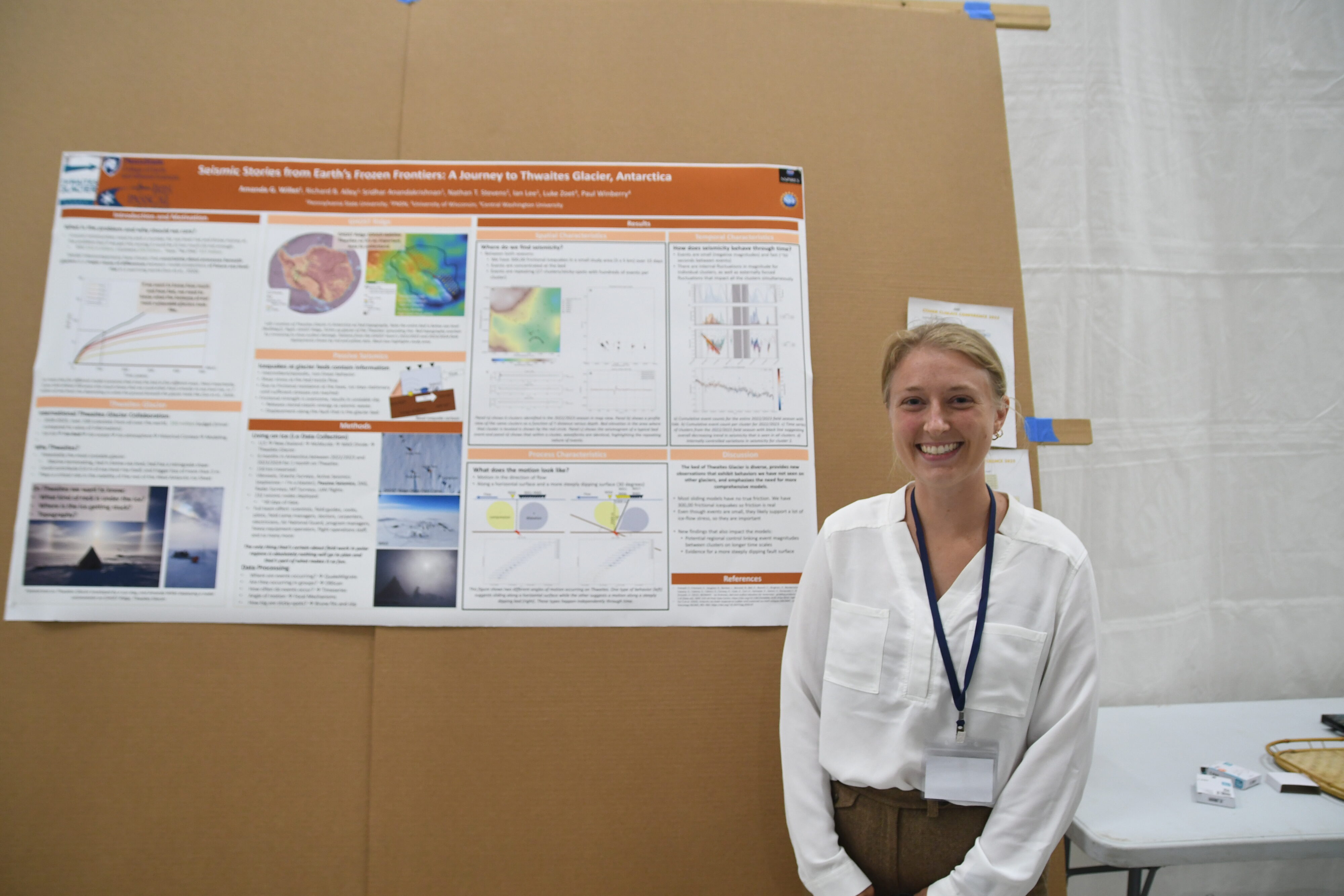
Penn State Researcher Amanda Willet, at the Comer Climate Conference in Wisconsin, where she shares her research on the stability of the bed of the Thwaites Glacier in Antarctica.
Jack Austin/Medill

January 15, 2026
Jack Austin/Medill
By Jack Austin

Amanda Willet’s research sits at the center of a high-stakes equation: predicting how fast sea levels will rise — and how coastal cities can defend themselves. An overestimate could waste billions. An underestimate could leave cities facing devastation on the scale of Hurricane Katrina.
Willet, a graduate student at Penn State, attended the 2025 Comer Climate Conference in the fall to present her upcoming research completed with Professors Sridhar Anandakrishnan and veteran glaciologist Richard Alley, titled “Seismic Stories From Earth’s Frozen Frontiers: Thwaites Glacier, Antarctica.” Alley teaches at Penn State and is the emcee for the annual Comer conference held in southwestern Wisconsin.
One reason sea level rise models remain uncertain, Willet said, is that scientists don’t yet know what lies beneath glaciers. Her team, in partnership with the British Antarctic Survey, is studying Thwaites — a glacier larger than Pennsylvania — because if it melts entirely, it could add 3 meters to global sea levels. That’s 9 feet, 10 inches of sea level rise, enough to inundate vast coastal areas and many islands. Thwaites is part of the West Antarctic Ice Sheet, which a Dartmouth study (combining data from 16 ice sheet models) concluded may disappear by 2300.
“Depending on what the bottoms of these glaciers look like in big places like Antarctica depends on how much sea level rise we actually get,” Willet said. “If we want to understand sea level rise, we need to know what the bottoms of glaciers look like.”
Alley said that model predictions for Antarctica vary so widely that “nobody can reliably say what will happen.” The single biggest uncertainty, he added, is how glaciers move across the materials beneath them. Once glaciers slide beyond a bedrock foundation, tongues in the water melt much faster.
The Thwaites Glacier is the ice shelf of the much larger West Antarctic Ice Sheet (WAIS). Thwaites is considered the “Doomsday Glacier” because if it collapsed completely it could raise sea levels by 10 feet. According to the International Thwaites Glacier Collaboration (ITGC),the massive glacier will face accelerated retreat in the 21st and 22nd centuries, with much of the glacier gone by the 23rd century. Full collapse may take hundreds to a few thousand years according to recent models.
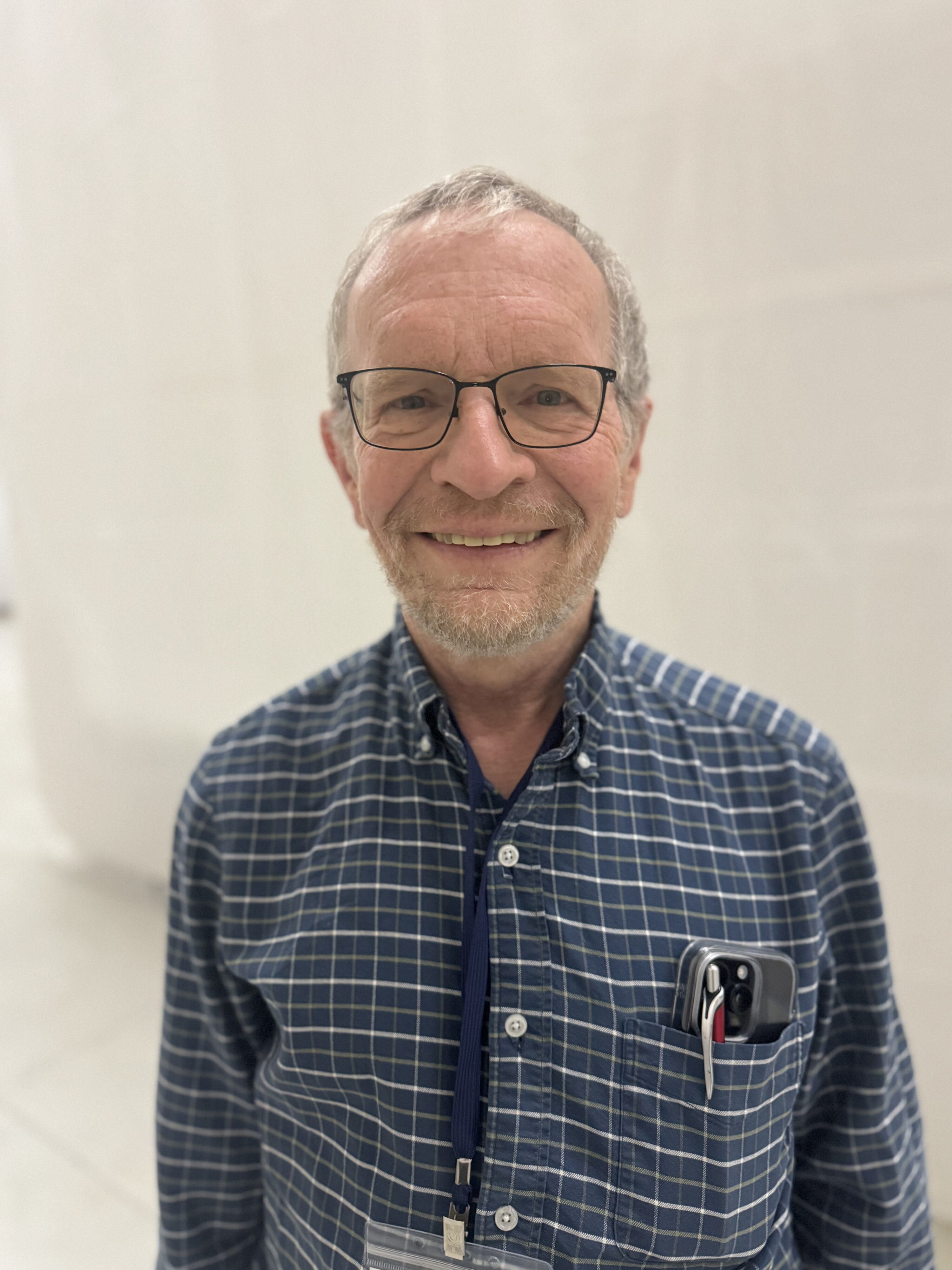
To study that hidden world two miles below the surface, Willet and her team use highly sensitive seismometers to listen to tiny earthquakes that can indicate cracks or breaks in the ice.
“They listen to the earthquakes and can tell where they are, how big the spot is that breaks, and how much energy it releases,” Alley said. “Those little spots are really important — they inform how glaciers move, and how the ice sheets behave. That’s what will let us build better models for what Antarctica will do.”
Willet said Thwaites’ bed is far more complex than most models suggest, with both hard and soft patches beneath the ice. That mixed environment is difficult to simulate — and potentially dangerous.
“If we have both, that’s the worst-case scenario,” Willet said. “It’s drawing down ice from inland and breaking off at the front — doing everything we wouldn’t want it to be doing. The data show the most likely scenario is this mixed environment. We want to get that information to modelers so they can make more informed decisions.”
Elizabeth Case, a Ph.D. researcher at Columbia University who also studies Thwaites Glacier, said the glacier may already be undergoing irreversible retreat. The bed beneath it — whether granite, sand, or clay — determines how easily it can slide or flow into the ocean.
“What happens at the bed affects crystal structure throughout the ice, influencing how fast Thwaites may disappear,” Case said. “This has serious implications for sea level rise, and the impacts will be felt around the world — directly along coastlines, and indirectly as displacement and migration follow rising seas.”
Willet said that improving the accuracy of those projections is essential. Most glaciologists, she believes, see current sea level predictions as overly optimistic. Alley agreed, emphasizing the urgency and value of the work.
“The costs of getting it wrong are flabbergastingly high,” Alley said. “Supporting Amanda’s research is saving you money. The cost is trivial compared to the value of what comes out.”
Though she calls herself an environmentalist — even a “tree hugger” — Willet said her motivation goes beyond nature.
“I want to protect this planet that we live on,” she said. “But more importantly, I want to protect people. Sea level rise doesn’t matter if there are no humans on the coast — but there are. We’re the ones who will struggle to live with that reality.”
A project of

in collaboration with