

 All Topics









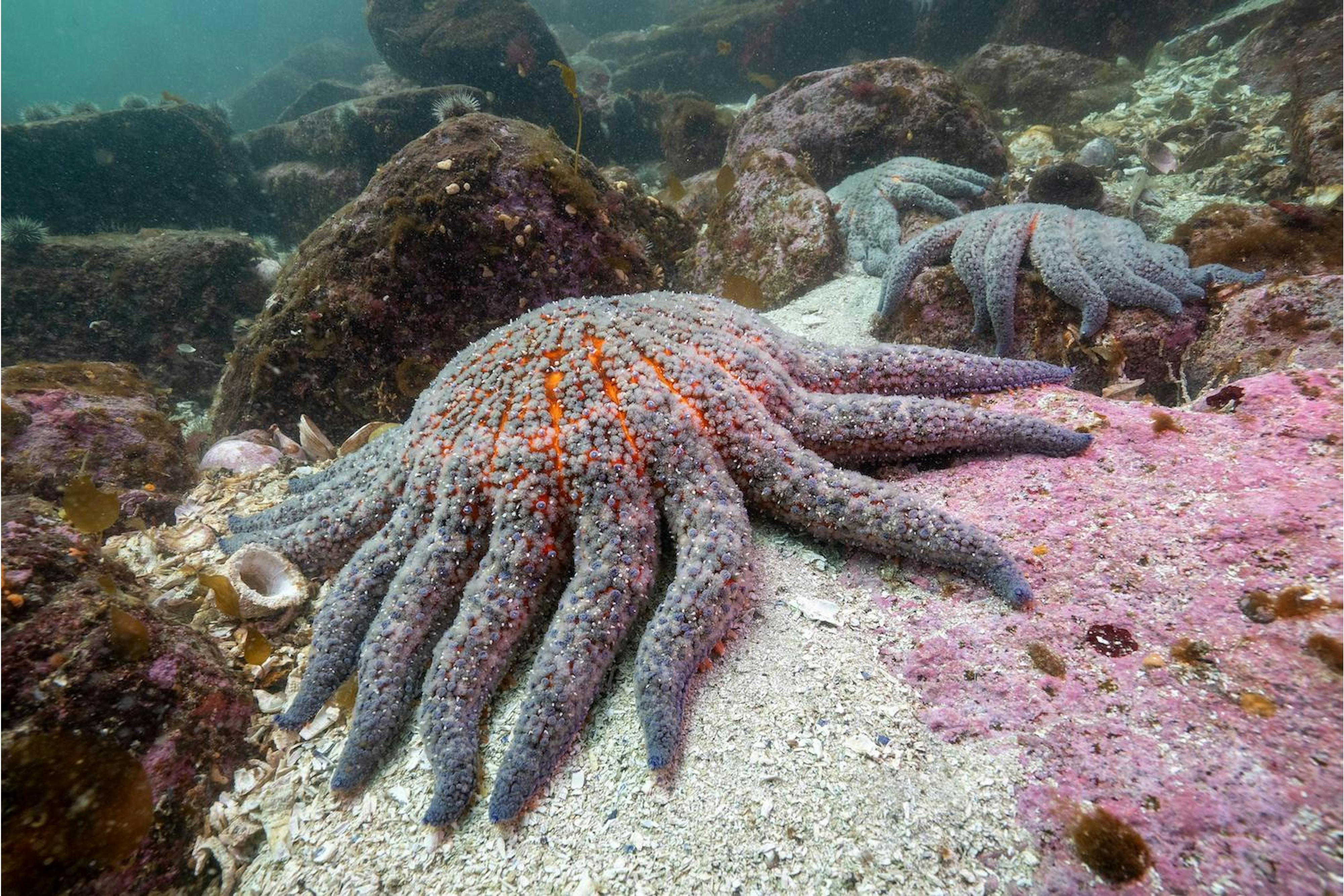
A sunflower sea star in Burke Channel, off the coast of British Columbia, Canada.
Courtesy of Bennet Whitnell

Abigail Meyers
University of Washington
January 13, 2026
Courtesy of Bennet Whitnell
University of Washington
The story was originally published in The Daily at the University of Washington on Aug. 18, 2025.

A study published Aug. 4 in Nature Ecology & Evolution outlines a recent breakthrough in sea star wasting disease (SSWD) research: Scientists have identified a causative agent.
SSWD emerged unexpectedly in 2013 and quickly spread along the Pacific coast. It destroys the tissue within sea stars, deforming their arms and causing them to break off. Since 2013, it has killed billions of sea stars, including more than 90% of sunflower sea stars.
Especially on the coast of California, sunflower sea star populations have been decimated, causing trophic cascades in kelp forest ecosystems. Die-offs have led to a boom in sea urchins, which have then depleted kelp, their primary food source.
“There’s a lot of regions along the California coast where the kelp forests are severely declined and that has huge impacts,” a doctoral student in the School of Aquatic and Fisheries Sciences, Grace Crandall, said.
Kelp acts as a carbon sink, making it crucial for combating global warming, Crandall explained.
A 2014 study suggested a virus as the causative agent of SSWD, leading initial research in that direction. Instead, the causation was found to be a bacterium known as Vibrio pectenicida.
Researchers used a method known as Koch’s postulate to identify the cause of SSWD. They began by performing a series of experiments to identify whether the disease was transmissible. They then boiled a sample of coelomic fluid, which is comparable to the human bloodstream, of the diseased sea star to determine whether the cause was alive. The boiled sample was no longer infectious, suggesting that the disease is caused by a living source, rather than environmental conditions.
Researchers used a subtractive technique to isolate the causative agent; they removed everything from the diseased sample that was also highly present in the healthy sample.
“There’s this one type of bacteria that was hugely abundant in these sick stars that was not present in the healthy stars,” Jason Hodin, a senior research scientist at Friday Harbor Labs (FHL), said.
This finding was a match for Vibrio pectenicida FHCF-3, the same genus of bacteria that causes cholera (Vibrio cholerae) in humans.
In early 2024, there was an outbreak of SSWD at the Friday Harbor Laboratories (FHL), a UW marine research station. Scientists were able to isolate the full sequence of the bacterium from that sample for the first time
“The title of the paper talks about a strain called FHCF-3, and the FH in that is Friday Harbor,” Hodin said.
The bacterium found in sea stars afflicted with SSWD was a match to a scallop larval culture in France, indicating that it may have jumped species. Identifying what drove the outbreak in sea stars is a next step for the research, according to Hodin.
Researchers are also looking to breed sea stars with more resistance to the disease. Ochre stars, for instance, are already showing signs of recovery, indicating that they’ve developed some resistance to SSWD. By breeding the most resistant stars, scientists could utilize artificial selection for recovery efforts. Additionally, researchers could inject sea stars with a low dose of SSWD, which would function similarly to a vaccine. However, scientists are uncertain whether sea stars’ immune systems work in a way that would be amenable to this.
A treatment for the disease has already been developed by the Oregon Coast Aquarium. The process involves altering environmental conditions so that sea stars have the strength to fight off the disease themselves.
“[Sea stars] are actually very robust and adaptable organisms, but they have this specific sensitivity to this disease,” Hodin said.
To treat SSWD, scientists put the sea stars in cooler water, adjust the pH, clean their wounds using iodine, and add probiotics to the water to support the sea stars’ microbiomes.
That afflicted sea stars heal in colder water is one piece of evidence of a correlation between SSWD and warmer water temperatures.
“In 2014, there was a massive marine heat wave that coincided with the outbreak of this disease,” Hodin said.
Exploring this correlation is another next step for researchers.
If you stumble upon a diseased sea star while tidepooling, Crandall suggests documenting it with an app like iNaturalist.
“A way that people can help is if they see a sea star that looks like it’s sort of melting or has white spots or its arms are twisted up, to not touch it,” Crandall said.
If you do touch the diseased sea star, wash your hands before touching anything else to prevent transmission, Crandall recommends.
A project of

in collaboration with