From waste to wildflowers: Chicago Native Garden Projects cultivates community on a forgotten slope
Chicago Native Garden Projects has raised nearly $13,000 in donations and materials for the Morgan Street Community Garden. Today, donors can memorialize their loved ones with a dedicated garden container.
Israel Ceballos stands outside his condo in University Village with a Tupperware container full of orange peels and a handful of breadcrumbs. His husband, Paul Matylonek, sits inside, surrounded by eight Día de los Muertos ofrendas and two leather suitcases from his Polish immigrant parents.
“I feed 50 birds right here, and six squirrels,” Ceballos says. “When I whistle, they all show up.”
Ceballos isn’t exaggerating. With one whistle, dozens of house sparrows creep out from tree branches to snack on Ceballos’s offerings. Above, a squirrel nest overlooks the couple’s newly completed project, nearly two decades in the making: the Morgan Street Community Garden.
A dream takes root
Lifelong Midwesterners, Ceballos and Matylonek met at church on Father’s Day, 28 years ago. Ceballos recalls seeing “a handsome man” light a candle for his recently deceased father, and the rest was history. Before transforming this patch of land into a thriving space, the pair spent years cultivating life in their own backyard. They planted milkweed to attract and raise monarch butterflies — a quiet practice that would later echo through their larger work, bringing nature and meaning to their neighborhood.
Inspiration for the garden came after the pair realized that the land behind their home, owned by the Burlington-Norfolk and Santa Fe (BNSF) Railway Company, had served as a dumping ground for debris for years. After the railway failed to respond to their emails seeking permission to clean up the plot, Ceballos and Matylonek went ahead on their own in May, enlisting neighbors and friends to help.
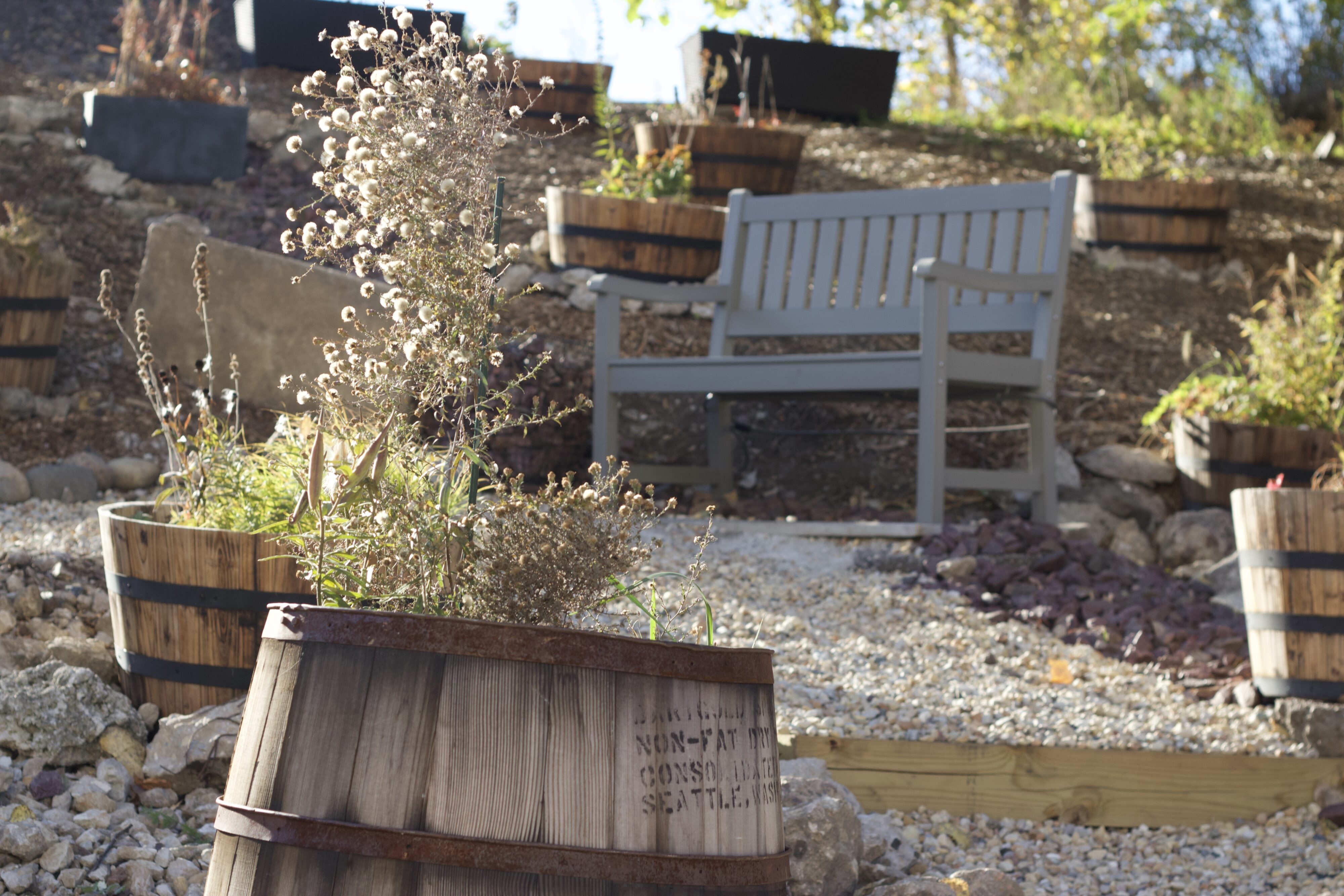
Once they had hauled away about 40 industrial trash bags of debris, the pair invested $1,000 of their own funds to build a small, raised garden bed on the plot. They also sent a request to community members asking for donations of pots for the garden, as the soil was likely unsuitable for growth.
This simple community act led to what is now Chicago Native Garden Projects, a nonprofit organization dedicated to restoring and maintaining native plant habitats in Chicago.
“I just wanted something that the community could enjoy,” Ceballos said. “Nothing makes me happier than walking by and seeing people sitting here.”
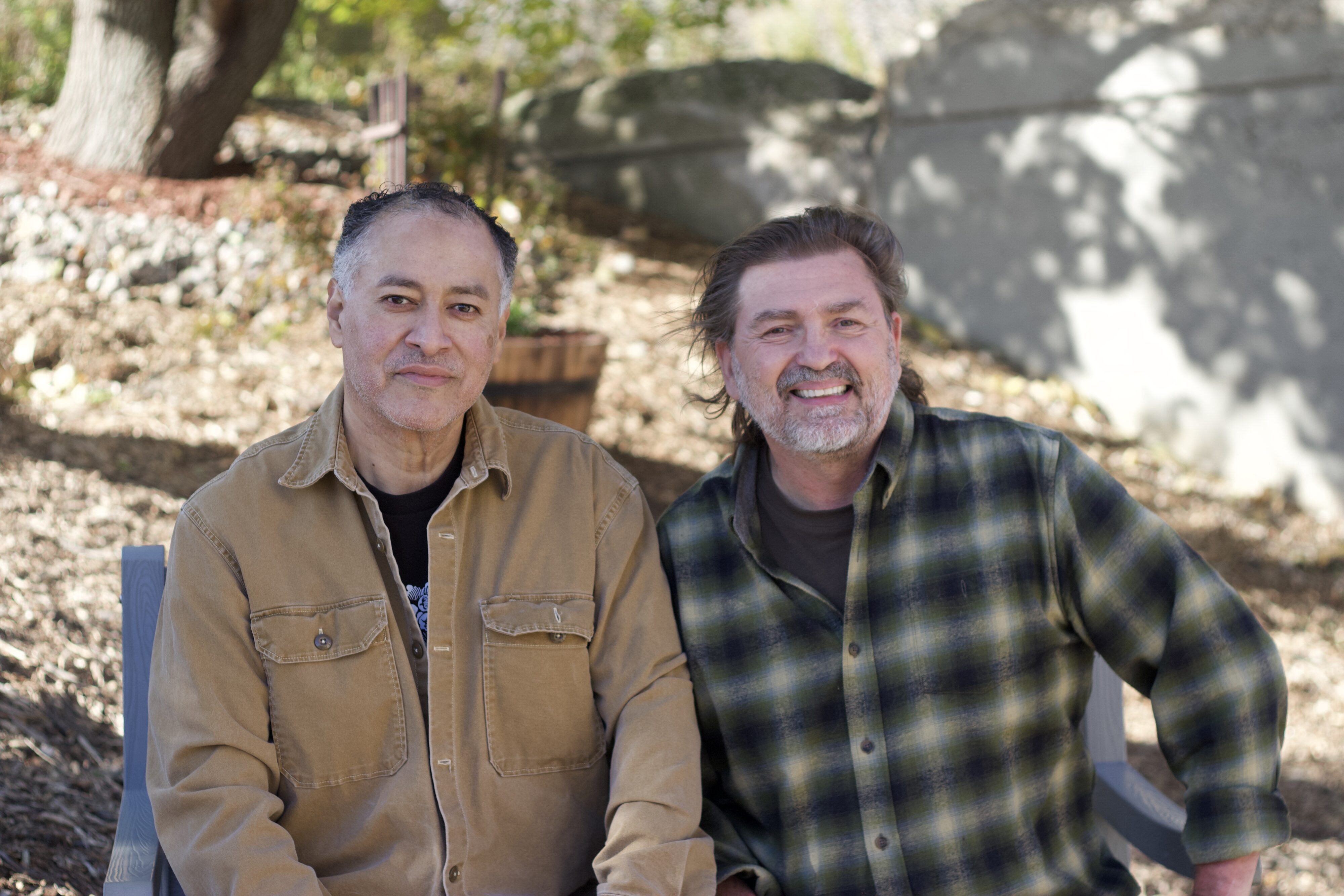
Israel Ceballos (left) and Paul Matylonek sit on a bench at the Morgan Street Community Garden. Their condo sits directly in front of the garden across an access road for railway company vehicles. (Emma Henry)
Ceballos said that many people wanted to help, but couldn’t deliver equipment, so the pair changed their request and asked for monetary donations. Over the past six months, Ceballos estimates that over 60 donors have raised around $13,000 in donations and materials for the community garden. The Chicago Department of Streets and Sanitation donated paint and a city garbage can to the cause, while 25th Ward Alderman Byron Sigcho Lopez attended a ribbon-cutting ceremony for the garden in September.
“It’s opened up my eyes to the community itself, dealing with people who don’t live in my building, but have donated and have helped,” University Village resident and volunteer Jesus Palacios said. “You turn from a neighbor into a friend.”
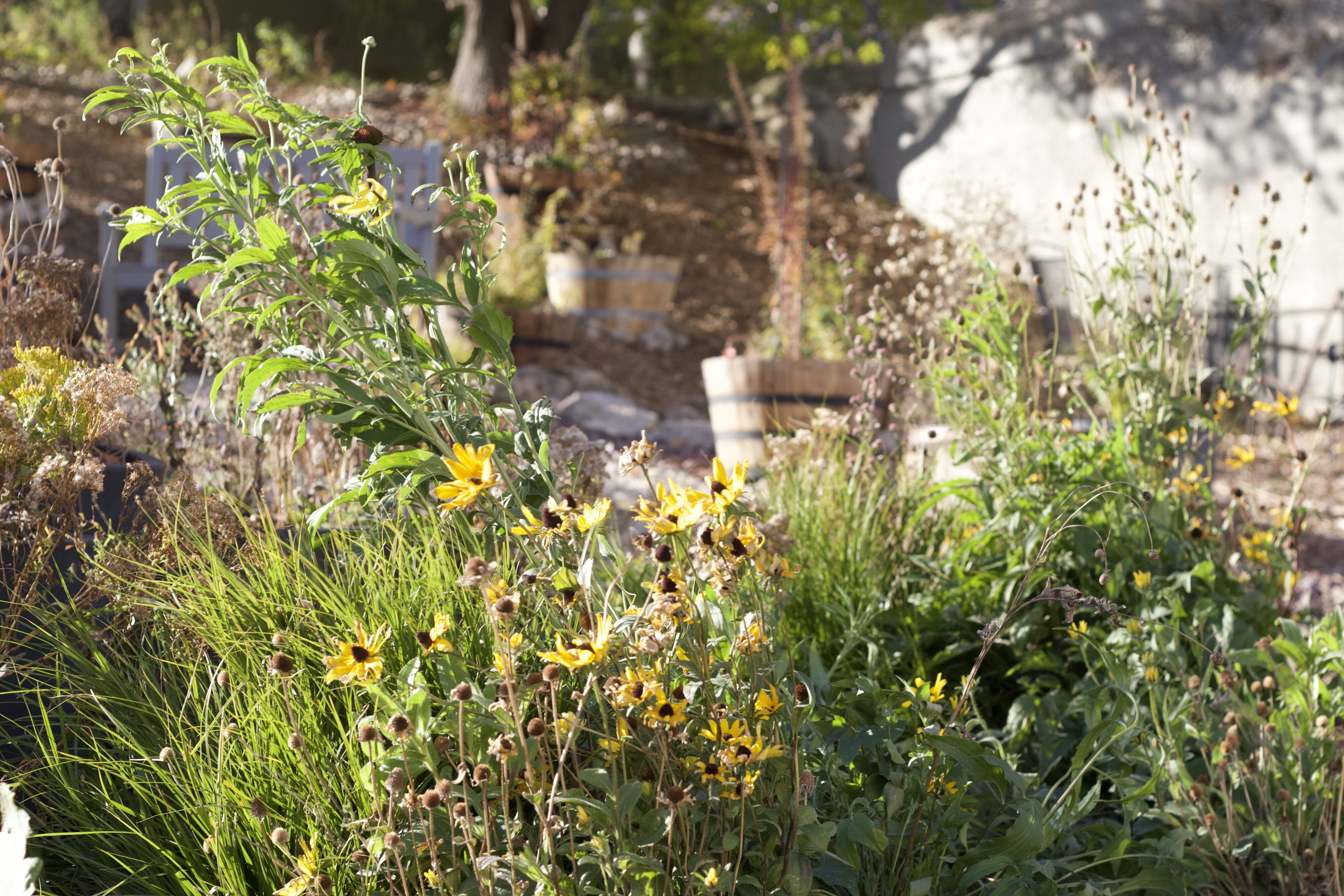
Under Ceballos and Matylonek’s leadership, what was once a patch of waste transformed into a neighborhood effort that now includes over 300 native plants across 90 species.
Community efforts bear fruit
Nearly 60% of the world’s population now resides in urban environments, and increased urbanization has caused a substantial loss in native biodiversity. As a result, planting native species offers benefits that extend beyond neighborhood aesthetics, helping to repair some of the ecological damage caused by urban infrastructure. Within city landscapes, native species have proven to outperform non-native species, providing critical habitat and food sources for pollinators, arthropods, and other local wildlife.
In addition to ecological benefits, expanding access to urban green spaces enhances climate resilience while benefiting human wellbeing. A 2016 World Health Organization report synthesizing multiple studies found, among other things, that urban green spaces may be linked to improved immune system function, enhanced mental health and cognitive performance, reduced exposure to air pollution, and an increase in pro-environmental behaviors. Together, these benefits illustrate how small-scale urban gardening efforts can connect people to the planet.
For Ceballos and Matylonek, however, they see that growth less as an achievement in horticulture and more as proof of what trust, kindness, and transparency can build.
“You don’t know until you put yourself out there,” Ceballos said. “What I’ve learned is you’ve got to let the fear go.”
Although Ceballos and Matylonek seem stunned at the community’s outpouring of support, secretary of CGNP Danielle Orihuela said that it isn’t surprising at all.
“[Israel] has always been the person to be able to talk to anybody. He’s captivating,” Orihuela said. “I think those are the most important things that make a leader: Do you actually care about the people sitting next to you? Do you want to get to know them? You level with them as an equal, and I think both of them are like that.”
Their approach to fundraising reflects that same ethos. Instead of chasing publicity, they invite people to participate through dedicated containers, which often honor loved ones.
After community members make donations, Ceballos builds pots or plants flowers within three days in order to maintain transparency over how funds are spent. (Emma Henry)
One Pilsen resident dedicated her garden container to her recently deceased brother and stops by once a month to honor his memory. Nearby, another container holds soil mixed with the ashes of a neighbor’s son. To Ceballos and Matylonek, these aren’t just plants: They’re reminders that what they’ve cultivated goes beyond the garden boundaries.
“It was these two that I realized, we’re really doing something right,” Ceballos said. “People want to memorialize; they want to remember their loved ones. They don’t know how or where, so people found solace in that. It goes to show that you just don’t know how you’re going to impact people.”
This fall, Ceballos and Matylonek opened their home during Día de los Muertos as part of their expanded fundraising efforts. In exchange for a small donation, Ceballos guided visitors through their many ofrendas – traditional memorials for Dia de los Muertos, or the Day of the Dead — and explained the holiday’s history. Monarchs, once fluttering through their backyard, reappeared as symbols of the season, woven throughout the altars to represent the souls of ancestors returning home.
Matylonek also offered visitors insight into his family history, explaining how his parents immigrated to the United States from eastern Poland.
Although Ceballos was born in Villa Juarez, San Luis Potosí, Mexico, and Matylonek is originally from Michigan, the pair consider themselves to be lifelong Chicagoans. (Emma Henry)
With the end of the gardening season, volunteers will continue to maintain the grounds and prepare for spring.
“I think we’re living in a society where it’s a little dark,” Palacios said. “Working together and seeing the different colors and shapes and sizes of people helps so much and brings the community together.”
Palacios said he’s come to understand why the garden keeps growing, not just with plants, but with people.
“[Israel and Paul] have such a beautiful view … they’re so kind, I think that’s also why people want to help,” he said. “You just become one, and I think they are the glue to everything.”
This website uses cookies to provide you with an improved and personalized experience. By using this site you agree to our use of cookies. Please read our cookies policy for more information on the cookies we use and how to delete or block them.


 All Topics