


 All Topics












al smith
Planet Forward Contributor
February 02, 2011
Planet Forward Contributor
The Automobile Industry Meets the 18th Century
Although the idea of interchangeable parts is often credited to Eli Whitney in the late 18th century, some credit 15th century Gutenberg. Maybe the idea will hit Detroit sometime in the 21st century, but I doubt it
Applying the Personal Computer Industry model to the Automobile Industry
The automobile industry is on the verge of rapidly moving from expensive vehicles powered by inefficient heat engines and complex mechanical transmissions to relatively inexpensive electric cars powered by fuel cells, Atkinson cycle engines, and diesel cycle engines. It may be too late to create a market based upon technical competition instead of advertising “competition,” but maybe not.
There is an opportunity to create an automobile industry based upon a model like the PC model having a standard bus and components having standard electrical and physical interfaces. However, I fear that, if someone outside the automobile industry does not step in, it will continue in its wasteful pattern of the past 50 years, specifically, multiple, incompatible components that perform the same function but providing absolutely no advantage to consumers in exchange for their incompatibility.
Consider how well an industry standard has served the personal computer business. A standard operating system would serve the automobile industry in the same fashion. An industry standard configuration concentrates available capital on solving problems with real economies of scale. It encourages innovation because automobile producers could become car assemblers, buying most of their components and assembling cars, as most computer manufacturers do today – not building multiple sets of infrastructure to produce parts that function in exactly the same way yet are physically incompatible with all other manufacturers. It allows for lower barriers to market entry because a manufacture can buy components and assemble the product rather than having to invest immense capital to create an entire, new, automobile also having parts incompatible with all the other automobile manufacturers.
If all automobile manufacturers used one mechanical and electrical interface like the PC industry, then a parts manufacturer or inventor could manufacture to one standard, not a multitude of different standards for different automobile manufacturers, thereby saving immense capital investment and also increasing the likelihood that an assembler would accept an innovation as has been the case with personal computers. The assembler companies would be much more receptive to new technologies because they have zero capital invested in current technologies.
Throughout the past century, electric systems and controlling software have replaced mechanical systems. Electronics and software have replaced mechanical components in telephones, watches, tape recorders, record players, ovens, electric power generation (fuel cell), typewriters, etc. The automobile industry is on the verge of its own electric revolution.
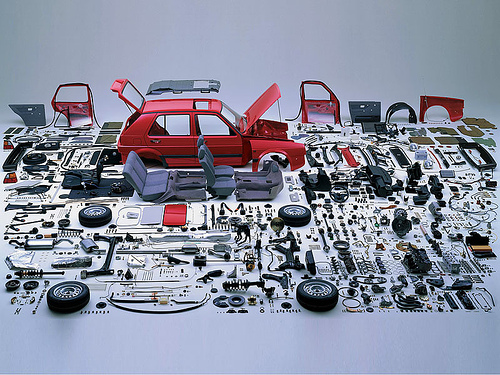
The current automotive industry structure is a vestige of a once competitive transportation market. The existing automotive industry is one where each manufacturer creates cars with functionally identical but non-substitutable parts. Many hundreds if not thousands of different and non-interchangeable oil filters, fuel filters, starter motors, fuel pumps, transmissions, CV joints, tie rods, etc. operate in precisely the same way but producing no advantage over one another as compensation for their non-interchangeability.
It would be a shame if an entire new automobile industry grew into the same wasteful pattern as the old. The automobile industry is stuck in the 17th century in a world of replaceable parts. The automobile industry will probably never advance to the 18th century and to interchangeable parts.

American University

University of Notre Dame


University of Richmond
A project of

in collaboration with